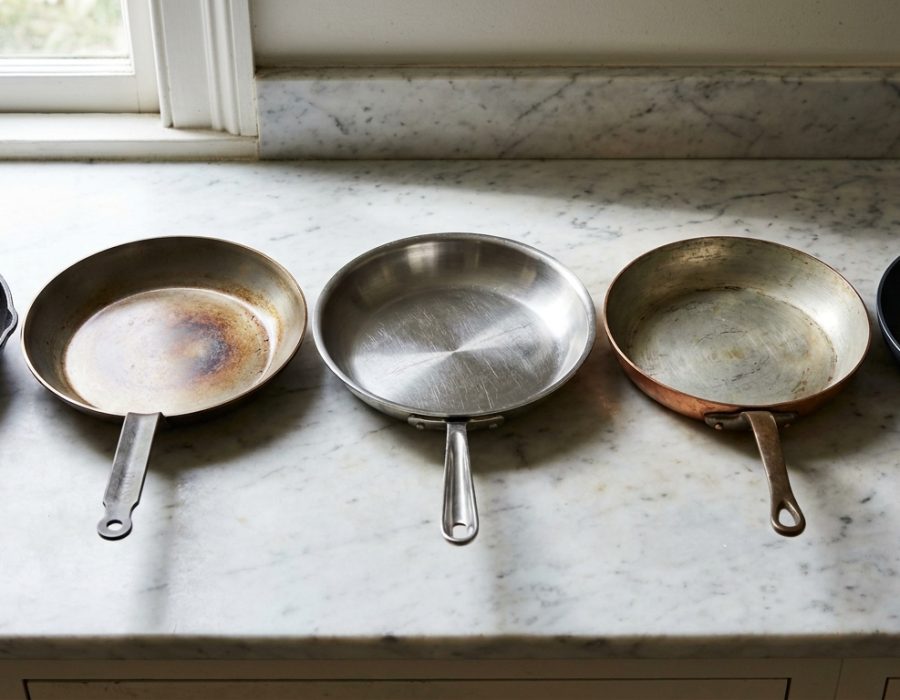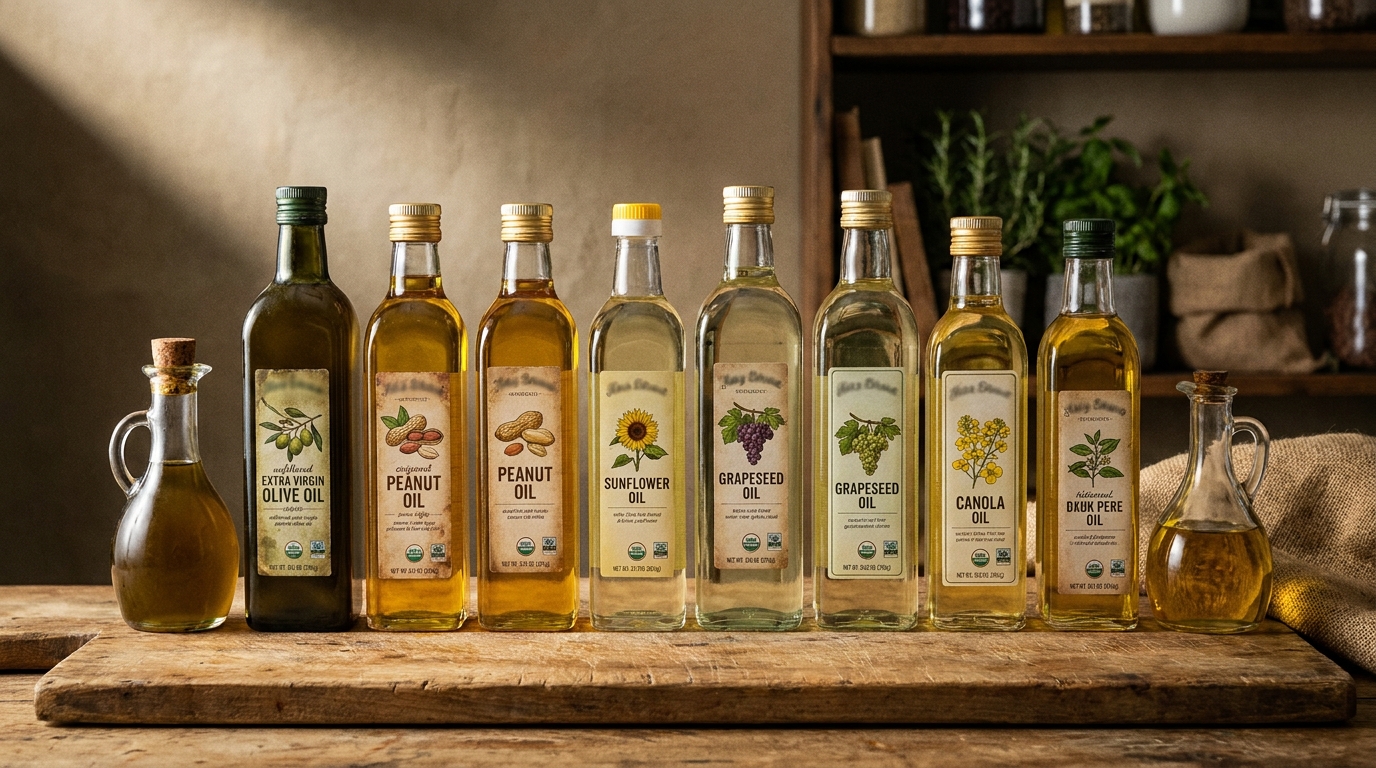
You have heard the rule, probably more than once, probably from someone who sounded sure: don’t cook with olive oil, its smoke point is too low. Use something neutral and refined — canola, sunflower, grapeseed — because it can take the heat. It is the single most repeated piece of cooking-oil advice in the English-speaking kitchen, and it rests entirely on one number printed on a chart.
That number is the smoke point: the temperature at which a heated oil first gives off a thin, continuous wisp of smoke. It feels like a safety threshold, a line you should not cross. It is treated as the one fact you need to choose an oil. And as a guide to how an oil actually behaves over heat, it is close to useless.
Not wrong, exactly. Just answering a question almost nobody is really asking. Smoke point tells you when an oil starts to smoke. It tells you very little about when an oil starts to break down — and those are two different events, separated by a gap wide enough to drive most of the bad advice in the category straight through.
This is the story of one convenient number, where it came from, and the number the charts should have printed instead.
The Smoke Point Lie
What “smoke point” actually measures — and why it lies
Start with how the number is made, because the method explains almost everything. Smoke point is determined in a laboratory by heating a small dish of oil and watching, by eye, for the first continuous stream of smoke (the standard procedures are the Cleveland open-cup test and ISO 2592). A clean sample, still air, a technician’s judgement about when “a wisp” becomes “a stream.” That is the measurement. It bears no resemblance to a pan on a live burner with food in it.
Think about everything that test leaves out. No food, so none of the water and steam that drive a whole category of breakdown in real cooking. No movement, when a wok is in constant motion and a fryer is churning. No repeated heating and cooling across a week of service. A clean, fresh, undisturbed sample in a quiet cup is about the gentlest life an oil will ever have — and even then, “the first visible smoke” is a judgement call made by a human watching for it. The figure that emerges is precise-looking and real, but it is the answer to a laboratory question, dressed up as kitchen advice.
The deeper problem is that the number is not stable. Smoke point is not a fixed property of an oil the way density or boiling point is. It moves — and it moves a lot — with the oil’s freshness, its batch, how refined it is, and above all its free fatty acid content. Refining strips out the compounds that smoke early, which is the entire reason “light” refined olive oil posts a higher smoke point than the extra-virgin it came from. The number on the chart is a snapshot of one idealised sample, not a trait you can count on.
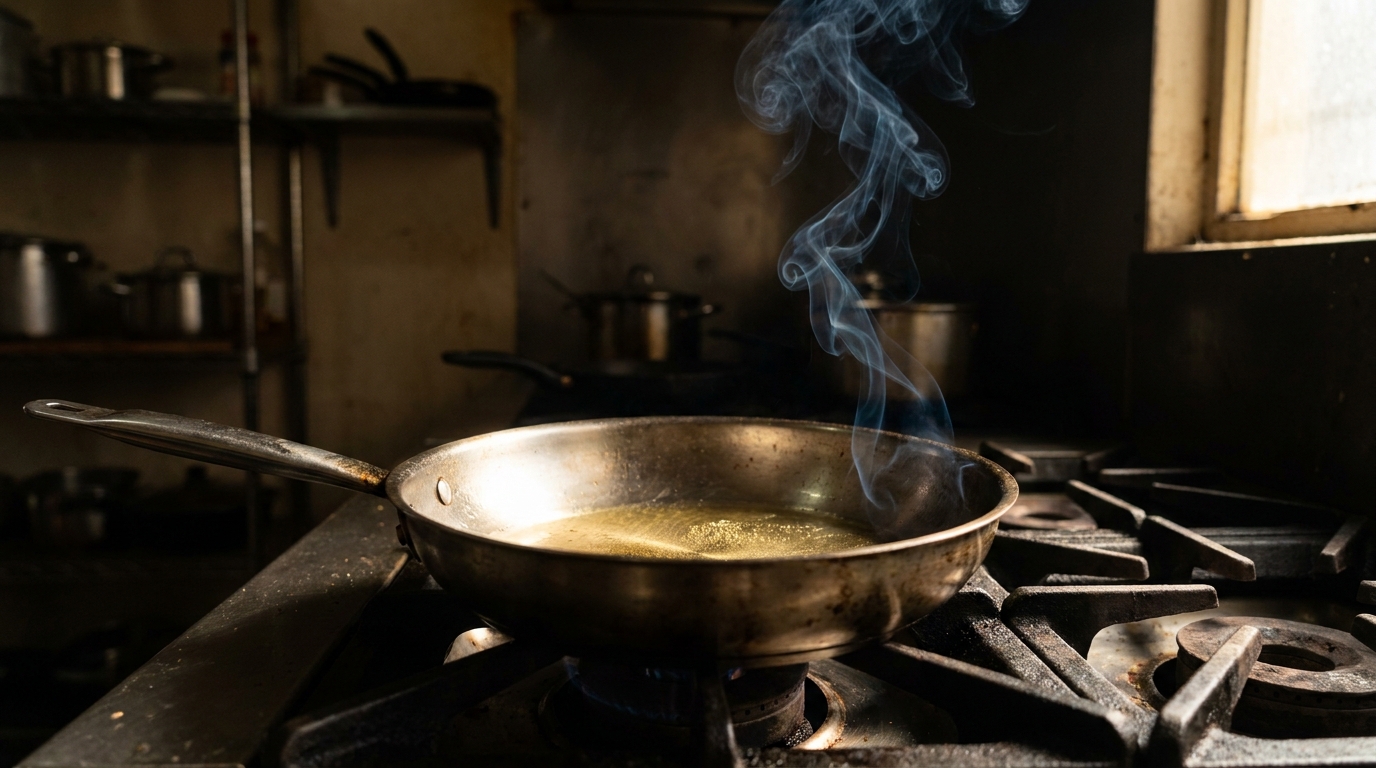
Consider extra-virgin olive oil, the oil the rule warns you off. Published smoke points for it run from about 163 °C all the way to 215 °C — a spread of more than fifty degrees, for the same category of oil. A fresh, high-quality bottle with low free fatty acids can sit comfortably above 200 °C; a tired, lower-grade one smokes around 175 °C. There is no single “olive oil smoke point.” There is a range, and the chart picks one figure out of it and presents it as fact.
Then there is age. Every time you fry in an oil, hydrolysis snaps triglycerides into free fatty acids, and each free fatty acid smokes earlier than the intact fat it came from — so the smoke point falls as the oil is used. Fresh canola in a commercial fryer might post around 204 °C; after a few days of service, with free fatty acids climbing, its effective smoke point can drop below the very frying temperature it is sitting at. The number on the box describes the oil you bought, not the oil in the pan. By the time you can see smoke, plenty has already happened that you cannot.
The smoke point tells you when an oil starts smoking — not when it starts degrading. The gap between them is where the real cooking happens.
The number nobody prints: oxidative stability
If smoke point is the wrong question, what is the right one? It is this: how readily does the oil break down when you hold it hot? That property has a name — oxidative stability — and it is measured, but it never makes it onto the consumer chart, because it is harder to reduce to a single tidy figure.
When an oil is held at cooking temperature, three things happen, in overlapping waves. Water from the food and air drives hydrolysis, cleaving fats into free fatty acids. Oxygen attacks the double bonds in unsaturated fats — oxidation — producing a cascade of secondary by-products. And fragments link back together — polymerisation — into heavier “polar compounds” that thicken the oil, make it foam, and leave the sticky varnish you find on a neglected pan. The industry measure for all of this is total polar compounds, and in Europe and Australia an oil is pulled from a commercial fryer once it passes roughly 24–25% of them.
Water — from the food, from the air — splits the fat into free fatty acids. These smoke earlier than the intact fat, which is why a used oil smokes sooner than a fresh one.
Oxygen attacks the double bonds in unsaturated fat, fastest where the bonds are most plentiful. This is the wave that fragile, polyunsaturated oils lose to first.
The fragments bond into heavy polar compounds. The oil thickens, foams, darkens, and leaves the sticky film on the pan. This is what the fryer meter is really counting.
Two of those three waves are accelerating the whole time, and the visible smoke is keyed to only part of the first. That is the heart of the disconnect. A polyunsaturated oil can be deep into oxidation — the second wave, the one that governs how it really holds up — while still posting a high smoke point, because smoke tracks free fatty acids and light volatiles, not the oxidative damage quietly accumulating in the bulk of the oil.
Here is the part the chart hides: none of that degradation needs visible smoke to be well underway. Polar compounds accumulate long before the first wisp. An oil can be chemically past its useful life — building the off-flavours, the acrid smell, the heavy compounds — without ever having dramatically smoked. Smoking is a late, visible symptom of a process that started much earlier and invisibly. Watching for smoke as your signal is like waiting for a fever to tell you the cold has arrived.

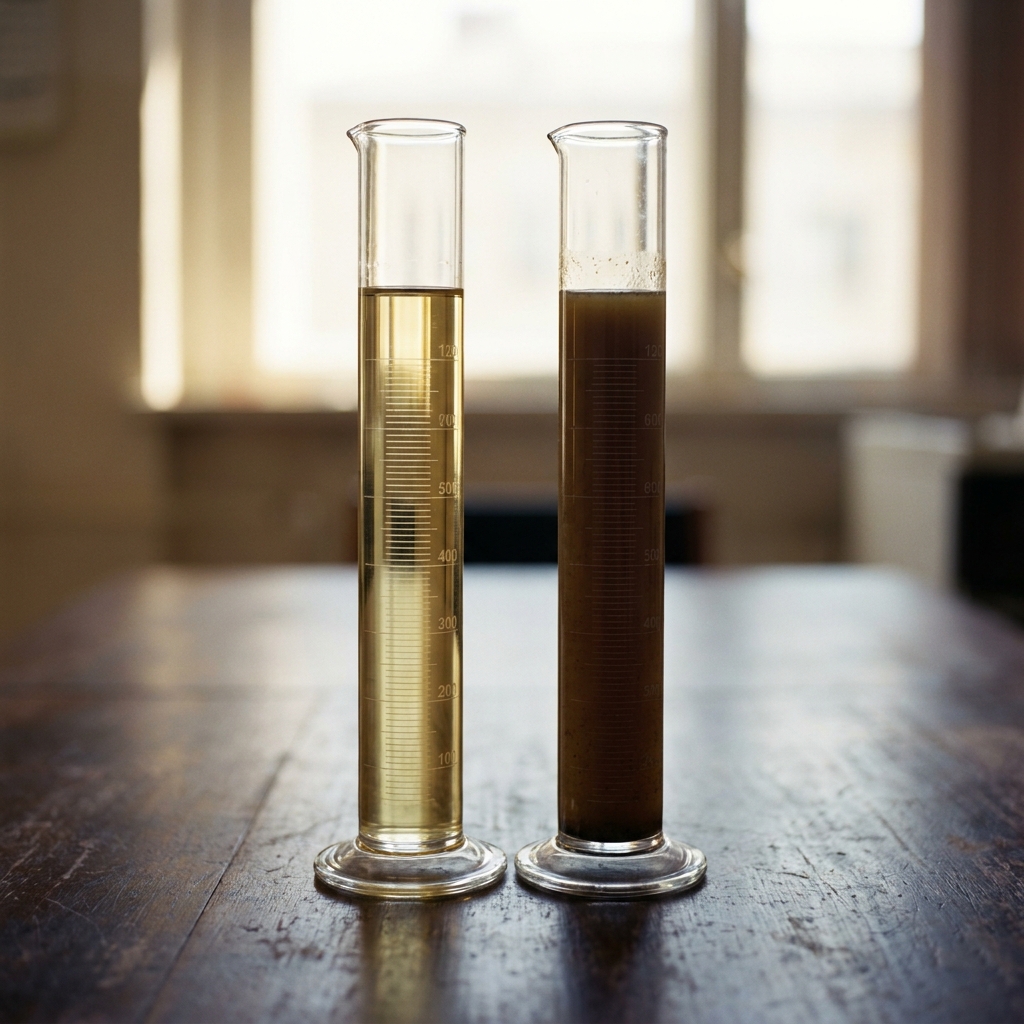
What governs oxidative stability is not the smoke point at all — it is the oil’s fatty-acid makeup and what protective compounds survive in it. Polyunsaturated fats, with two or more double bonds, oxidise dramatically faster than monounsaturated ones; the relative rates run roughly one for a saturated fat, ten for oleic (the main monounsaturate), a hundred for linoleic, and higher still for the most unsaturated. An oil heavy in polyunsaturates is fragile over heat no matter how high its smoke point. An oil rich in monounsaturated oleic acid, and carrying its own antioxidants, is sturdy — even if it smokes earlier. This matters most at the temperatures where degradation accelerates, which is exactly the territory of high-heat methods and the flip side of gentle low-temperature cooking.
The study that broke the chart
In 2018, a laboratory in Australia (Modern Olives, ISO 17025 accredited) ran the experiment the chart implies but never tests. They took ten common oils, heated them to 240 °C, then held them at 180 °C for six hours — and tracked what actually degraded, measuring smoke point, oxidative stability, free fatty acids, and total polar compounds along the way. If smoke point predicted performance, the high-smoke-point oils should have come out cleanest.
They came out the dirtiest. Extra-virgin olive oil — one of the lowest smoke points in the test, around 207 °C — produced the fewest polar compounds of any oil after six hours of heat. Grapeseed and canola, with the highest smoke points in the test (around 268 °C and 256 °C), produced some of the most. The relationship between smoke point and degradation was not just weak; in this data it was backwards — higher smoke points went with more breakdown, not less.
| Oil | Smoke point °C |
Stability OSI, hrs |
Polyunsat. % |
Polar cmpds after 6 h |
|---|---|---|---|---|
| Extra-virgin olive | ~207 | 32.7 | ~7 | 10.5 |
| Coconut | ~191 | 50.3 | ~2 | 9.7 |
| Peanut | ~226 | 35.4 | ~7 | 10.7 |
| Avocado | ~197 | 10.2 | ~12 | 11.6 |
| Sunflower | ~255 | 6.1 | ~51 | 15.6 |
| Canola | ~256 | 10.8 | ~26 | 17.3 |
| Grapeseed | ~268 | 6.6 | ~69 | 20.2 |
Single-study values (De Alzaa, Guillaume & Ravetti, 2018), rounded. Read the columns against each other: the highest smoke point in the table (grapeseed) posts the lowest stability and the most polar compounds; the lowest cooking smoke point (olive) posts the best.
The mechanism is no mystery once you read the last two columns. Extra-virgin olive oil is mostly monounsaturated oleic acid, low in fragile polyunsaturates, and it still carries its natural polyphenol antioxidants — a few hundred milligrams per kilogram in a decent bottle. Grapeseed is the opposite: around two-thirds polyunsaturated fat, the most oxidation-prone kind. The high smoke point that makes grapeseed look like the “high-heat” oil is irrelevant to the thing that actually determines how it holds up.
The polyphenols are worth dwelling on, because they are the part the chart can’t see at all. They are antioxidants — compounds like oleuropein and oleocanthal that the olive carries into the oil — and their job, chemically, is to take the oxidative hit so the fat doesn’t. They are also exactly what gives a good extra-virgin its green, grassy, peppery bite. So the very thing you taste as “quality” in olive oil is also part of what makes it hold up over heat. And here is the trade made visible: refining olive oil into pale “light” oil raises the smoke point — and, by stripping out those same polyphenols, lowers the oxidative stability at the same time. You buy a higher number on the label by removing the thing that actually protected the oil. The chart records the gain and is blind to the loss.
For the cook, the stakes are not abstract. The polar compounds the fragile oils generate faster are what you eventually taste and see: the flat, slightly off flavour in food fried in tired oil, the foam that climbs the sides of the pot, the darkening, the greasy film that won’t quite wash off. An oil that resists all of that simply makes better food for longer — which is the only test that was ever going to matter at the stove.
Two honest caveats, because the science deserves them. This was a single study, published in a smaller journal, and the oils were heated without food in them — real cooking adds water and steam that change the picture, a limitation the authors themselves noted. It is evidence, not gospel. But it lines up with the broader chemistry of fatty acids and antioxidants, and it points in a clear direction: smoke point and real-world stability are simply different things, and only one of them is on the label.
Where the lie came from — a short history of a convenient number
A claim this durable usually has a sales pitch behind it, and this one does. The modern fixation on smoke point traces to the rise of refined seed and vegetable oils in the early twentieth century — and to one product in particular. Crisco landed on American shelves in June 1911: a solid, shelf-stable cooking fat made by hydrogenating cottonseed oil, launched by Procter & Gamble with a reported advertising budget of around $180,000 (roughly five million in today’s money) and a free cookbook to teach a generation how to use it.


Part of the pitch was that, unlike butter or olive oil, the new fat had a high smoking temperature and could take the heat of frying. That was true. It was also a marketing convenience rather than a discovery: hydrogenation simply happened to yield a fat that smoked late, and “high smoke point” became a selling point because it was easy to say and easy to believe. The number came first. The chemistry that would eventually complicate the story — what these oils actually do over hours of heat — came much later, and said something else entirely.
What started with one product became the logic of an entire aisle. Through the twentieth century the refined, neutral, high-smoke-point oil became the default — cheap to produce, long on the shelf, mild in flavour, and easy to sell on that one tidy specification. “Neutral oil with a high smoke point” turned into shorthand for “the sensible choice for cooking,” and the older fats, with their flavour and their lower, more honest smoke points, got reframed as delicate or unsuitable for heat. The chart wasn’t invented to deceive anyone. It was just the number that happened to flatter the products the industry most wanted to sell, and it travelled with them.
The chart endured for the most ordinary of reasons on top of that: it is simple. One oil, one number, one rule of thumb. Oxidative stability needs a paragraph and a couple of caveats; a smoke-point chart needs a single column. Simplicity won, as it usually does, and a measurement built for a laboratory cup quietly became the way an entire culture chose its cooking oil.
We spent a century arguing about the wrong number. Oxidative stability isn’t harder to understand — it was just harder to fit on a label.
Choose by the job, not the number
None of this means smoke point is meaningless. It means it is a ceiling, not a score. There are jobs where the ceiling genuinely matters — a screaming-hot wok, a deep-fry held at temperature — and for those you want an oil whose smoke point sits comfortably above the heat and whose stability holds up. For almost everything else, the ceiling is high enough that it stops being the deciding factor, and flavour and stability take over. The trick is to match the oil to what you are actually doing.
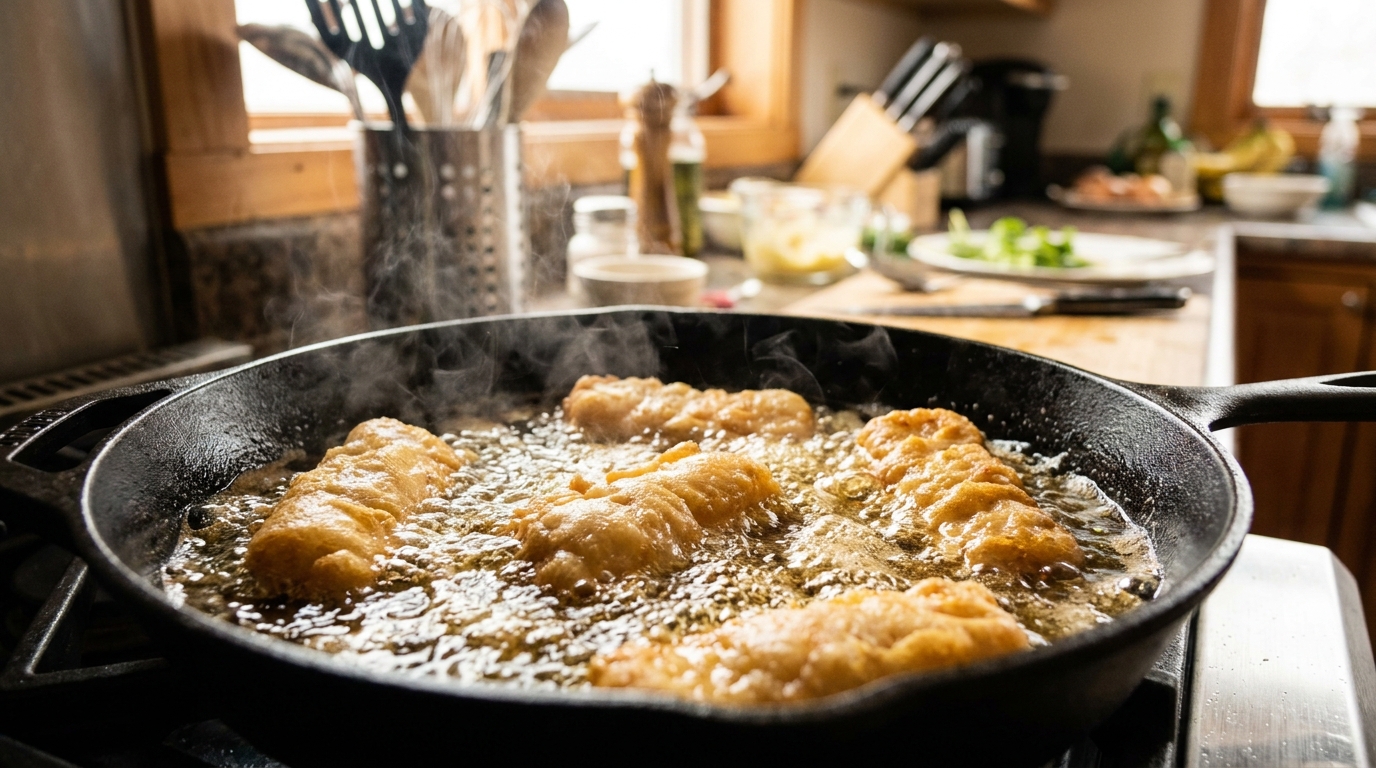
Here the ceiling counts. A refined high-smoke-point oil with mostly monounsaturated fat — avocado, peanut, or ghee.
Stability first. Low-polyunsaturate oils — peanut, rice bran, even olive — outlast the high-smoke-point seed oils across repeated use.
The ceiling is irrelevant here. Extra-virgin olive oil or clarified butter — choose for flavour and stability, not the chart.
Spend the polyphenols on flavour. A grassy, peppery extra-virgin olive oil, raw — never heated, where smoke point could not matter less.
Notice what falls out of the table. The refined seed oils that the old rule pushes toward high heat — sunflower, grapeseed, plain canola — are the ones most loaded with the fragile fats, which means they are arguably the worst choice for the long, hot, repeated frying the rule recommends them for. And the olive oil the rule warns you away from turns out to be one of the steadier performers across most of what a home cook actually does. The advice did not just oversimplify. On the jobs that matter most, it pointed the wrong way.
So keep the chart if you like. Just read it as a ceiling, and add the column it is missing. Smoke point tells you the temperature you should not blow past. Oxidative stability tells you how the oil performs on the way up — which is the part you are actually cooking in. Know where both sit, reach for the oil whose strengths match the job in front of you, and trust your nose over the number on the box.
The best oil is the one suited to what you are doing with it. The number on the chart was never going to tell you that.
De Alzaa, Guillaume & Ravetti, Evaluation of Chemical and Physical Changes in Different Commercial Oils during Heating, Acta Scientific Nutritional Health (2018). Summary analysis via the Olive Wellness Institute.
Choe & Min, Chemistry of Deep-Fat Frying Oils, J. Food Science (2007). Katragadda et al., Emissions of volatile aldehydes from heated cooking oils, Food Chemistry (2010). Symoniuk et al., Oxidative Stability of Selected Edible Oils, Molecules (2018).
ThermoWorks, Oil Smoke Points. USDA FoodData Central. Codex Alimentarius STAN 33 (olive oils). Grains Canada, canola composition (2024). Metrohm, OSI application notes.
Helen Zoe Veit, How Crisco Made Americans Believers in Industrial Food, Smithsonian Magazine (2019). AOCS, The Battle Over Hydrogenation.
A note on scope: this article is about how cooking oils behave over heat — their culinary quality and performance — not about nutrition or diet. For questions about your own diet, a registered dietitian or doctor is the right person to ask.
— Iris L., with Morgan H.