
There is a particular kind of cook — usually self-taught, often ambitious — who collects sauce recipes the way other people collect spices. A béarnaise here. A bordelaise there. A béchamel learned for lasagna, a hollandaise improvised for Sunday eggs. Each sauce treated as its own small continent, mastered in isolation, half-forgotten between uses.
This is the slow way. It is also, eventually, the frustrating way.
There is another way to think about French sauces, and it is older than any recipe currently in your kitchen. It treats sauce-making not as a list of preparations but as a system — a compact grammar of five base sauces from which roughly two hundred others descend. Learn the grammar, and you stop memorising recipes. You start reading them.
That grammar has a name.
The Five Mother Sauces
The architecture of a kitchen
Sauces, in the European tradition, were a problem of organisation long before they were a problem of taste. By the late eighteenth century, French haute cuisine had accumulated so many distinct preparations that the kitchens of the aristocracy were drowning in lineage. Every great cook had his sauces; every grand house had its variations. Nothing was indexed. Apprentices learned by imitation, and the system was, in the most literal sense, illegible.
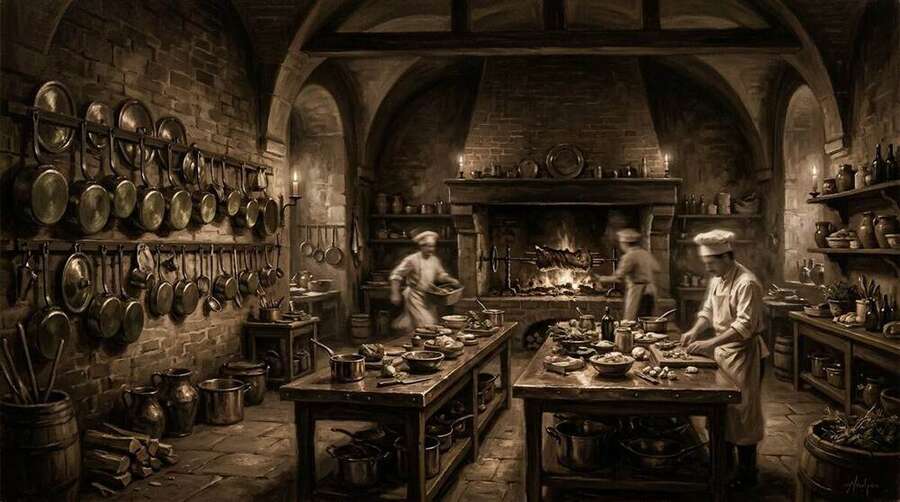
The first man to make it legible was Marie-Antoine Carême — chef to Talleyrand, the Prince Regent of England, and Tsar Alexander I; a man who wrote about sauces with the seriousness of a philosopher. In L’Art de la cuisine française au XIXe siècle (1833), Carême defined four grandes sauces from which all the rest descended: Espagnole, Velouté, Allemande, Béchamel. He drew the family — mothers and daughters, the language we still use today.
His framework was monastic in its labour. An espagnole could simmer for a full day, drawing roasted bones, mirepoix, and ham trimmings into a brown that you could see your reflection in. The grand kitchens had the staff for it. Almost no one else did.
Seventy years later, Auguste Escoffier reformed the system for a different kind of kitchen — the brigade, the hotel, the restaurant — where service was timed in minutes, not hours. In Le Guide Culinaire (1903), he reclassified Allemande as a daughter of Velouté, added Sauce Tomat, and, in the 1907 English edition, elevated Hollandaise from the small sauces to mother-sauce status. The number became five, and it has not moved since.
What Escoffier did was less taxonomy than tempo. He standardised roux ratios, shortened simmering times, and made fonds — proper stocks — the non-negotiable foundation of everything. He turned a baroque inheritance into a working tool.
Two centuries of practice, distilled into five techniques. Master them, and the daughters arrive almost on their own.
The five mothers
What follows is not a set of recipes in the usual sense. It is a reference — the underlying skeleton of a few hundred sauces, written down. Read it in order, the first time. After that, return to whichever one you need.
2–3 min. Just past raw flour. Smells like pastry. Béchamel.
4–6 min. Pale honey. Faintly nutty. Velouté.
12–20 min. Mahogany or fresh brick. Deeply nutty. Espagnole.
i. Béchamel
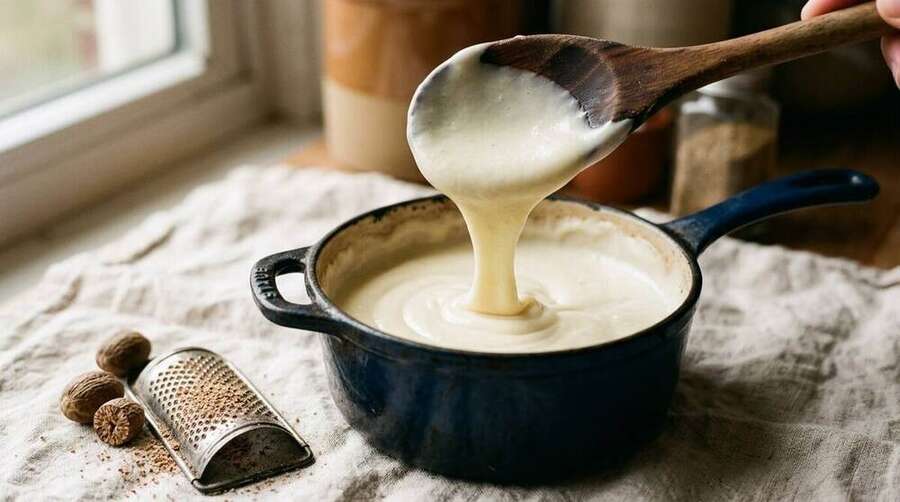
The plainest of the mothers, and for that reason the one most often misunderstood. A béchamel is milk thickened by a white roux — and it is the sauce by which a kitchen most reliably exposes its laziness.
by weight
- 50 gbutter
- 50 gall-purpose flour
- 1 Lwhole milk, infused
- —onion, clove, bay, white pepper, nutmeg
The roux is taken to the white stage: long enough for the raw flour smell to disappear, but not a second past it. The texture should look like wet sand. The aroma should suggest fresh pastry. If colour appears, you have already gone too far for béchamel — that roux belongs in a velouté.
Heat the milk gently with half an onion studded with two cloves, a bay leaf, and a few white peppercorns; hold it at around 80°C for ten minutes, then strain. The infusion is technically optional. In practice, omitting it is what separates a domestic béchamel from a professional one. Pull the roux off the heat, add the warm milk in a steady stream while whisking, then return to a gentle simmer for ten to fifteen minutes — long enough for the starch granules to fully gelatinise, which they cannot do below 85°C. Finish with salt, white pepper, and freshly grated nutmeg. The target is nappé: it should coat the back of a spoon.
Mornay
+ Gruyère, Parmesan, yolk
For gratins. The serious mac and cheese.
Soubise
+ slow onion purée
The proper companion to roast lamb or veal.
Nantua
+ crayfish butter, cream
Fish quenelles. A Lyonnaise inheritance.
What goes wrong: lumps, almost always. They come from cold milk meeting hot roux too fast, or from inadequate whisking. Pass the sauce through a chinois if you must; better, take it more slowly the next time. The other failure is thinness — caused, more often than not, by impatience. Starch needs heat and time. A béchamel pulled off the heat at three minutes will never be a béchamel; it will be milk with flour in it.
ii. Velouté
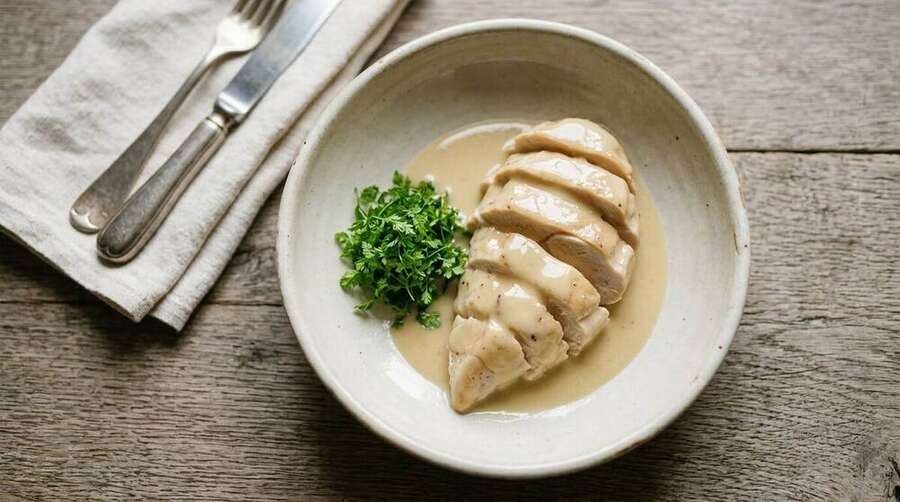
The same architecture as béchamel — equal butter and flour, ten parts liquid — but the milk is replaced by a light stock (chicken, veal, or fish, made with unroasted bones), and the roux is taken one shade further.
by weight
- 50 gbutter
- 50 gall-purpose flour
- 1 Llight stock (chicken, veal, or fish)
- —salt, white pepper
The roux goes to blond: until the colour shifts from white to pale honey and the smell turns faintly nutty. Cool the roux briefly; then add the stock cold. Velouté is the one mother where this matters — cold stock prevents premature thickening and gives a smoother final texture.
Bring it gently to a simmer, then leave it there for thirty to forty-five minutes, skimming the impurities that rise. Strain through a chinois. The word velouté means velvety, and a properly made one earns it: lighter than béchamel, glossy, sliding off a spoon rather than sitting on it.
Allemande
+ yolk, lemon, cream
For poached poultry and veal.
Suprême
+ mushroom liquor, cream
The sauce that taught a generation why classical French refuses to die.
Vin Blanc
+ fish fumet, yolk, butter
Built on fish stock and ladled over poached sole.
iii. Espagnole
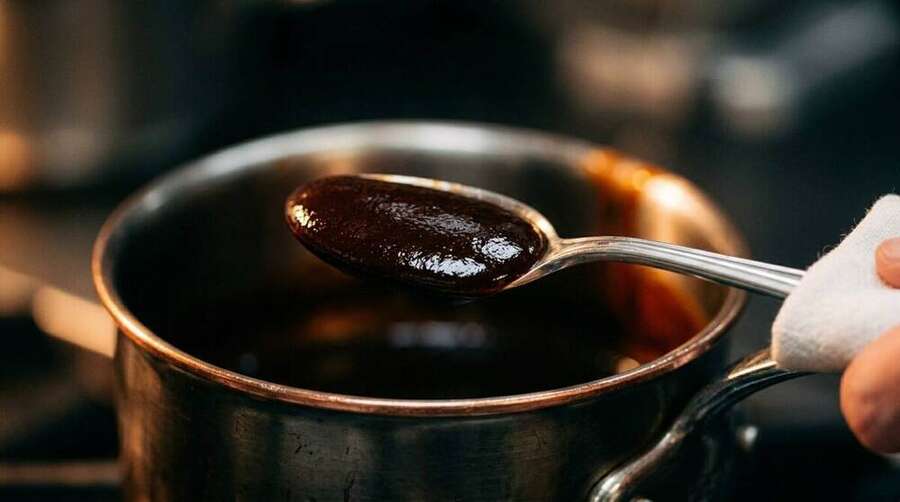
The first of the mothers that demands real time. An espagnole is a brown sauce, built on roasted veal or beef bones, thickened with a brown roux, fortified with mirepoix, tomato, and traditionally a little ham or marrow, then simmered for hours.
by weight
- 60 gbutter
- 60 gall-purpose flour
- 100 gtomato purée
- 150 gmirepoix (2:1:1)
- 1bouquet garni
- 100 gmarrow or ham trimmings (optional)
acceptable 6 h
classical 8 h
grand maison
The roux goes brown: stirring without pause, until it reaches the colour of milk chocolate or fresh brick and smells deeply nutty. The danger here is not subtle. A brown roux taken thirty seconds too far becomes black, and a black roux is acrid in a way that no quantity of stock will mask. There is no rescuing it. Watch it; do not check your phone.
There is also, more counterintuitively, a price for the colour. The darker the roux, the less it thickens. The starch granules, fragmented by long cooking, lose much of their swelling capacity — a brown roux holds roughly half the thickening power of a white one. This is why Cajun “peanut butter” roux is used in such generous quantity: the cook has traded thickening for flavour and is paying for both.
Brown the mirepoix and ham in butter, add the tomato and let it caramelise for three or four minutes, then pour in the brown stock and add the bouquet garni. Whisk in the cooled roux. Hold a low simmer for at least three hours, traditionally six to eight, skimming the fat and impurities every twenty minutes. Strain. The finished sauce should be glossy, deep brown, almost shellac-like — never greasy.
Demi-Glace
+ stock, reduced 50%
The most useful single thing a serious cook can keep frozen.
Bordelaise
+ red wine, shallot, marrow
For grilled beef. The proper one.
Madeira
+ Madeira wine, finished
The discreet companion of veal and ham.
iv. Sauce Tomate
The mother that tourists most often confuse with marinara. They are not the same thing. Escoffier’s sauce tomat is richer, slower, and built on stock and pork fat — designed as a base for further sauces, not as a finishing sauce in its own right.
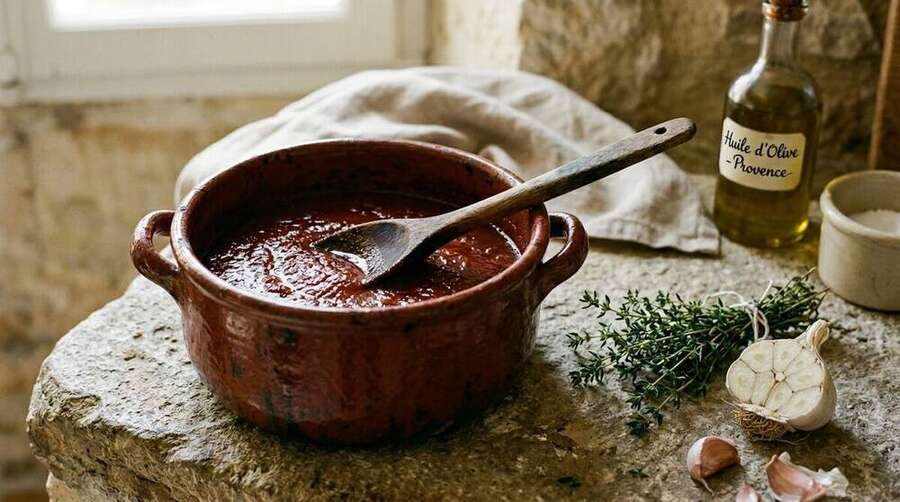
until thick
- 1 kgtomatoes, peeled, seeded
- 100 gsalt pork or bacon, diced
- 200 gmirepoix
- 10 ggarlic, minced
- 250 mlwhite veal stock or water
- 1bouquet garni
- 5 gsugar
- 30 + 30 gblond roux (optional)
Render the salt pork until crisp; remove the cracklings. Sweat the mirepoix and garlic in the rendered fat. Add tomatoes, stock, sugar, and bouquet garni; simmer forty-five to ninety minutes, until reduced and thick. Pass through a food mill or chinois. Escoffier’s original carries a light blond roux for body; modern interpretations frequently omit it, leaning on the natural pectin of the tomato and a longer reduction instead. Either is correct, depending on what the sauce will ultimately be doing.
Puttanesca
+ olive, caper, anchovy, chili
Italian by birth, structurally a daughter.
Creole
+ pepper, celery, cayenne, thyme
What happened when the technique met New Orleans.
Provençale
+ garlic, basil, olive oil
The Mediterranean cousin everyone meets first.
v. Hollandaise
And then, the difficult one.
Hollandaise is not a roux sauce. It is an emulsion — butterfat suspended in the aqueous phase of egg yolk, held there by the lecithin in the yolk and stabilised by gentle, attentive heat. The technique it asks for has nothing in common with the four sauces above, which is one of the reasons many cooks who can produce a flawless espagnole still treat hollandaise as a coin flip.
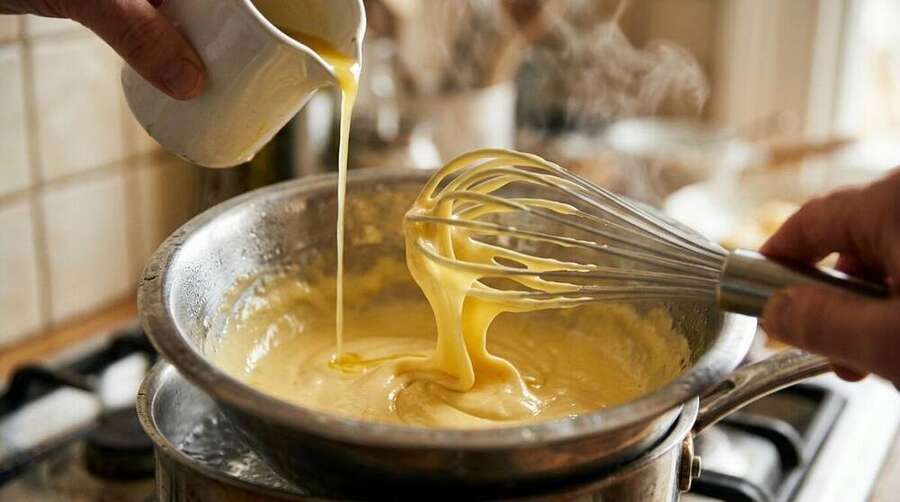
by weight
- 4egg yolks (≈ 80 g)
- 200 gclarified butter, warm (~50°C)
- 30 mlwater or vinegar reduction
- 15 mlfresh lemon juice
- —salt, cayenne
In a stainless bowl, whisk yolks with the water (or a vinegar reduction) and lemon juice. Set the bowl over a double boiler — the water beneath should not touch its base. Whisk continuously until the yolks reach the ribbon stage: the mixture pales, thickens, and trails behind the whisk in a visible band. This is where the egg proteins (ovotransferrin first, around 62°C) begin to denature. Pass 75°C and they will scramble. There is no margin to ignore. Pull the bowl off the heat the instant the ribbon forms.
Add the warm clarified butter in a thin stream, whisking constantly, the way you would build a mayonnaise. The lecithin in the yolks will emulsify the butterfat into the water phase. Finish with salt, cayenne, and another squeeze of lemon. Hold the sauce between 45° and 55°C until service.
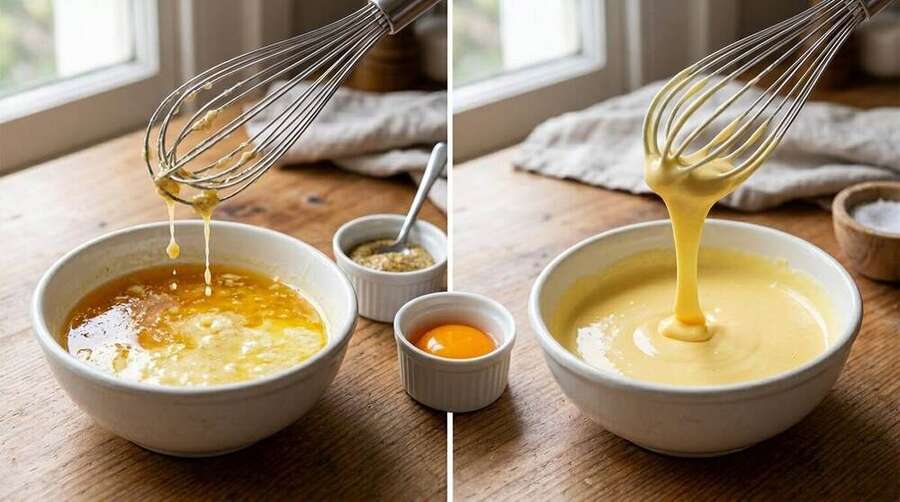
When hollandaise breaks — and it will, eventually, even for cooks who have made it a thousand times — there is a single rescue worth memorising.
In a clean bowl, whisk a fresh yolk with a teaspoon of cold water and, if you have it, a small spoon of Dijon mustard (it carries additional emulsifiers). Then whisk the broken sauce, slowly, into the new base. It will come back together. You are not “shocking” anything; you are reintroducing emulsifier and water at the right ratio. Heat-scrambled yolks, however, are unrecoverable. Throw them out and start the sabayon again.
Béarnaise
+ tarragon, chervil, shallot reduction
For grilled steak. Full stop.
Mousseline
+ whipped cream, folded
The sauce asparagus has been waiting for.
Maltaise
+ blood orange, juice and zest
An early-spring lunch with tender greens.
The family tree
The five mothers and a working selection of their daughters. The full classical map runs to several hundred entries; most working cooks know perhaps thirty by heart. Knowing all of them is not the point. Understanding why the map can be drawn at all — that is.
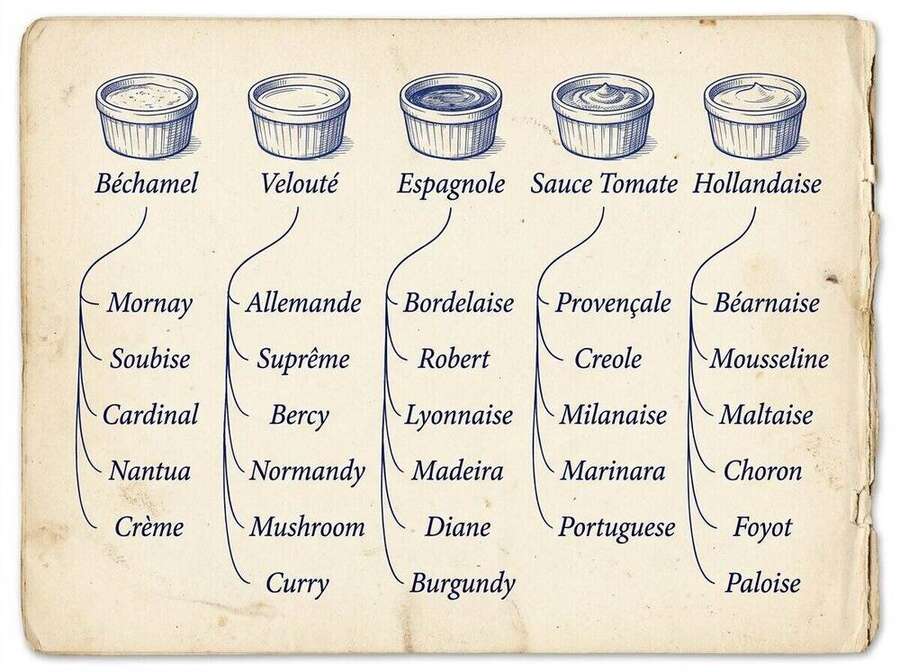
- Mornay
- Soubise
- Nantua
- Crème
- Cardinal
- Allemande
- Suprême
- Vin Blanc
- Bercy
- Aurore
- Demi-Glace
- Bordelaise
- Madeira
- Chasseur
- Robert
- Puttanesca
- Creole
- Provençale
- Bolognese
- Portugaise
- Béarnaise
- Mousseline
- Maltaise
- Noisette
- Foyot
Why it works
Behind the recipes is a small body of physical chemistry — old, well-understood, and worth the few minutes it takes to learn. Five ideas account for almost everything that can go right or wrong in a sauce.
Brown roux as a chemical event
When flour and fat cook together over time, amino acids and reducing sugars react to produce hundreds of new aromatic compounds: pyrazines, furans, thiophenes — nutty, caramel, roasty. The reaction accelerates above 140°C. A brown roux trades thickening power for flavour and pays for both. Every degree of colour costs you a fraction of body.
Gelatinisation, slow and unforgiving
Wheat starch granules absorb water, swell, and burst, releasing amylose into the fluid. The fluid thickens. Gelatinisation begins at 60°C; maximum thickness at ~85°C. The fat coating from the roux slows water penetration, which is why roux sauces simmer longer than slurries. Pull early and the sauce stays thin. The cook’s job is patience.
Why hollandaise breaks
Butterfat suspended in water, held by lecithin — a phospholipid with a hydrophilic head and lipophilic tail. The emulsion fails for four reasons. Overheating denatures the proteins. Underheating leaves the yolks too thin. Adding butter too quickly overwhelms the system. Overdiluting drops the emulsifier below threshold.
Acid into dairy, carefully
Below pH 4.6, the casein in milk loses its negative charge, stops repelling itself, and clumps. Three precautions: add acid only after the sauce is thickened and off direct heat; keep fat content high enough to buffer; use full-fat dairy. Skim curdles far more readily than whole milk.
What a sauce gains by simmering, exactly
Reducing concentrates flavour, which is the obvious effect, but it also concentrates the gelatin extracted from bones and connective tissue. Gelatin is what gives a properly reduced espagnole its glossy, lip-coating mouthfeel — roughly one to two percent by weight is the target. A stock made from joints already carries it. A stock made from lean meat does not, and no amount of reduction will conjure what was never there.
When it doesn’t work
A short field guide. Most failures in sauce work fall into a small number of named conditions; the corresponding fixes are equally finite. Diagnose first, react second.
Lumps
Cause — Cold liquid into hot roux too fast; insufficient whisking.
Fix — Pass through a chinois, or blend. Next time: warm the liquid; whisk constantly.
Burnt, bitter
Cause — Heat too high, or roux taken seconds too far.
Fix — Discard. Burnt Maillard compounds dominate everything. Lower the heat next time. Watch the colour.
Broken, split
Cause — Past 75°C, or butter added too fast.
Fix — Fresh yolk + cold water + Dijon. Whisk broken sauce in slowly.
Scrambled
Cause — Yolks cooked above 75°C.
Fix — Discard the sabayon. Restart. Pull off heat the moment the ribbon forms.
Too thin
Cause — Insufficient roux, or not simmered long enough; ratio off.
Fix — Reduce further; whisk in a beurre manié (kneaded butter and flour, equal parts) for emergency body.
Greasy mouthfeel
Cause — Inadequate skimming during the long simmer.
Fix — Chill, lift the fat cap, reheat. In future: skim every twenty minutes without exception.
Grey cast
Cause — Stock made with roasted bones, or under-strained.
Fix — Re-strain through cheesecloth. Insist on white stock — unroasted bones — for veloutés.
Curdled
Cause — Acid added too early, or over high heat.
Fix — Off heat, whisk in cold cream. Next time: add acid off-heat, into thickened sauce.
What the system gives you
It gives you, eventually, the ability to read a recipe and see the bones beneath the words. A bordelaise is not a separate thing to memorise; it is an espagnole reduced with red wine and finished with shallot and marrow. A béarnaise is not a different sauce from a hollandaise; it is the same emulsion built on a different aromatic base. A mac-and-cheese is a Mornay folded into pasta. The list, once internalised, is shorter than it looks.
It also gives you the thing professionals get from working through Escoffier’s framework: confidence under pressure. You stop running through the ingredient list. You start running through the technique, which is far more compact, and which generalises. A cook who understands roux can make any roux-based sauce in any cuisine. A cook who understands emulsion can make hollandaise, mayonnaise, vinaigrette, beurre blanc, and aioli without thinking of them as four separate problems.
The mother sauces are not a finishing line. They are a starting grammar. Two centuries of cooks have used them as such, and the system has not yet shown signs of needing replacement.
That tells you something about the design.
— Morgan H.

