We are three. We trained in different places, we cook from different angles, we write with different rhythms. The journal works because of the friction between us — every recipe goes through all three before it goes to print, and the version that ends up published is rarely the version any one of us first wrote alone.
Below: who we are, in long form.

Morgan Hale
Founder · Editor-in-Chief
Morgan started cooking in restaurant kitchens at twenty-one, in London — first at a small neighbourhood bistro, then at the kind of restaurant where the menu changes every two weeks and the line cooks read the producers' invoices like fiction. After three years she moved to Paris, where she spent another three at Septime, mostly on the garde-manger station, occasionally at sauce. She left the line because she wanted to cook for fewer people more carefully, and started a private supper club out of her flat in the eleventh — Sundays only, twelve covers, no menu in advance.
The supper club ran for four years. It is also where she started writing — first as service notes for herself, then as longer pieces about why a particular dish had failed three times before working, which she sent to a small mailing list of regulars. The mailing list is now this journal.
Morgan edits everything that ships. She has a slight bias toward shorter sentences, against unnecessary adjectives, and in favour of phrases like "do this and don't do this" over "consider doing this." She writes mostly in the Mains section — the Sunday roast, the weeknight plate, the technique-driven dish that doesn't fit into Atlas or Techniques.
What she cares about: stocks, salt, why a recipe takes the time it takes, the moment a piece of editorial writing stops earning its words.
Bylines as: — Morgan H.
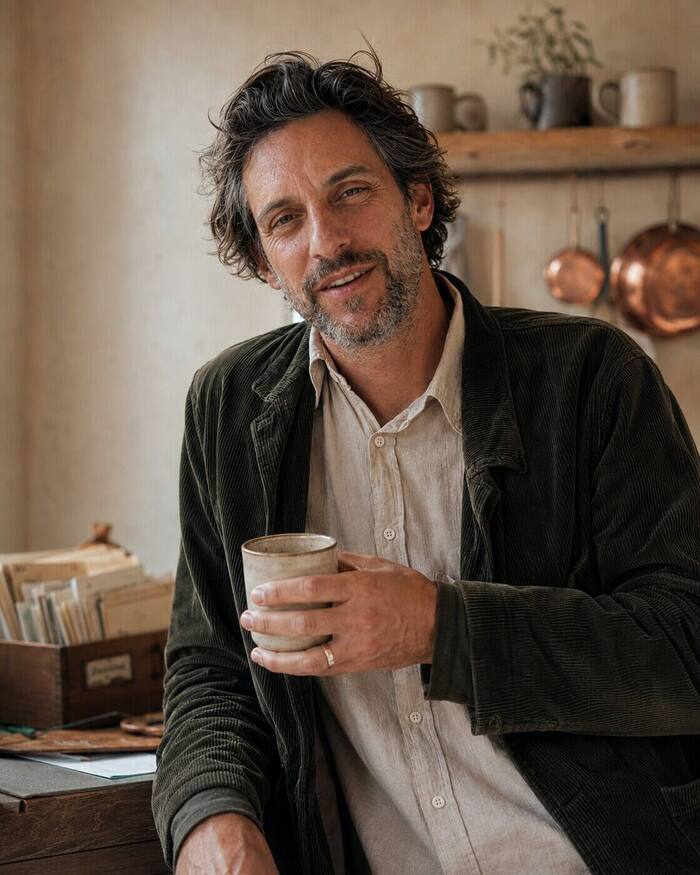
Theo Marsh
Atlas Editor · World Cuisines
Theo studied archaeology at Lyon II, with a focus on food anthropology — how cuisines move, what survives long migrations, what gets lost when a dish crosses a border. He realised somewhere around the second year that you cannot write about cooking without cooking, so he took two years off graduate school and worked in restaurants in Lyon, mostly in service to begin with, then in the kitchen. He never finished the doctorate. He says he did not need to.
What he did instead, over the next decade, was take short stages in kitchens around the world. He has spent time in Sichuan studying mapo dofu, in Naples on pasta sections, in Oaxaca behind moles, in Tbilisi with khinkali makers. Not as a chef in title — he is careful about the word — but as a cook who turned up, paid attention, and cooked for the family meal. He keeps a wooden box of file cards from every cook he has worked with, organised by region and indexed in his own handwriting.
Theo writes Atlas. He believes a recipe is incomplete without a brief account of where it came from, who carried it, and what got lost on the way. His articles tend to run longer than ours and have more footnotes. We trim them and they still run longer than ours.
What he cares about: origin, attribution, the small technical detail that survives every translation, the difference between a dish and its anglicised cousin.
Bylines as: — Theo M.

Iris Linden
Sweet & Pastry Editor
Iris trained at Ferrandi, the pastry program, and finished in the top of her cohort. She did not stay in haute pastry. Her first job was a corner boulangerie in the fourteenth, sixty hours a week, learning the fundamentals — viennoiseries before dawn, baguettes at five, brioche at noon — for a year and a half. She moved next to Yann Couvreur, where she stayed two years on decoration and structural work, learning the kind of pastry that gets photographed. Then she left Paris for a small artisan bakery in Lyon, where she worked alongside two other pastry chefs and learned, finally, what it meant to take her time.
She is the youngest of the three of us. She is also the most disciplined. She owns a thermometer dedicated to the ambient temperature of her kitchen. She weighs salt before adding it. We trust her on ratios because she is the only one of us who is incapable of approximating.
Iris writes Sweet. Her articles tend to explain why a ratio is what it is — why a génoise needs eggs at this exact temperature, why a hydration percentage above sixty-five changes a dough's behaviour. She believes pastry is taught badly almost everywhere, and that the recipes most home bakers fail at are not failing because the bakers are inexperienced, but because the recipes themselves leave out the explanation.
What she cares about: hydration, butter quality, the moment a dough goes from "wet" to "right," ratios that survive a kitchen change.
Bylines as: — Iris L.
Want to know how a recipe gets from one of our kitchens to a published article? Read Our Method. Want to write to one of us directly? Drop us a line.