
A traditional steak is, structurally, a compromise. The centre reaches 55 °C — clean medium-rare. The outer two centimetres reach 70 °C and well beyond — overcooked, grey, fibrous. Between the two, a band of disappointment that no resting time can quite repair.
This is not a problem of skill. It is a problem of physics. Hot air, hot oil, and hot metal all move heat into the meat far faster than the meat can equilibrate, so the surface always overshoots the centre. For most of cooking history, this gradient was simply the price of cooking.
It does not have to be. There is another way to think about doneness — older than sous-vide, older than thermometers, in a sense as old as the question — that treats temperature as the primary variable and time as the second. Set the bath to the temperature you want the meat to be. Wait until the meat is that temperature. There is no overshoot, because there is nothing in the system hotter than the target.
It sounds too simple. In practice, it is.
Low-Temperature Cooking
The three approaches
Low-temperature cooking is any method that holds the food at a core temperature between roughly 50 °C and 85 °C — which is to say, well below traditional roasting (175–230 °C) or grilling. The principle is the same in each version. The setups differ.
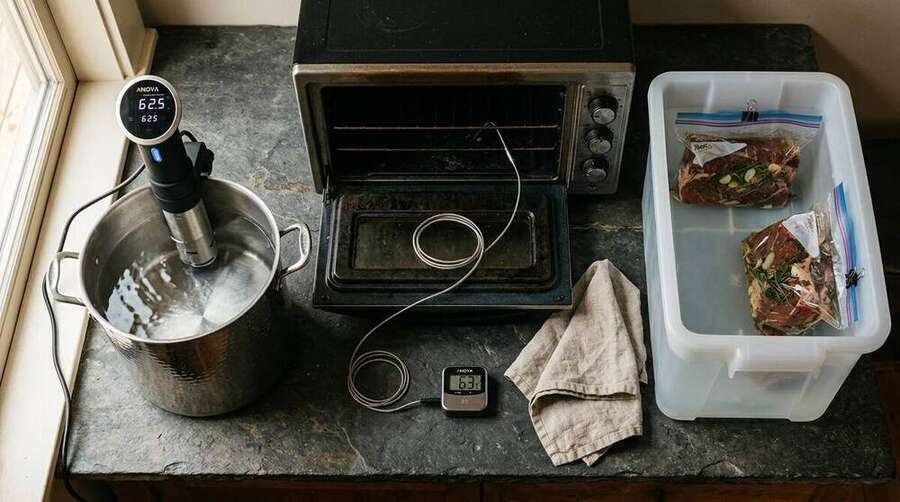
Vacuum-sealed bag in a circulating water bath. Water moves heat 23 times more efficiently than air. The gold standard.
Conventional oven on its lowest setting, with a leave-in probe thermometer. Workable, less precise.
An insulated cooler filled with hot water; bags submerged. Cheap, slow-drift, surprisingly good.
Sous-vide is the gold standard for one structural reason: water transfers heat about 23 times more efficiently than air, and a circulating bath means the temperature at the surface of the bag and the temperature at the centre of the meat converge quickly and stay locked together. Cycling and edge gradients — the two enemies of low-temperature cooking — are largely eliminated.
The slow oven works, with concessions. A conventional oven cycles its element on and off and runs warmer near the top than the bottom, so a “150 °F oven” is really anywhere between 145 and 165 depending on where the meat sits. With a leave-in probe thermometer and patience, this is acceptable for large cuts where carry-over cooking is part of the plan.
The cooler method is the unglamorous member of the family and the one most home cooks underestimate. A well-insulated beer cooler filled with water at the right starting temperature will drift only a degree or two per hour. For four-hour and six-hour cooks at 55 °C, this is functionally identical to a circulator that costs forty times more.
Why precise temperature matters
The argument for low-temperature cooking is, fundamentally, an argument against the gradient. In a 230 °C oven, the surface of a roast hits 100 °C the moment moisture finishes evaporating, and continues climbing toward 200 °C as it browns. The interior is several centimetres of well-insulated meat protein, and it warms slowly. By the time the centre reaches your target, the outer band has been past it for a long time.
Set the cooking medium to the target itself, and the gradient disappears. A bath at 55 °C cannot push the meat past 55 °C, no matter how long it stays in. Edge to edge, the steak is exactly the doneness you specified, with no compromised perimeter. This is the visual signature of sous-vide work — the uniform, edge-to-edge pink that traditional cooking simply cannot produce.
The danger zone, properly understood
Every cook has heard about the USDA “danger zone” — the 4 °C to 60 °C window where bacteria multiply most rapidly. The simplified guidance says: get food out of this zone as quickly as possible.
This is correct for traditional cooking, where you cannot meaningfully hold food between 60 °C and 70 °C anyway. It is misleading for sous-vide, which is engineered specifically to hold food in that range long enough to pasteurise it without overcooking it.
Pasteurisation is not a temperature; it is a temperature and a time. Salmonella in beef takes 35 minutes to drop by 6.5 logarithmic decades at 60 °C. At 55 °C, the same reduction takes about 90 minutes. At 52 °C, around four hours. There is nothing magical about 74 °C — it is simply the temperature at which kill is essentially instant, useful guidance for short-order cooking but irrelevant once you accept that you are willing to wait.
The practical translation: a 55 °C bath holding a 25 mm steak for three hours is not just safe — it is safer than the same steak grilled to medium-rare and served. Sous-vide cooks know this. Most home cooks do not.
There is no single safe temperature. Safety is a logarithmic function of temperature and time.
The proteins
What follows is the working reference. Five categories, with target temperatures, target windows, and the ranges where each cut belongs. Times assume the meat starts cold from a refrigerator at around 5 °C.
i. Beef
The most forgiving category — and the one where the difference is most visible. A perfectly cooked sous-vide steak is a piece of evidence; once you have eaten one, the case for the technique no longer needs to be made.
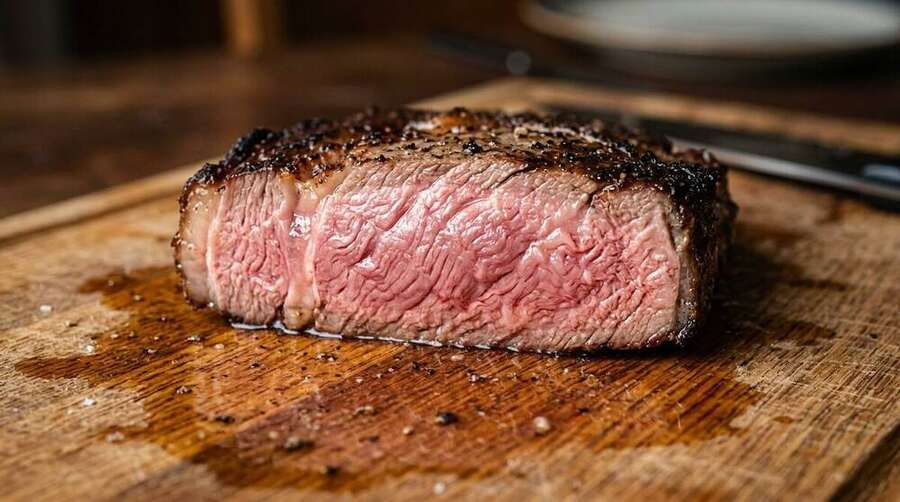
the working window
- 50 °C / 122 °Ftender cuts · rare1 – 2 hr
- 55 °C / 131 °Ftender cuts · medium-rare1 – 4 hr
- 60 °C / 140 °Ftender cuts · medium1 – 4 hr
- 55 °C / 131 °Fchuck, flat iron · tenderised24 – 48 hr
- 57 — 60 °Cshort ribs48 – 72 hr
- 60 — 65 °Cbrisket36 – 72 hr
Tender cuts ask only for time-to-temperature. A 25 mm ribeye comes to 55 °C in roughly an hour and stays in its window for two more without losing anything; pull it any time within that window and sear. Tough cuts ask for a different commitment — the long, patient breakdown of collagen into gelatin that turns chuck into something extraordinary. Below 50 °C the conversion does not happen meaningfully; above 65 °C the muscle fibres themselves start to seize, even as the connective tissue dissolves. The narrow window between is where the magic is.
ii. Chicken & poultry
The category that frightens new sous-vide cooks the most, almost always for the wrong reason. The USDA’s instant-kill temperature for chicken is 74 °C (165 °F). Sous-vide can pasteurise chicken at 60 °C with a long enough hold — and the result is a different food entirely from the rubbery, dry-fibred breast that 74 °C produces.
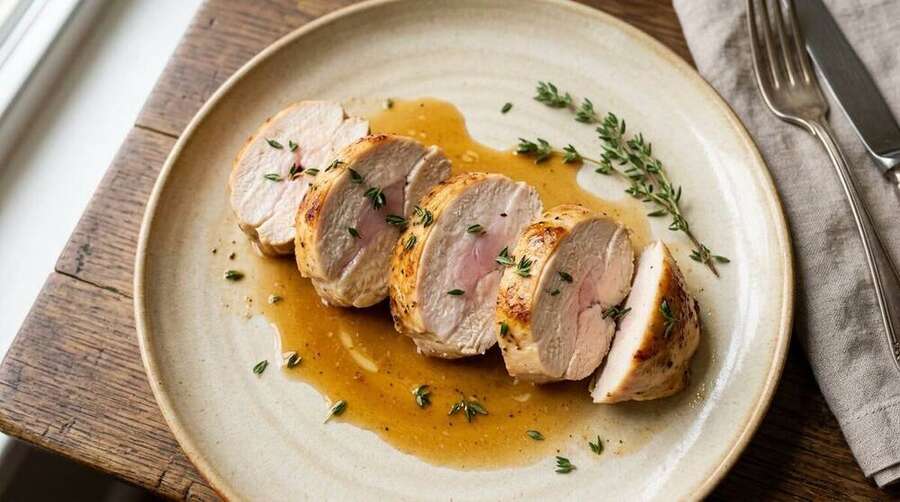
breast low · thigh high
- 60 — 63 °Cbreast · tender, slightly pink at bone1 – 2 hr
- 65.5 °C / 150 °Fbreast · white throughout, still moist1 – 2 hr
- 73 — 76 °Cthigh · tender, fat fully rendered2 – 4 hr
- 75 °C / 167 °Fwhole leg · pull-apart8 – 12 hr
Pasteurisation of poultry takes about sixty percent longer than beef at the same temperature, which is why the times here run a little longer than they would for tender steak. A 25 mm chicken breast at 60 °C needs roughly three and a half hours for the safety margin. Beyond that, nothing improves; the meat simply waits for you.
iii. Pork & lamb
The USDA quietly revised its pork recommendation downward in 2011, from 71 °C to 63 °C. The change was overdue. Pork loin cooked sous-vide at 60 °C for two hours is fully safe and noticeably juicier than the previous standard ever was — and the new official guidance, which most home cooks have not yet absorbed, is now closer to what serious cooks have been doing for years.
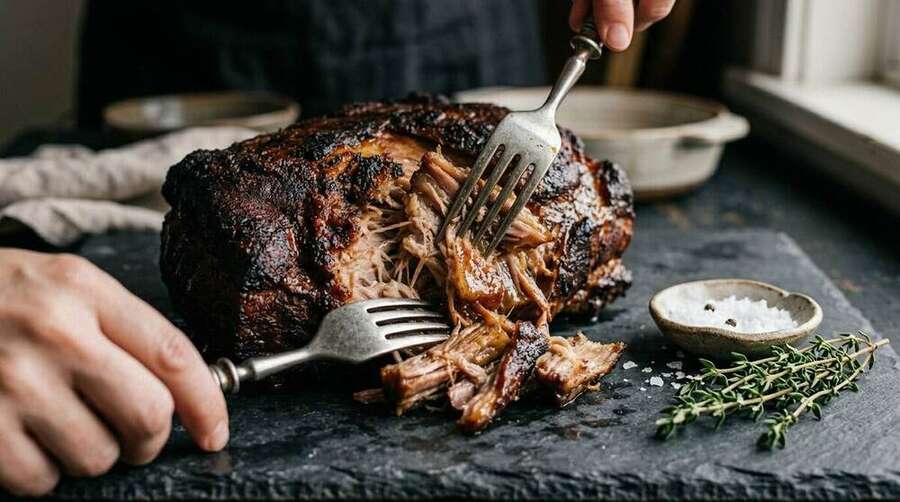
chops low · pulled high
- 55 °C / 131 °Fpork loin, chops · slow, tender2 – 6 hr
- 60 °C / 140 °Fpork loin, chops · traditional1 – 3 hr
- 74 — 80 °Cpork shoulder · pulled18 – 36 hr
- 75 — 80 °Cpork belly · crisp-finished8 – 14 hr
- 55 °C / 131 °Flamb · medium-rare, tender cuts1 – 4 hr
- 65 — 70 °Clamb shoulder, shank · falling24 – 48 hr
Pork shoulder is the cut that converts most reliably. Eighteen hours at 74 °C produces a shoulder that pulls apart cleanly with two forks — closer in texture to a Carolina barbecue than to a roast — and which can then be finished under a broiler for the bark, if you want one. Lamb shoulder behaves identically; the cooking principles are the same.
iv. Fish & seafood
The category that punishes the most. Fish cooks in minutes at sous-vide temperatures, not hours, and the single most common sous-vide failure is treating fish as a holding item, the way one treats meat. A salmon fillet left in a 60 °C bath for two hours is not still good — it is mealy, dry, and structurally collapsed.
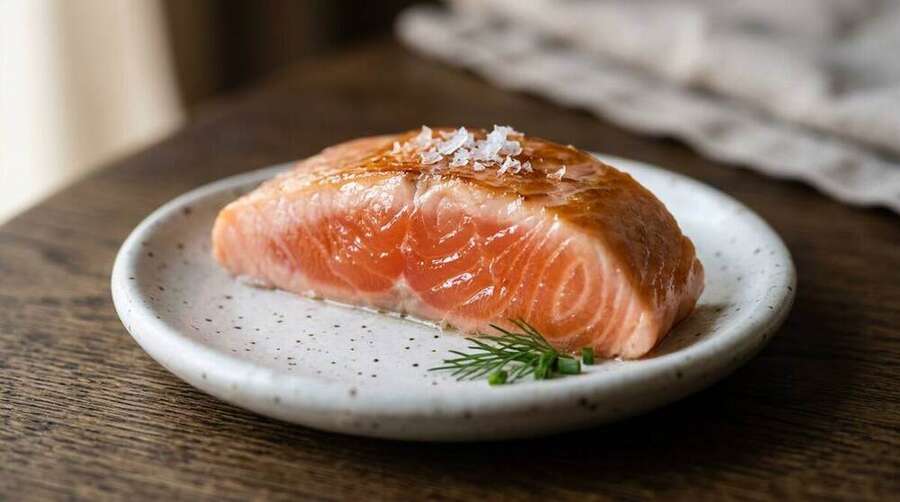
minutes, not hours
- 38 — 43 °Ctuna · rare to very rare15 – 25 min
- 42 °C / 108 °Fsalmon · mi-cuit20 – 30 min
- 50 °C / 122 °Fsalmon · medium-rare20 – 40 min
- 55 — 60 °Ccod, halibut, lean white fish25 – 40 min
- 55 °C / 131 °Fscallops · medium-rare25 – 40 min
- 57 °C / 135 °Flobster tail30 – 45 min
v. Eggs
The unexpected gift. The famous “63 °C egg” is not a flavour breakthrough, exactly — it is a textural one. At precisely 63 °C, held for forty-five minutes, the yolk becomes a thick custard while the white sets only barely. Crack it over a slice of toast or a bowl of polenta and the yolk slumps slowly out of the shell, holding its shape for a moment before pooling. It is the same egg you have always cooked, photographed in a register no other technique reaches.
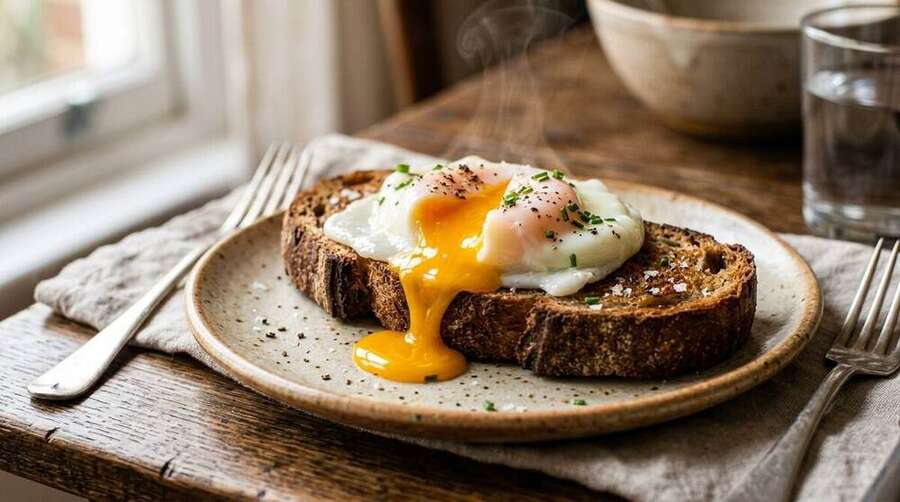
custard yolk, set white
- 57 °C / 135 °Fpasteurised in-shell · safe raw uses75 min
- 63 °C / 145 °F“the perfect egg” · runny yolk40 – 50 min
- 65 °C / 149 °Fjammy yolk, tender white40 – 50 min
- 75 °C / 167 °Fhard-boiled · no green ring30 – 40 min
The finishing step, properly done
A piece of meat lifted out of a sous-vide bath looks wrong. Pale, flat, faintly waxy on the surface — what the Maillard reaction was supposed to handle has not happened, because Maillard browning starts around 140 °C and the bath was nowhere near that. The sear is not optional. It is the entire visual and aromatic argument of the meat, compressed into thirty seconds.
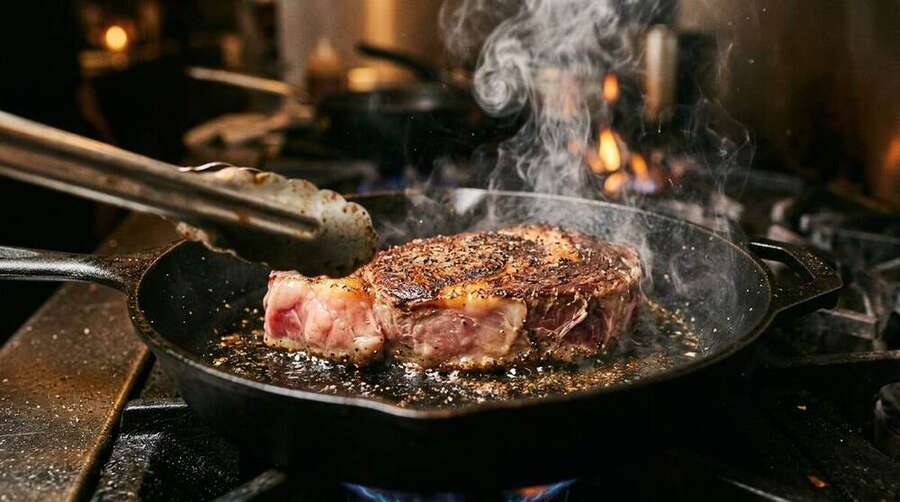
- 01Pat bone-dry. Moisture must evaporate before browning begins. Air-chill the meat in the fridge, uncovered, for five to ten minutes after pulling it from the bag.
- 02High-smoke-point oil. Avocado, grapeseed, or clarified butter. Extra-virgin olive oil burns at around 190 °C and should not be used here.
- 03Cast iron, screaming hot. 230 to 260 °C. Heat the empty pan dry, add the oil only when the pan is ready, and proceed immediately.
- 04Thirty seconds, per side. No more, for rare and medium-rare beef. Each additional thirty seconds adds about a millimetre of grey band — which is what you came here to avoid.
- 05Butane torch for precision. A serious butane torch produces a darker crust faster than any pan. Choose butane over propane — propane leaves a faint off-flavour.
- 06For thick cuts, ice-bath first. Five minutes in ice water before the pan creates a thermal buffer; the surface can sear longer without overcooking the centre. Worth it for steaks above 40 mm.
Equipment, in three forms
The most expensive setup is not always the one that produces the best result, and the cheapest is closer to the most expensive than equipment marketing would have you believe.
The immersion circulator
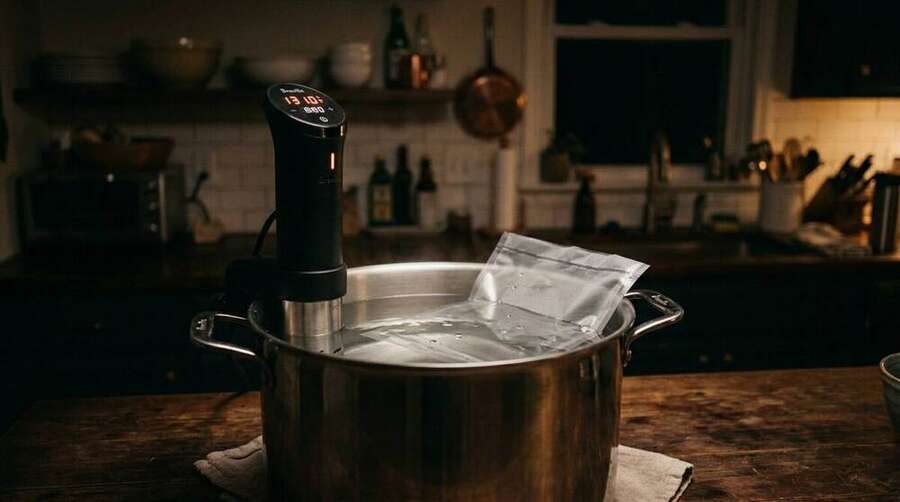
Heating element, circulation pump, PID controller, all clipped to any pot. Anova or Joule are the two reasonable consumer brands. Accurate to within a tenth of a degree. Used for any cook longer than a few hours; the only viable choice for the 24-to-72-hour territory.
The water-displacement bag
Freezer-grade zip-lock, food sealed inside, lowered slowly into the water with one corner open so the pressure of the water itself pushes the air out. Seal at the last moment. Cheapest entry point; perfectly safe up to 60 °C, and good freezer bags hold up to 100 °C. Clip the bag to the pot to prevent floating.
The thermal-mass cooler
A well-insulated beer cooler filled with water at the target temperature. Drift is one to two degrees per hour. Add boiling water periodically to compensate. For four-to-twelve-hour cooks at fixed temperatures, indistinguishable in result from a circulator costing forty times more.
The slow oven
A conventional oven on its lowest setting, with a leave-in probe thermometer in the meat. Best reserved for very large cuts where carry-over makes precise targeting unnecessary, or for finishing pasteurised meat that needs holding. Not equivalent to a water bath.
Storage, briefly
Pasteurised, sealed, and rapidly chilled in an ice-water bath, a vacuum-sealed protein keeps for surprisingly long. Below 5 °C, ten days is comfortable. Below 3 °C, a month. Below 2.5 °C, up to ninety days — though almost nobody’s home fridge is reliably that cold. The point is that batch cooking on a Sunday and reheating through the week is not a compromise; it is a feature of the technique.
The reheat itself is the same as the cook: drop the bag back into a water bath at the original temperature, leave it for thirty to sixty minutes depending on thickness, then sear and serve. Do not reheat above the original temperature, or you will overcook the meat retroactively. Eggs and seafood do not reheat well; treat both as service-time preparations.
When it doesn’t work
The failures of low-temperature cooking are largely preventable, and almost always traceable to one of six causes.
Mushy texture
Cause — Left in the bath beyond the optimal window. At 55 °C, beef tenderises up to 24–48 hours and then begins to disintegrate.
Fix — Pull at the upper edge of the recommended window. Long does not mean longer always.
Floating bag
Cause — Trapped air or water-vapour ballooning at higher temps. The bag floats, breaks contact with circulating water, and the meat is effectively cooked in nothing.
Fix — Weigh it down: a metal butter knife in the bag, a heavy ceramic plate on top, or sous-vide weights. Clip the bag to the rim.
Off-flavour from oil
Cause — Extra-virgin olive oil oxidises into something faintly metallic and unpleasant when held at temperature for hours.
Fix — Use grapeseed or another refined oil for cooks above two hours. Reserve EVOO for finishing, off heat.
Raw garlic, sealed
Cause — Raw garlic in a sous-vide bag develops a sharp, sulphurous, faintly chemical aroma — nothing like the garlic you wanted in the dish.
Fix — Sweat the garlic in a little oil first, or add it after the cook. A small pinch of garlic powder is, surprisingly, a better choice than fresh raw garlic in the bag.
Overcooked fish
Cause — Treating fish like beef. A salmon fillet at 60 °C for two hours is mealy and dry; the same fillet at 50 °C for thirty minutes is precisely correct.
Fix — Set the timer. Pull at the time, not when it is convenient. Fish is the one category where holding is a real cost.
Alcohol in the bag
Cause — Wine or spirits added raw to a bag will partially vaporise at bath temperature, ballooning the bag and cooking the meat unevenly.
Fix — Reduce wine or spirits in a saucepan first, until most of the alcohol has cooked off. Cool, then add to the bag.
What the technique gives you
It gives you, eventually, the ability to cook without watching. A steak in a 55 °C bath at five o’clock is still a 55 °C steak at seven, and substantially still a 55 °C steak at eight, give or take a faint loss of texture at the long end of the window. The control of the variable that traditional cooking spends most of its energy fighting — the gradient between centre and surface — is simply handed to you. What you do with the time you save is your own business.
It also gives you the ability to do certain things you could not do at all. A chuck steak with the texture of filet, for forty-eight hours and the price of a chuck steak. A pork shoulder pulled apart with two forks at sixteen hours, no smoker required. An egg whose yolk is exactly between liquid and solid, every time. Reheated chicken that tastes like first-service chicken, three days later.
The technique is not new. The science behind it has been understood for decades, and the equipment to use it at home has been affordable for years. What was missing, for a long time, was simply the willingness to trust temperature over time — to set a number and walk away.
Most cooks who do once, never go back.
— Morgan H.

