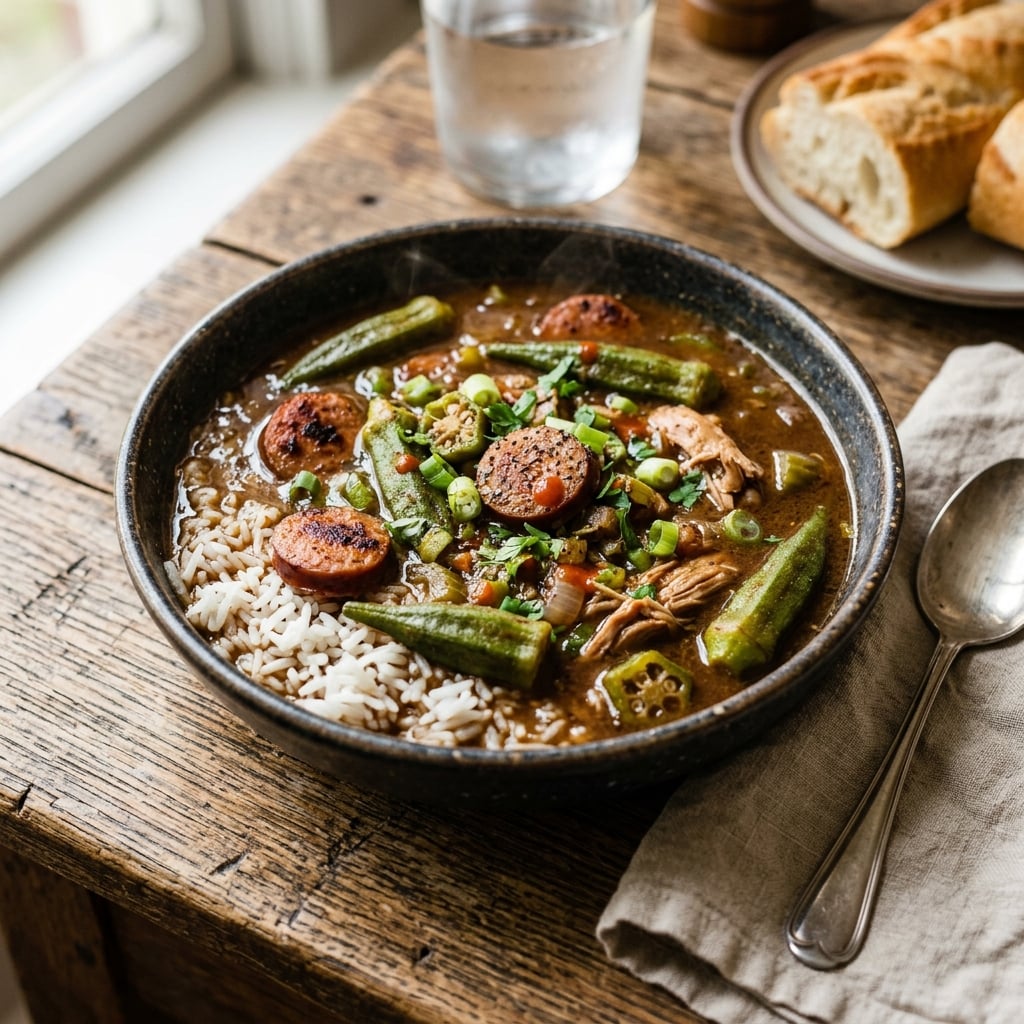
Sunday in January is the right time for gumbo. Not because of any rule, but because gumbo is a pot that demands time, and Sunday is one of the few days you actually have it. Both versions here — dark-roux Cajun with turkey andouille, and Creole seafood — are built on the same principle: a proper roux, a proper base, and the discipline to leave things alone.
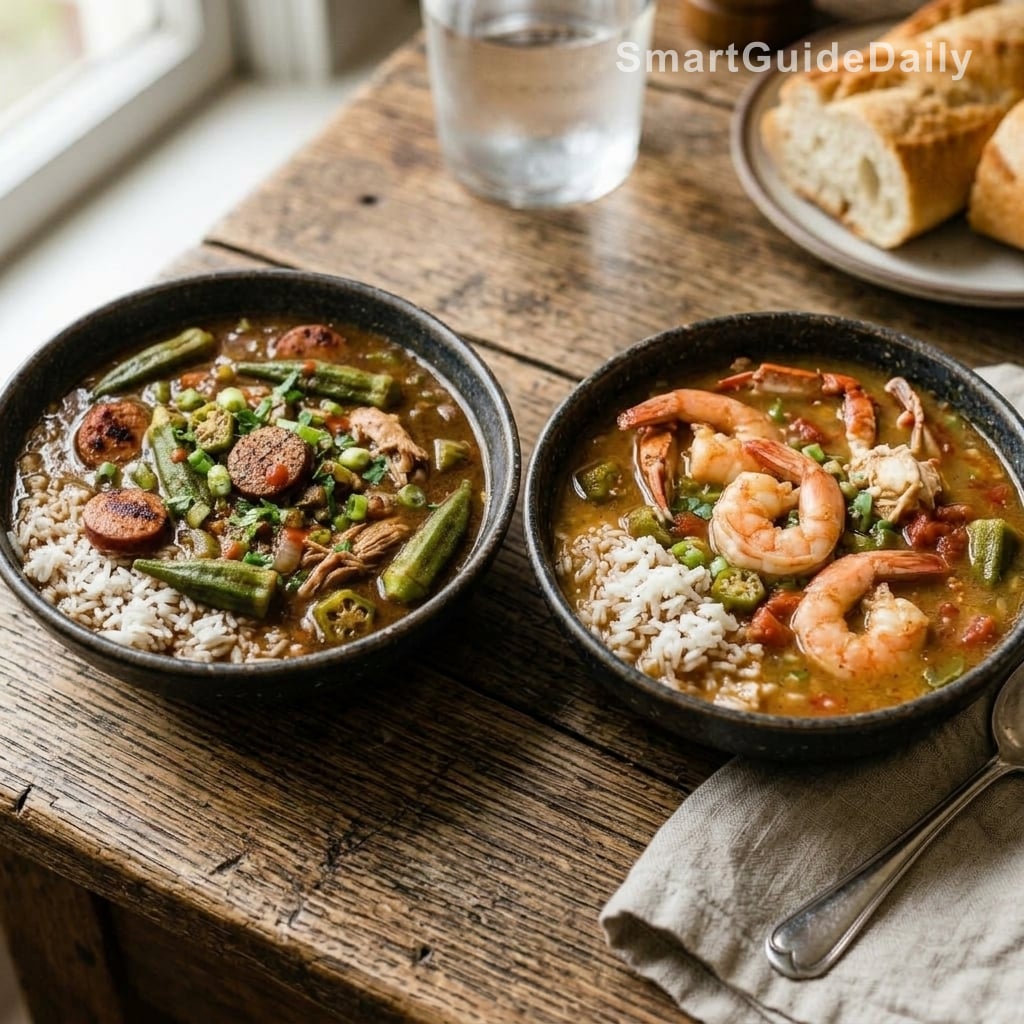
The Cajun version smells of toasted flour and smoked turkey sausage from the moment the onions hit the pot. The Creole version is cleaner — the shrimp adding a quiet sweetness where the sausage adds smoke. They share the same bones: holy trinity, okra, long-grain rice. But they arrive at different places. One is heavy and grounding; the other is lighter without being thin. Neither version requires culinary school. They require attention.
Why you’ll love this recipe
Ingredient Notes
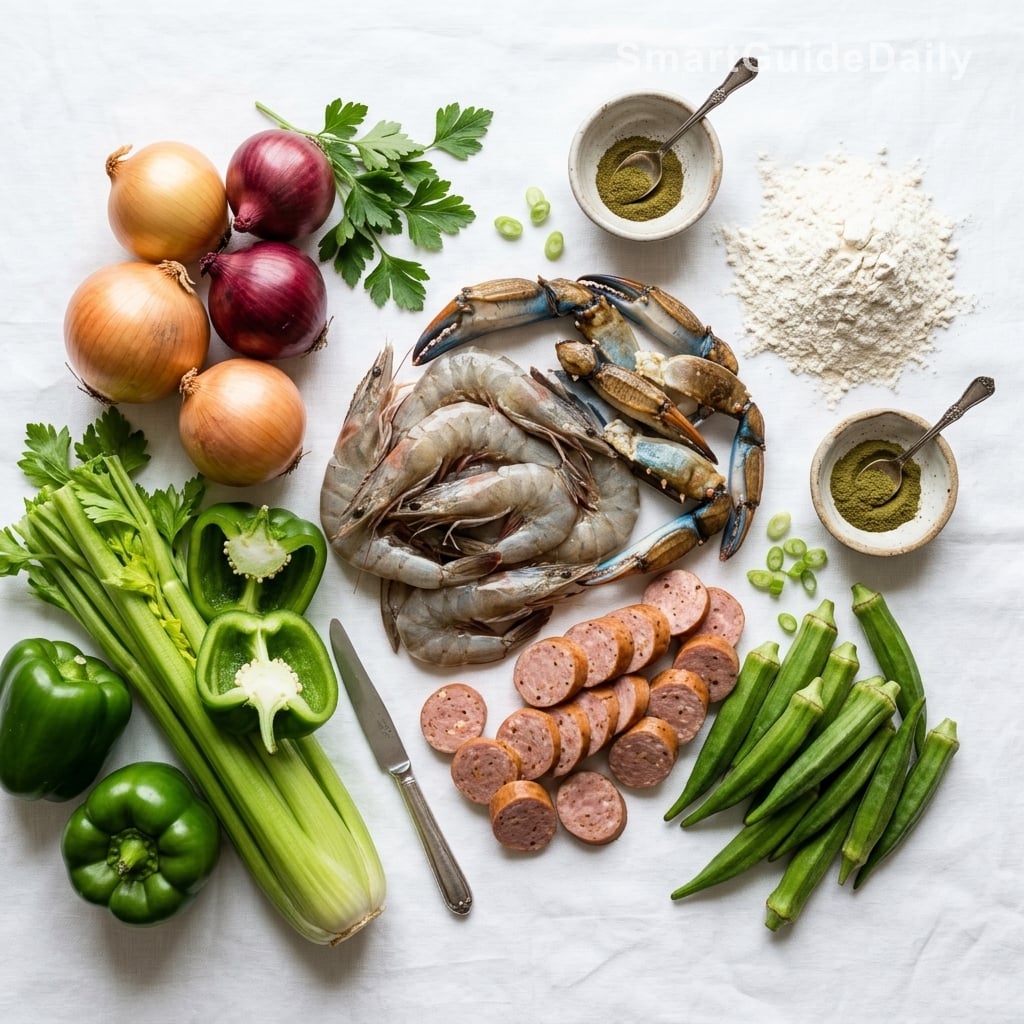
Everything before the pot: okra, the holy trinity, turkey andouille, shrimp, crab, and the flour that will become the roux.
- Dark roux (flour + neutral oil) : The engine of the Cajun version. Equal weights of oil and flour, medium heat, constant stirring for fifteen to twenty minutes. There is no shortcut, and the moment you think you can walk away is the moment it burns.
- Turkey andouille sausage : Smoked, heavily seasoned, sliced into rounds before browning. Look for one with visible spicing on the casing — paprika, black pepper, cayenne. If it smells only of liquid smoke, find another brand.
- Okra : Both a thickener and a vegetable, which is a useful combination. Fresh is better. Frozen works if you drain it and pat it dry — excess moisture in the pot makes the gumbo soupy instead of silky.
- Shrimp — Creole version : Medium-sized, shell-off for convenience, but buy them shell-on and peel them yourself. Simmer the shells in the stock for fifteen minutes, then strain. The broth becomes noticeably more substantial.
- Filé powder : Ground sassafras leaves. Stir it in off the heat, at the very end. Boiling filé makes it stringy and bitter. It’s a thickener and an aromatic both — used correctly, it adds a faint herbal depth that okra alone doesn’t provide.
- The holy trinity (onion, celery, green bell pepper) : Equal parts by volume, roughly. The base of both versions. They go in together, they cook together, and nothing else happens until they’re soft and fragrant — about eight minutes over medium-low heat.
Pick Your Version Before You Turn On the Heat
The two gumbos diverge at the roux. Cajun goes dark — a deep chocolate color that takes nerve and patience. Creole goes lighter, and adds tomatoes, which the Cajun tradition historically avoids. This is not a debate worth relitigating here, but it is a decision you need to make before the oil heats up. The structure of the entire dish follows from it. The Cajun version is built on fat and char. The Creole version is built on the acidity of the tomato and the sweetness of the seafood. They’re different cooking logics, not different difficulty levels.
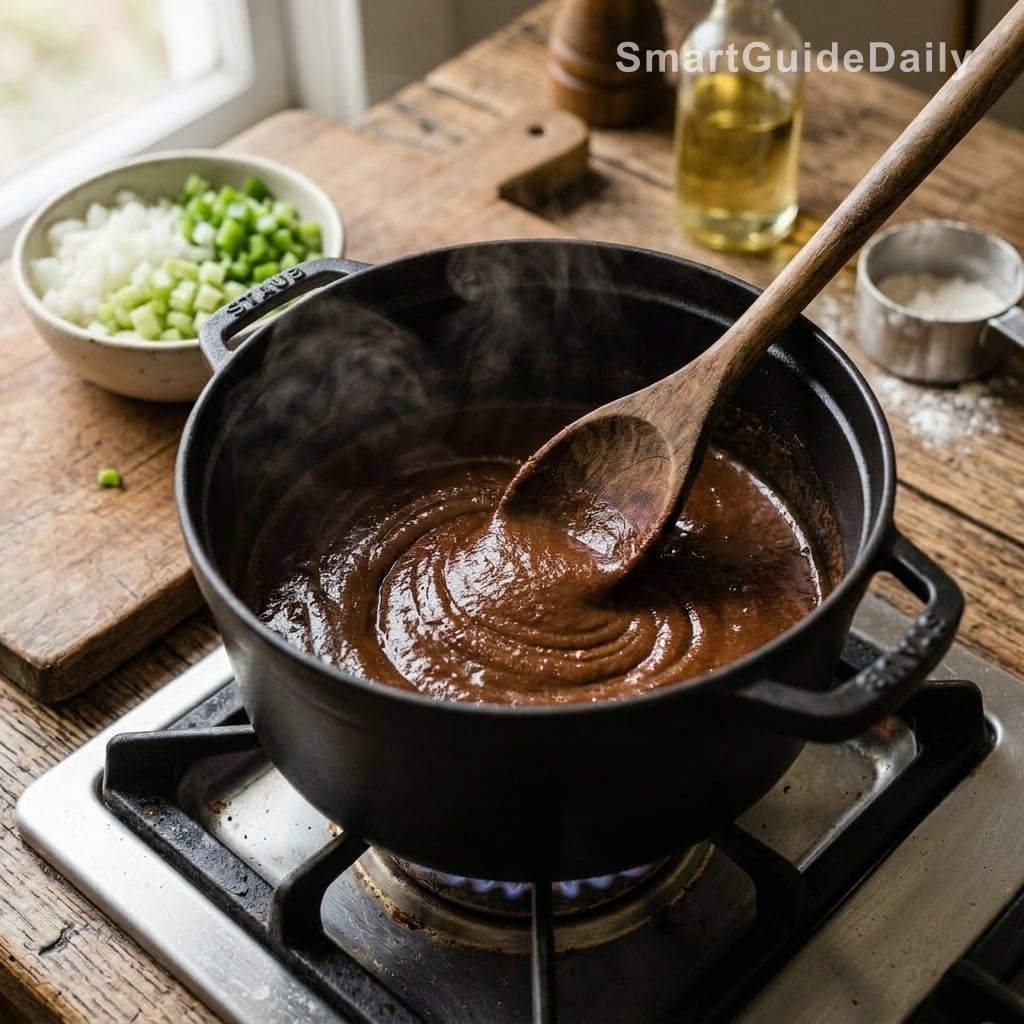
Stir the Roux the Entire Time — No Interruptions
Combine equal weights of neutral oil and all-purpose flour in a heavy Dutch oven over medium heat. From that moment, the spoon doesn’t stop moving. At the blond stage the mixture smells of warm biscuit. At the peanut butter stage it sharpens into something almost nutty. By the time it reaches a deep reddish-brown — the color of bittersweet chocolate — it will smell faintly of coffee, and the heat coming off the pot will be intense. That’s where you want it. If you see black specks in the roux, the fire was too high, and there is no recovering it. Start again. A burned roux flavors everything it touches.
Don’t Add the Vegetables Until the Roux Looks Almost Too Dark
The holy trinity goes in all at once — onion, celery, and green bell pepper. They’ll hit the roux with a hard sizzle and release a burst of steam that smells of caramelizing onion and something denser underneath. Reduce the heat immediately and cook, stirring, until the vegetables soften and absorb into the roux. About eight minutes. The mixture tightens into something dense and fragrant before a drop of stock has been added. This is the moment the Cajun version earns its depth — not from the stock, but from the roux and what happens when the vegetables cook into it.
For the Creole Version: Add the Seafood at the End, Not Before
The shrimp go in during the last five to seven minutes, with the broth at a steady simmer — not a boil. Medium shrimp take three to four minutes to cook through, until just opaque and slightly pink at the edges. Pull the pot off the heat while they still look marginally underdone. They’ll finish in the residual warmth. Overcooked shrimp is the single most common failure point in home-cooked gumbo. They become dense and rubbery, and no amount of filé powder or okra will fix the texture.
Leave It Alone for Ten Minutes Before Serving
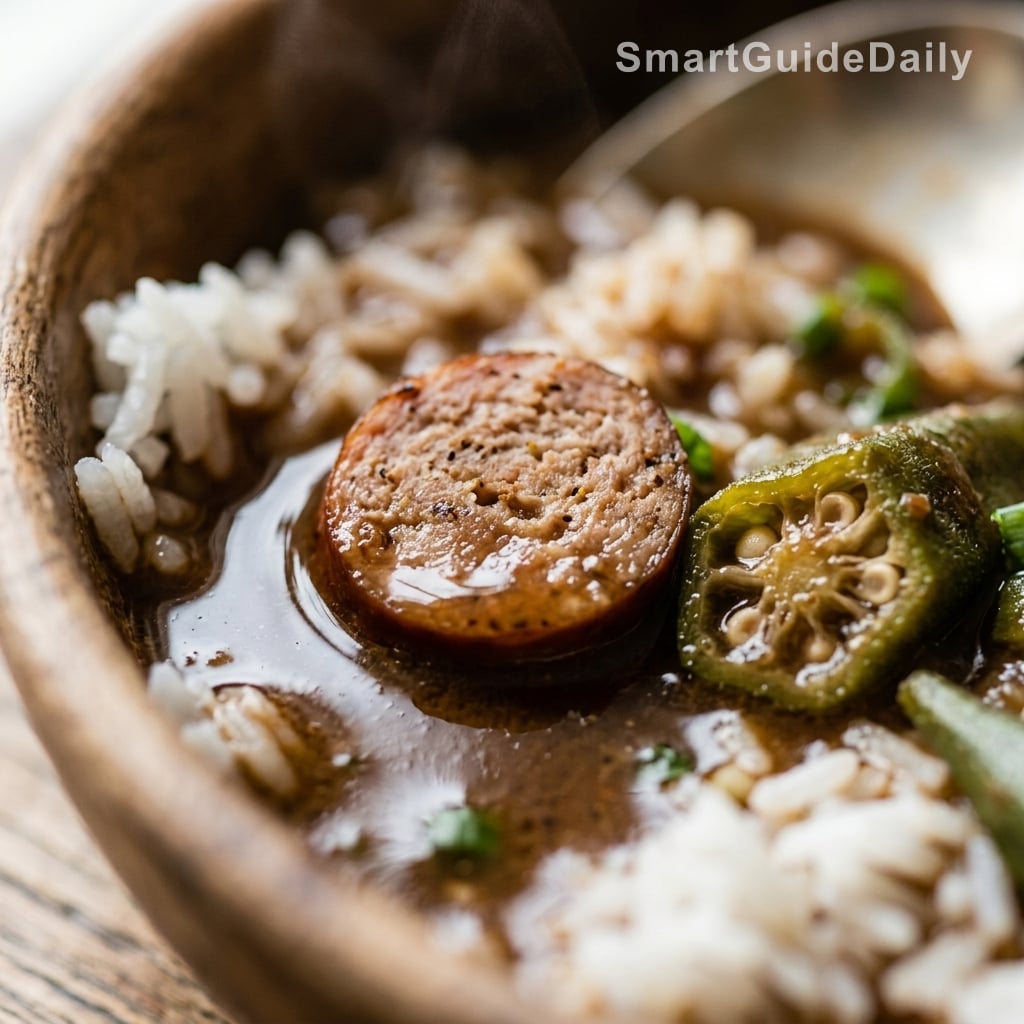
Off the heat, covered, ten minutes. This is not optional. The okra finishes softening. The filé — stirred in right before the lid goes on — does its thickening work without boiling. The flavors settle into something more coherent than they were at the simmer. Serve in deep bowls over a mound of long-grain white rice. Don’t stir the rice into the gumbo. The point of the rice is textural contrast: the grains should hold their shape against the dense, yielding broth around them.
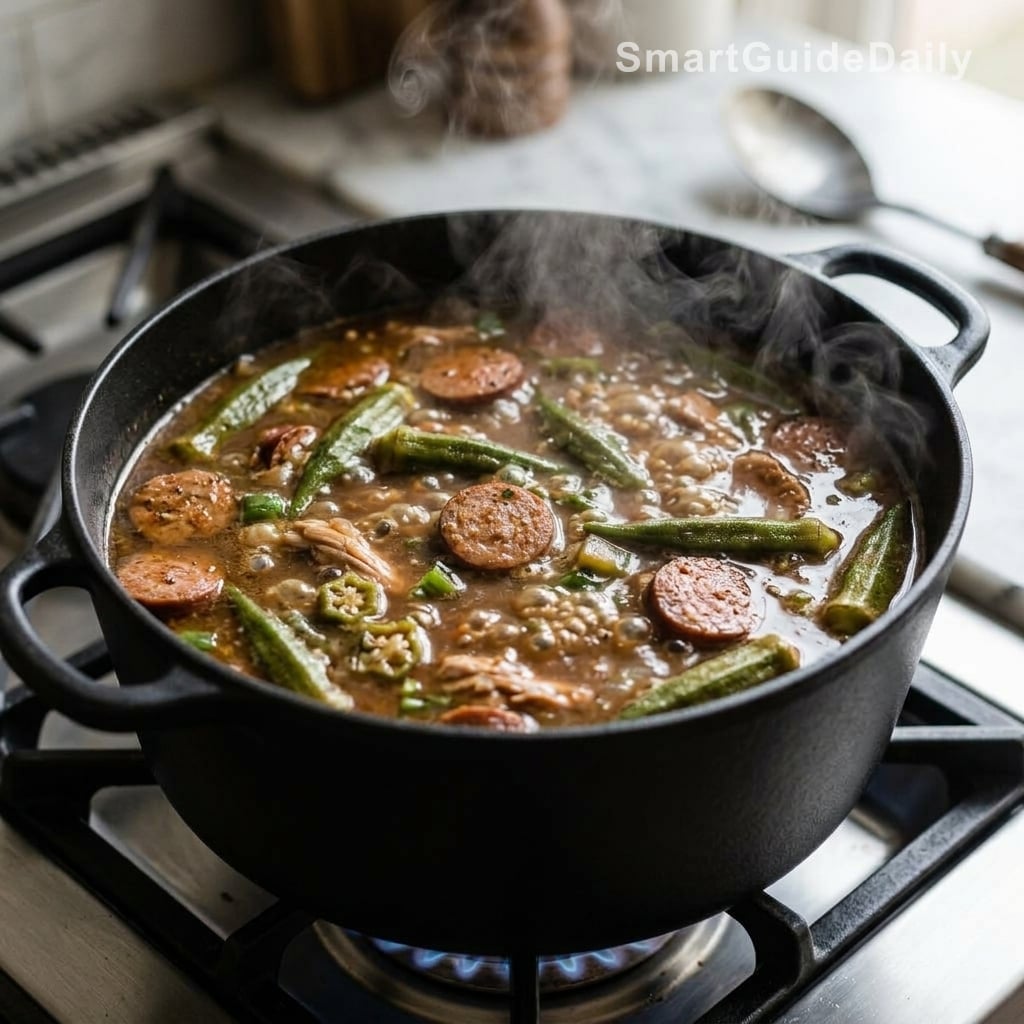
Tips & Tricks
- Season at the very end. Both versions concentrate significantly as they cook. Salt added too early becomes oversalting by the time the pot is done. Taste after the resting period, not during.
- Make a double batch of dark roux and freeze the excess. It keeps for months in tablespoon-sized portions. The next pot of Cajun gumbo starts in three minutes instead of twenty.
- If the Cajun version feels too thick after resting, thin it with a splash of warm chicken stock — never water, which dilutes the flavor without adding anything.
- For both versions, long-grain white rice is the correct choice. Jasmine is close but slightly too fragrant. Medium-grain rice absorbs too much broth and loses its texture. Use long-grain, cooked plain, slightly firm.
What is the actual difference between Cajun and Creole gumbo?
Cajun gumbo uses a very dark roux — cooked to near-black — and relies on the roux and filé powder for body, with no tomatoes. Creole gumbo is lighter, more likely to include tomatoes, and leans toward seafood. The distinction is geographic and cultural: Cajun cooking developed in rural southwestern Louisiana, Creole cooking in the urban communities of New Orleans. The line is blurred in practice, and both traditions have absorbed each other over generations.
Can I make the dark roux ahead of time?
Yes, and it’s worth doing. A finished dark roux keeps in the refrigerator for up to two weeks in a sealed jar, and in the freezer for several months. Store it in tablespoon-sized portions so you can use exactly what you need. When you’re ready to cook, bring it to room temperature before adding it to the pot — cold roux added to hot stock can seize and clump.
How do I know when the dark roux has reached the right color?
You’re looking for the color of bittersweet dark chocolate — a deep reddish-brown with no black specks. The smell will shift from nutty to something closer to dark coffee as it approaches the target stage. If you see black specks, the roux has burned and needs to be discarded. There is no correcting a burned roux once it’s in the pot.
Can I use frozen okra instead of fresh?
Frozen okra works, but it releases considerably more moisture than fresh. Thaw it completely, drain in a colander, and pat it dry before adding to the pot. Skip this step and the extra water thins the gumbo and dilutes the roux base. Fresh okra, sliced just before use, gives better texture with less effort.
Can I freeze gumbo, and for how long?
The Cajun version freezes well for up to three months — without the rice. The Creole seafood version is more complicated: shrimp and crab degrade in texture after freezing and reheating. Cook the Creole base, freeze it without the seafood, and add fresh shrimp and crab when you reheat. Refrigerated, both versions keep four days and improve noticeably by day two.
Gumbo Two Ways: Dark-Roux Cajun or Creole Seafood
American — Louisiana
Mains
Two gumbos built on the same roux foundation, diverging from there. The Cajun version uses a dark chocolate roux, turkey andouille, and chicken thighs. The Creole version is lighter — tomato-based, built around shrimp and crab. Both serve eight and hold well over several days.
Ingredients
- — CAJUN DARK-ROUX VERSION —
- 120ml neutral oil (vegetable or canola)
- 120g all-purpose flour
- 450g turkey andouille sausage, sliced into ¼-inch rounds
- 450g boneless skinless chicken thighs, cut into 1½-inch chunks
- 1 large yellow onion, finely diced
- 3 stalks celery, finely diced
- 1 green bell pepper, finely diced
- 4 cloves garlic, minced
- 225g fresh okra, sliced into ½-inch rounds
- 1.5L chicken stock
- 2 bay leaves
- 2 tsp Cajun seasoning blend
- 1 tsp filé powder, added off heat at the very end
- salt and black pepper to taste
- — CREOLE SEAFOOD VERSION —
- 60ml neutral oil
- 60g all-purpose flour
- 1 large yellow onion, finely diced
- 3 stalks celery, finely diced
- 1 green bell pepper, finely diced
- 4 cloves garlic, minced
- 400g canned crushed tomatoes
- 450g medium shrimp, shell-on — peeled and deveined, shells reserved for stock
- 225g crab meat, picked clean of any shell
- 225g fresh okra, sliced into ½-inch rounds
- 1.2L seafood stock, made from reserved shrimp shells (or chicken stock)
- 2 bay leaves
- 2 tsp Creole seasoning blend
- ½ tsp filé powder, added off heat at the very end
- salt and black pepper to taste
- — TO SERVE — BOTH VERSIONS —
- 800g long-grain white rice, cooked plain
Instructions
- 1CAJUN VERSION — In a heavy Dutch oven over medium heat, combine the oil and flour. Whisk constantly for 15–20 minutes until the roux reaches the color of dark bittersweet chocolate. Adjust heat as needed to avoid scorching. Do not stop stirring.
- 2Add the diced onion, celery, and bell pepper all at once. The roux will sizzle hard. Reduce heat to medium-low and cook, stirring often, for 8 minutes until the vegetables are fully softened.
- 3Add the garlic and cook 1 minute. Add the turkey andouille rounds and chicken chunks. Stir to coat everything in the roux base and cook 3 minutes.
- 4Add the chicken stock gradually — one large ladle at a time — stirring after each addition to prevent lumping. Once all the stock is incorporated, add the okra, bay leaves, and Cajun seasoning.
- 5Bring to a simmer and cook uncovered for 45–60 minutes, stirring occasionally. The gumbo will thicken as it cooks. Remove the bay leaves.
- 6Pull the pot off the heat. Stir in the filé powder. Cover and let rest 10 minutes undisturbed. Season with salt and black pepper. Serve in deep bowls over a mound of white rice.
- 7CREOLE VERSION — Combine the reserved shrimp shells with 1.4L cold water and a bay leaf in a saucepan. Bring to a simmer and cook 15 minutes. Strain and discard the solids. Reserve 1.2L of this stock.
- 8In a Dutch oven over medium heat, combine the oil and flour. Stir constantly for 10–12 minutes until the roux reaches a light peanut-butter color. Stop there — this version does not go dark.
- 9Add the holy trinity (onion, celery, bell pepper). Cook 8 minutes, stirring often. Add the garlic and cook 1 minute. Add the crushed tomatoes and cook 5 minutes, stirring to incorporate.
- 10Pour in the seafood stock. Add the okra, bay leaves, and Creole seasoning. Bring to a simmer and cook 30 minutes. Remove the bay leaves.
- 11Add the shrimp and crab meat. Cook 4–5 minutes over a steady simmer — not a boil — until the shrimp are just opaque. Do not overcook.
- 12Remove from heat immediately. Stir in the filé powder. Cover and rest 10 minutes. Season to taste. Serve over long-grain white rice.
Notes
• A burned dark roux is irreversible — the window between correct and ruined is about thirty seconds once the roux nears the target color. When in doubt, pull it off the heat and stir.
• Both gumbos improve overnight. If time allows, make either version a day ahead and reheat gently over low heat the following day.
• The Cajun version freezes well without rice for up to three months. For the Creole version, freeze the base without the seafood and add fresh shrimp and crab at reheating.
• If filé powder is unavailable, omit it rather than substitute. The gumbo thickens from the roux and okra regardless. Filé adds an herbal, faintly root-like depth — noticeable in its absence, but not essential.
Nutrition Facts (per serving, estimated)
| 410 kcalCalories | 29gProtein | 41gCarbs | 13gFat |