Baklava is a Saturday project. Not because it’s difficult — the technique is learnable in one attempt — but because the syrup needs four hours to finish distributing, and rushing that part is precisely how you end up with a tray that bends instead of shatters. Set aside the afternoon.
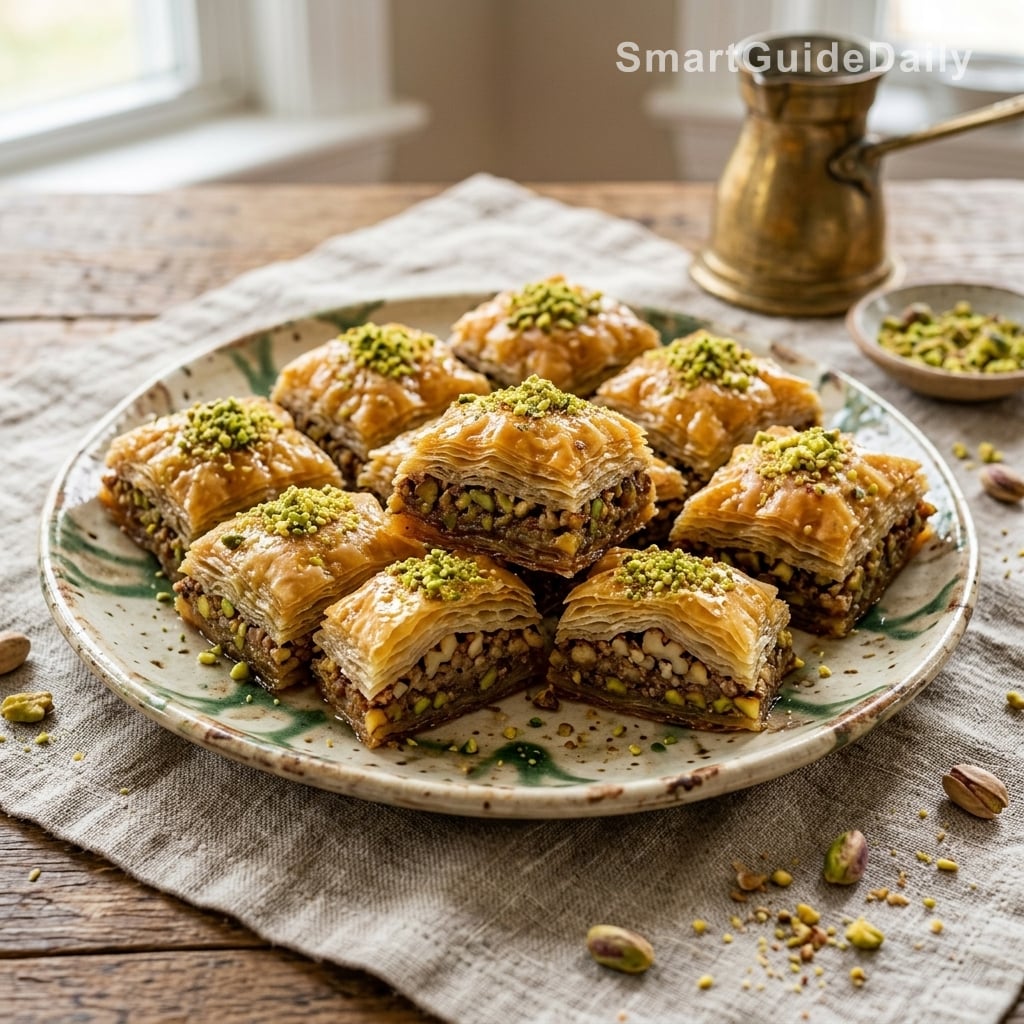
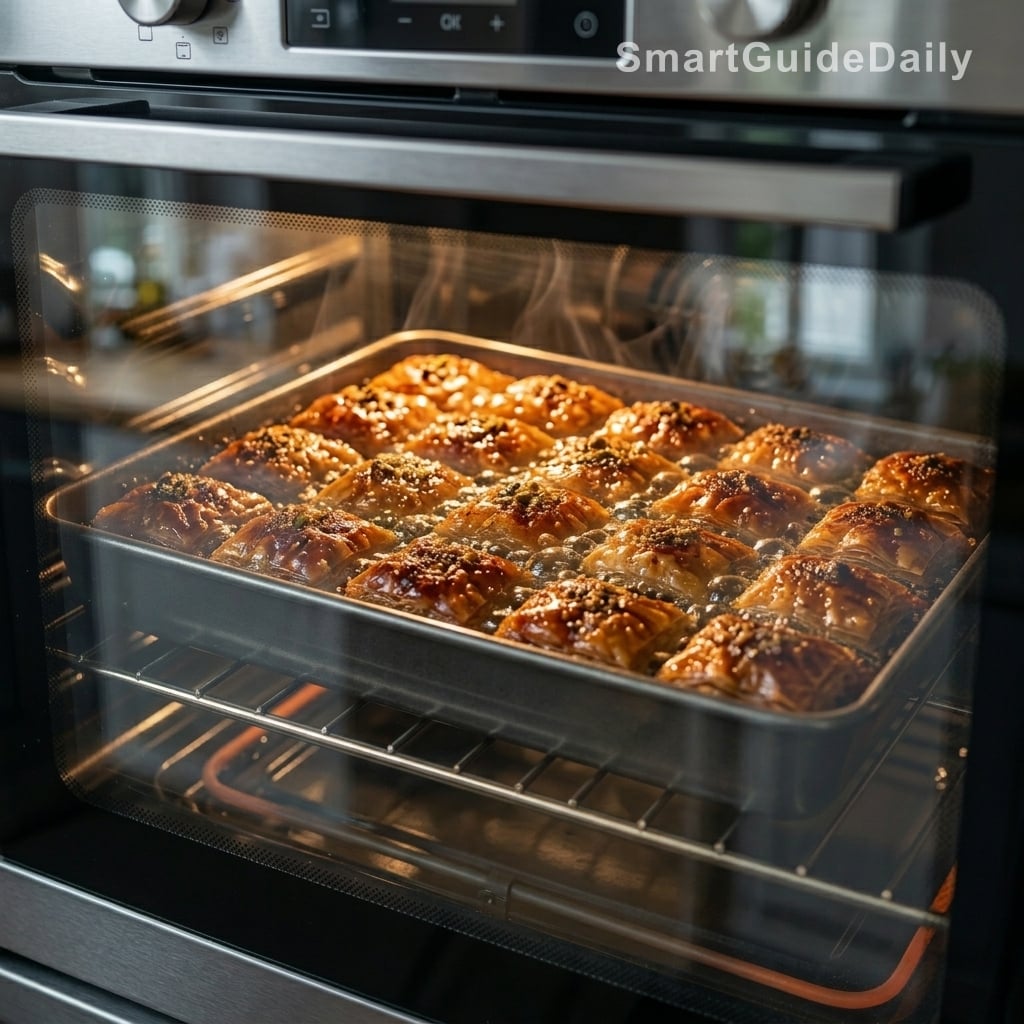
When you pull a properly made tray from the oven, the top layer should crackle audibly when you press it lightly with a finger. The butter has browned into something nutty and faintly caramel-smelling, and the cut lines you made before baking have opened into clean channels. Those channels are not decorative. They are how the syrup reaches the interior layers without pooling on the surface. The difference between a crisp tray and a soft one is almost always in that moment — how the syrup enters the pastry, and at what temperature.
Why you’ll love this recipe
Ingredient Notes
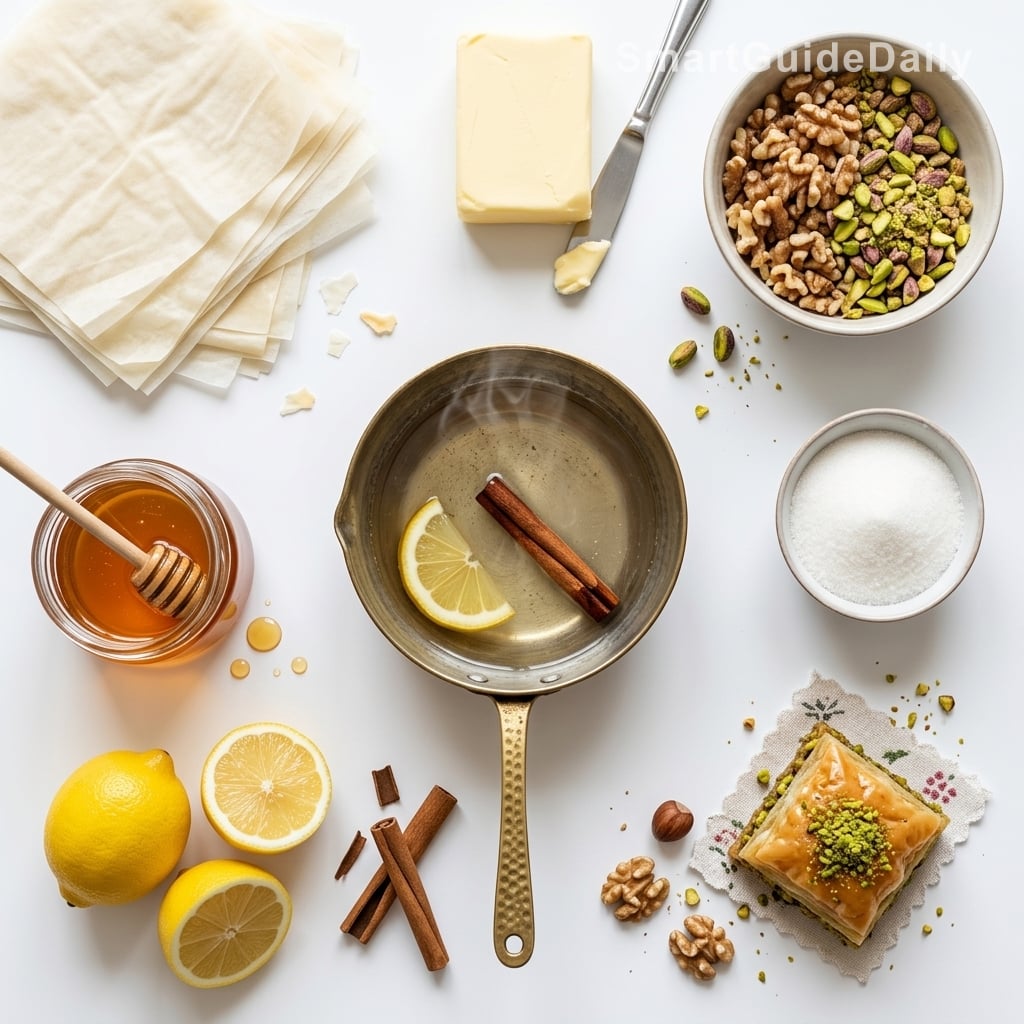
The ratio between butter, nuts, and syrup determines whether the result is crisp or waterlogged.
- Phyllo dough (450g / 1 lb, thawed overnight in the fridge) : The structural lattice of the whole tray. Keep it refrigerated until the moment you open the package, and work quickly — exposed phyllo dries in minutes and becomes brittle in a way that’s difficult to recover from. If a sheet tears, lay it in anyway. It won’t matter by the time it bakes.
- Clarified butter or ghee (225g / 1 cup) : Non-negotiable. Regular butter contains roughly 16–18% water, which turns to steam inside the oven and softens the phyllo from within. Ghee, or butter you’ve clarified yourself, has nearly zero water content. That fat-to-water ratio is the single biggest determinant of whether your tray shatters or chews.
- Walnuts and pistachios (300g combined, roughly 60/40) : Pulse them in a food processor to a coarse crumb — pieces between 3mm and 5mm. Finer than that and the filling compacts into a dense paste under the weight of the layers above. Coarser and the sheets won’t bond properly during baking.
- Sugar (200g) + water (120ml) for the syrup : A 62% sugar solution by weight. Add a tablespoon of lemon juice while it cooks — the acid converts a portion of the sucrose into fructose and glucose, which prevents crystallization as the syrup cools. A crystallized syrup distributes unevenly and leaves a gritty coat.
- Honey (3 tablespoons, added off heat) : Stirred into the finished syrup once it’s off the burner. Honey is hygroscopic, meaning it helps the syrup stay fluid slightly longer during absorption — long enough to penetrate the interior layers rather than seizing on the surface.
- Ground cinnamon (1 tsp) + cardamom (½ tsp), mixed into the nuts : Both bloom significantly in oven heat. Cardamom in particular shifts from a faintly soapy raw note to something floral and warm once baked. Don’t substitute extra cinnamon for it — the balance is not arbitrary.
Keep the Phyllo Covered Until You Need Each Sheet
Phyllo is made of very thin flour-and-water dough, which means it reacts immediately to ambient humidity. In a dry kitchen, an uncovered stack can become crumbly in under five minutes — you’ll know it’s gone too far when the edges start lifting and the surface develops a papery rigidity. The fix is a barely damp kitchen towel laid flat over the stack while you work, replaced between sheets. You’re not trying to add moisture to the dough. You’re preventing evaporation. Once a sheet has dried to the point of cracking at the edges, it will fracture unpredictably when you position it, leaving gaps in the structural stack. Those gaps translate directly into uneven syrup absorption later. The discipline here costs about thirty seconds per sheet.
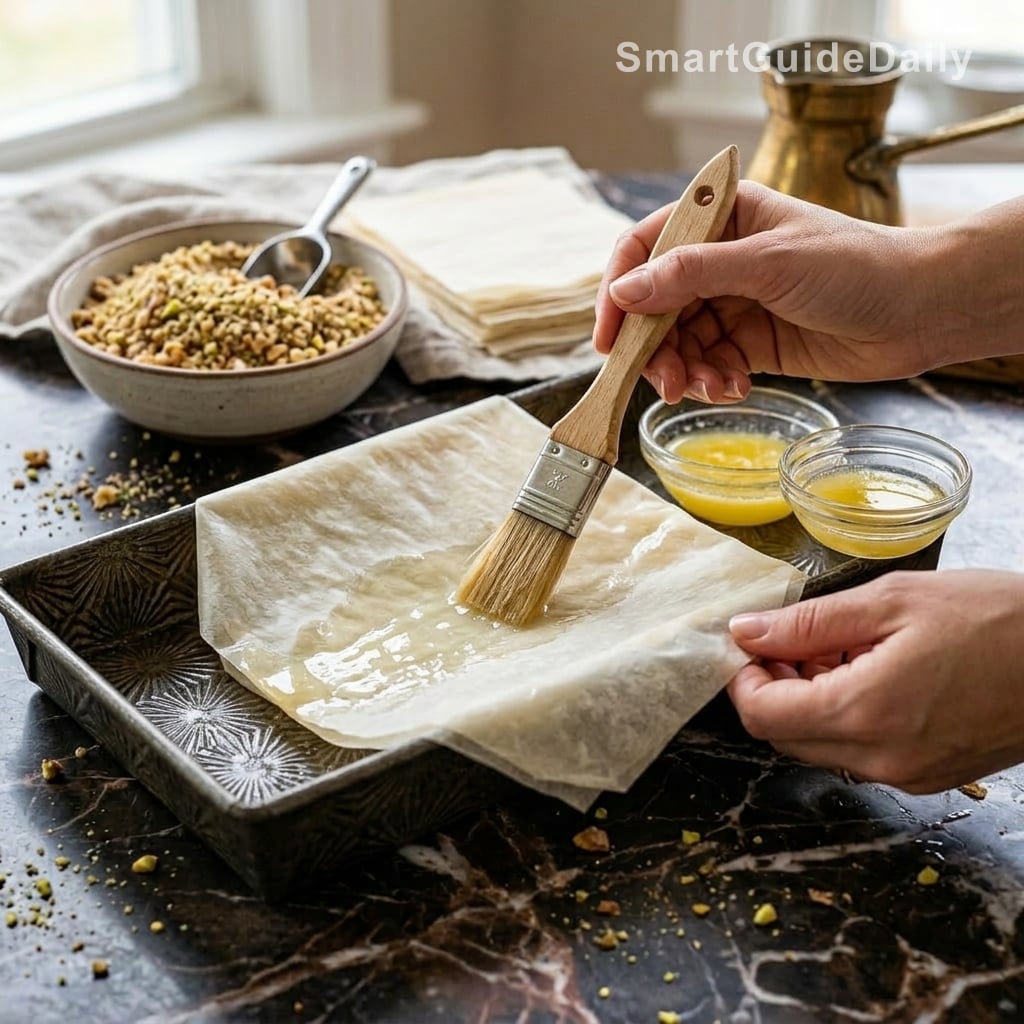
Brush Every Single Layer With Ghee — No Exceptions
This is where most home bakers undercut themselves. The instinct is to economize on butter, either for cost or out of some vague sense of restraint. Resist it entirely. Each layer of phyllo needs its own coat of clarified butter, applied in a thin, even film from edge to edge. The fat accomplishes two things simultaneously: it conducts heat efficiently during baking, browning the layers from within, and it prevents the sheets from fusing into a solid, chewy mass. A tray with properly buttered layers shatters cleanly when you bite through it. A tray with stingy buttering produces a dense, leathery result that holds its shape but offers no resistance. The total fat content for a standard 9×13 pan — roughly 225g of ghee — sounds excessive until you consider that it’s distributed across thirty or more layers. It works because fat is not the enemy here. Water is.
Score the Tray Before It Goes Into the Oven, Not After
Cut the baklava into its diamond or square shapes before baking, pressing the knife all the way through to the bottom of the pan. This step is structural. The cuts create channels through the full depth of the pastry, and when the syrup is poured later, it travels down those channels rather than spreading only across the top surface and oversaturating it. A tray that hasn’t been pre-scored will pool syrup at the surface — the top layers absorb it all and turn heavy, while the interior stays dry and snaps in an unpleasant, floury way. Use a sharp knife and don’t rush this. Bake at 175°C (350°F) for 30 to 35 minutes, until the surface reaches an even amber and the kitchen carries a clear smell of browned butter and toasted nuts.
Pour Cold Syrup onto the Hot Tray — and Understand Why
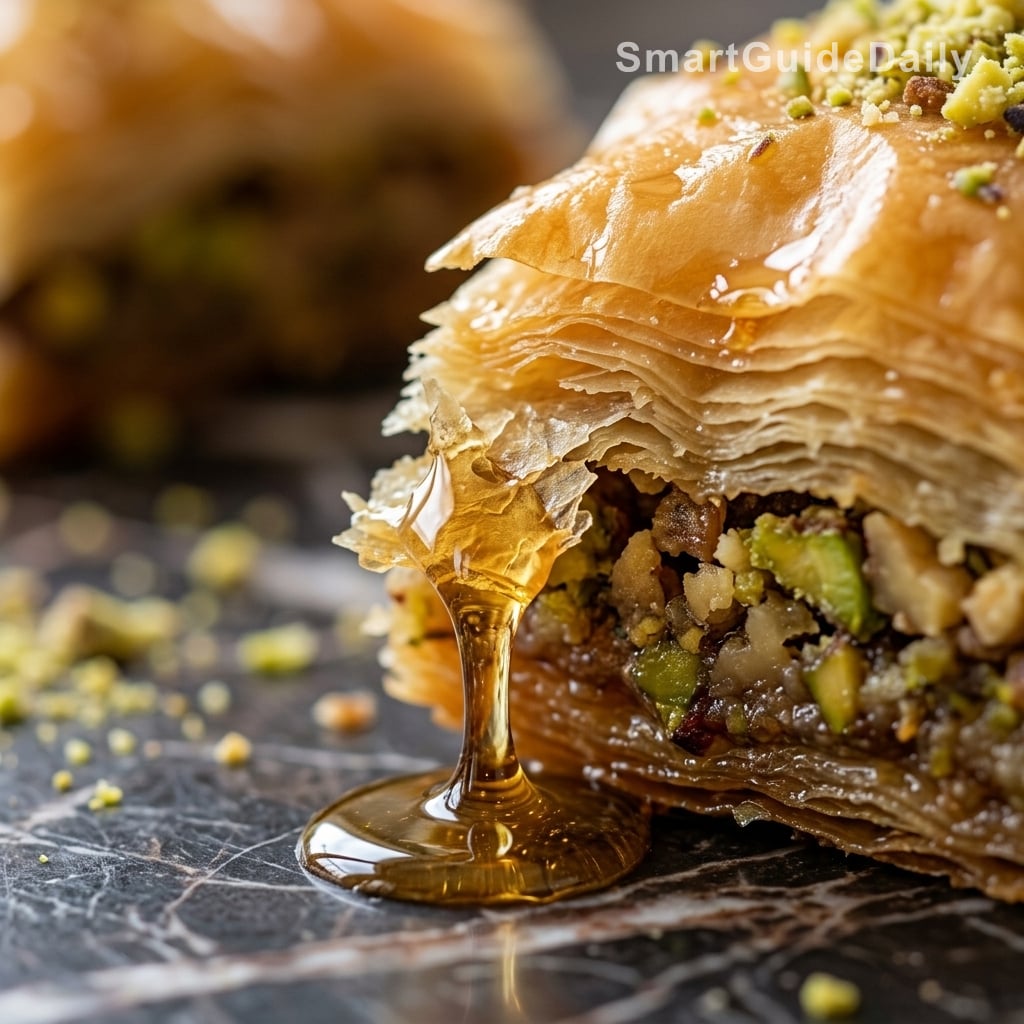
This is the rule that determines whether your tray shatters or turns soggy, and it’s worth understanding properly rather than just following. When cold syrup — made ahead and cooled to room temperature — hits a baking tray fresh from the oven, the rapid temperature exchange causes the syrup to thin slightly as it warms, allowing it to penetrate the pre-cut channels quickly and reach the interior layers before the pastry firms up and closes around them. If you pour hot syrup onto a hot tray, both sitting near 80°C, the syrup stays fluid too long and oversaturates the top three or four layers while the bottom receives almost nothing. If you pour hot syrup onto a cold tray, you risk partial crystallization and uneven distribution. Cold syrup on a hot tray. Make the syrup while the baklava bakes, set it aside to cool completely, and pour it the moment the tray comes out of the oven. You’ll hear a sharp, sizzling hiss as it hits the surface. That sound is exactly right.
Don’t Touch It for at Least Four Hours
The syrup migrates through the layers by capillary action, and that process takes time. Four hours is the minimum; overnight is better. The temptation to cut into the tray early is understandable — by the two-hour mark the kitchen still smells of honey and toasted cardamom, and the surface looks finished and set. It isn’t finished. The interior layers are still in the process of absorbing at the correct, gradual rate. Cutting too early breaks the capillary channels and you’ll find the middle of the tray significantly drier than the edges. Leave the tray uncovered at room temperature. A lid or plastic wrap traps condensation, and that surface moisture will undo the crispness of the top layer within an hour. If you started this on Saturday afternoon, it’s ready for Saturday evening. That’s the timeline. Work with it.
Tips & Tricks
- Don’t refrigerate baklava — cold air causes moisture to condense on the phyllo surface and the top layer turns soft within an hour. Room temperature, uncovered or lightly tented with a dry cloth.
- The nut-to-phyllo ratio matters more than most recipes acknowledge: aim for one heaped tablespoon of filling per two-sheet layer. Too much filling and the layers can’t compress during baking, leaving air pockets that collapse under the syrup weight.
- Lemon juice in the syrup is load-bearing, not optional — without it, the sugar solution crystallizes as it cools and you end up with a gritty, uneven distribution across the tray.
- If your kitchen runs particularly dry, keep a small bowl of water nearby and mist your work surface lightly — not the phyllo directly, just the air around it. Humidity is the enemy of dry phyllo, and dry phyllo is the enemy of clean layers.
Why does my baklava always turn out soggy?
The most common cause is syrup temperature. If you pour warm or hot syrup onto a hot tray — both near the same temperature — the syrup stays fluid long enough to oversaturate the top layers rather than distributing evenly through the pre-cut channels. Cool the syrup completely to room temperature before pouring, and pour it immediately the moment the tray leaves the oven.
Can I use regular butter instead of ghee?
Technically yes, but the result will be noticeably different. Regular butter contains 16–18% water, which converts to steam inside the oven and softens the phyllo layers before the browning process can set them. If you don’t have ghee, clarify your butter by melting it slowly, skimming the white foam, and straining the clear fat through a fine sieve — that removes most of the water and milk solids.
How far in advance can I make baklava?
Baklava made two days ahead is often more even than baklava made the same day — the syrup has more time to distribute through every layer. Store it uncovered at room temperature; a dry cloth tent is fine if you’re concerned about dust. Refrigeration is the one thing to avoid: it condenses moisture onto the phyllo surface and softens the top layer within an hour.
Can I use a single type of nut?
Yes. All walnuts produces a slightly more bitter, earthier result; all pistachios is more expensive but delivers a cleaner, more distinct flavor. Avoid pre-roasted or salted nuts — the salt concentration becomes too pronounced once the syrup is absorbed into the filling.
Why does scoring the tray before baking matter?
The pre-cut channels allow cold syrup to travel downward through the full depth of the pastry when it’s poured. If you score after baking, the set layers resist penetration and the syrup spreads across the surface rather than moving vertically. The temperature-differential technique only functions if those channels are open and ready before the syrup makes contact.
Can I freeze leftover baklava?
You can, though the texture shifts slightly upon thawing. Freeze individual pieces on a flat tray before transferring to a container, then thaw at room temperature — not in the microwave, which softens the layers unevenly. The flavor holds well for up to a month. Don’t refrigerate after thawing.
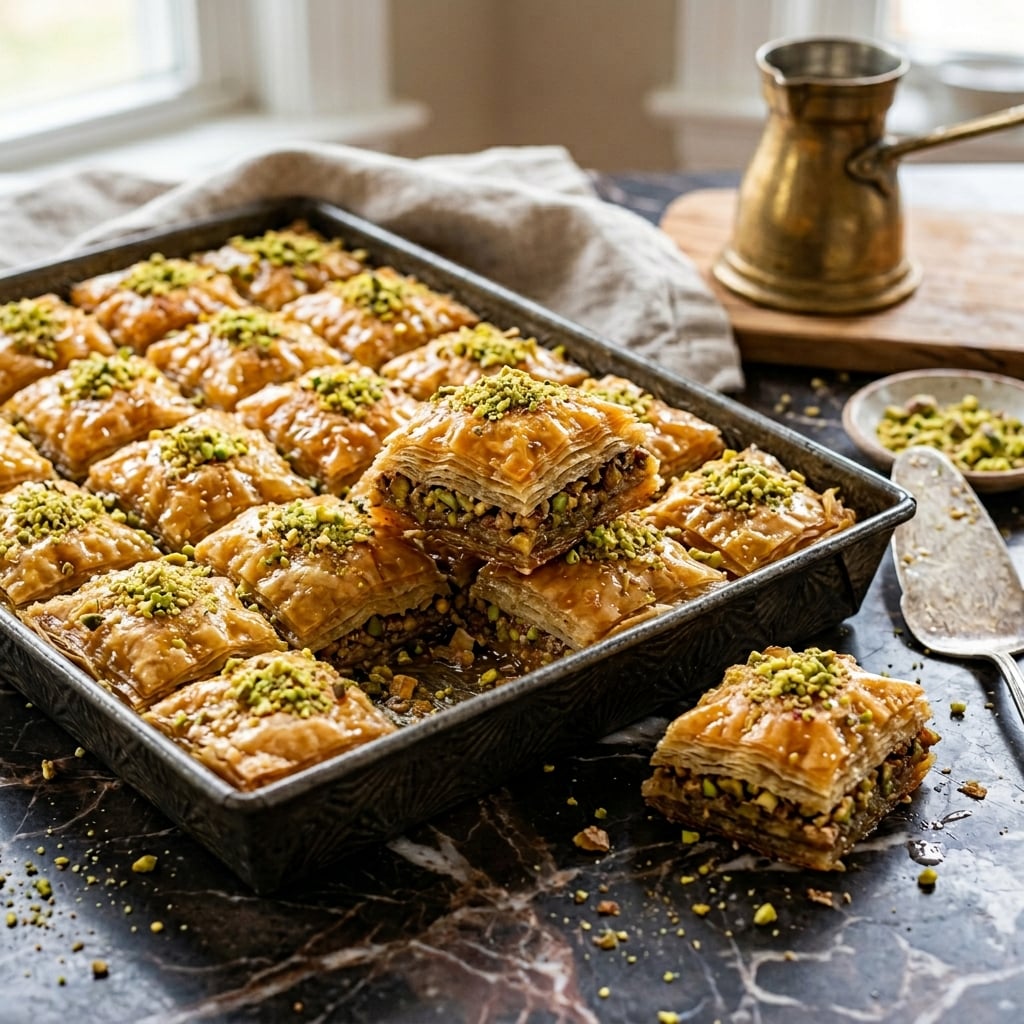
Baklava
Middle Eastern
Pastry
A 30-piece tray of layered phyllo, walnuts, pistachios, and clarified butter, finished with a cold sugar-and-honey syrup poured over a hot tray. The technique determines whether the result shatters or bends.
Ingredients
- 450g phyllo dough, thawed overnight in the fridge
- 225g clarified butter (ghee)
- 180g walnuts
- 120g unsalted pistachios
- 1 tsp ground cinnamon
- ½ tsp ground cardamom
- 200g granulated sugar
- 120ml water
- 3 tbsp honey
- 1 tbsp fresh lemon juice
Instructions
- 1Remove the phyllo from the fridge 30 minutes before starting and leave it sealed. Preheat the oven to 175°C (350°F). Brush a 9×13 baking pan thoroughly with ghee.
- 2Pulse walnuts and pistachios in a food processor to a coarse crumb, roughly 3–5mm pieces. Combine in a bowl with the cinnamon and cardamom.
- 3Open the phyllo and immediately cover the stack with a barely damp kitchen towel. Keep it covered between every sheet.
- 4Layer 10 sheets of phyllo in the prepared pan, brushing each sheet edge-to-edge with ghee before placing the next one.
- 5Spread half the nut mixture evenly over the phyllo base. Top with 5 more sheets, brushing each with ghee.
- 6Spread the remaining nut mixture in an even layer. Add the final 8 to 10 sheets, brushing each with ghee. Brush the top sheet generously.
- 7Using a sharp knife, score the tray into diamond shapes, pressing all the way through to the bottom of the pan.
- 8Bake for 30 to 35 minutes, until the surface is an even, deep amber.
- 9While the baklava bakes, bring sugar and water to a boil in a small saucepan, stirring until dissolved. Add the lemon juice, reduce to a simmer, and cook for 10 minutes. Remove from heat, stir in the honey, and set aside to cool completely to room temperature.
- 10The moment the tray comes out of the oven, pour the cooled syrup slowly and evenly over the hot surface, starting at the edges and working inward. Leave uncovered at room temperature for at least 4 hours before serving.
Notes
• The syrup must be at room temperature when it hits the hot tray. This temperature differential drives the syrup into the interior layers. Hot syrup on a hot tray oversaturates only the top layers.
• Ghee is strongly preferred over regular butter. The water content in regular butter steams the phyllo from within, preventing the layers from crisping properly.
• Do not refrigerate the finished tray. Cold air condenses moisture on the surface and softens the top layer within an hour. Room temperature, uncovered, is correct.
• The 4-hour resting time is structural, not approximate. The syrup migrates by capillary action, and cutting too early produces a drier center than edges.
Nutrition Facts (per serving, estimated)
| 220 kcalCalories | 3gProtein | 20gCarbs | 14gFat |