
A croissant cross-section is, at its best, a record. Of fifteen or twenty invisible decisions made twelve hours earlier — what butter was used, at what temperature, how often the dough was rolled, how long it rested, how the final fold was tucked. Each layer in that honeycomb is one of those decisions, made permanent.
This is what laminated dough is, structurally: a sequence of choices preserved as geometry. There are perhaps a dozen working versions of it in classical pastry — puff, croissant, Danish, kouign-amann, palmiers, mille-feuille, vol-au-vent — and they all rest on the same compact set of rules. The rules are not negotiable, but they are not many.
Most home bakers, when they fail, are failing one of three of them. Often the same one. Often without quite knowing which.
This is the field guide to those rules.
Laminated Doughs
What lamination actually is
Lamination, in pastry, is the process of building a dough out of alternating sheets of dough and butter through repeated rolling and folding. The dough is called the détrempe; the butter, the beurrage; the act of folding, tourage. Done correctly, the result is a single block of dough containing dozens — sometimes hundreds — of impossibly thin, parallel layers of butter, each separated by an equally thin sheet of dough.
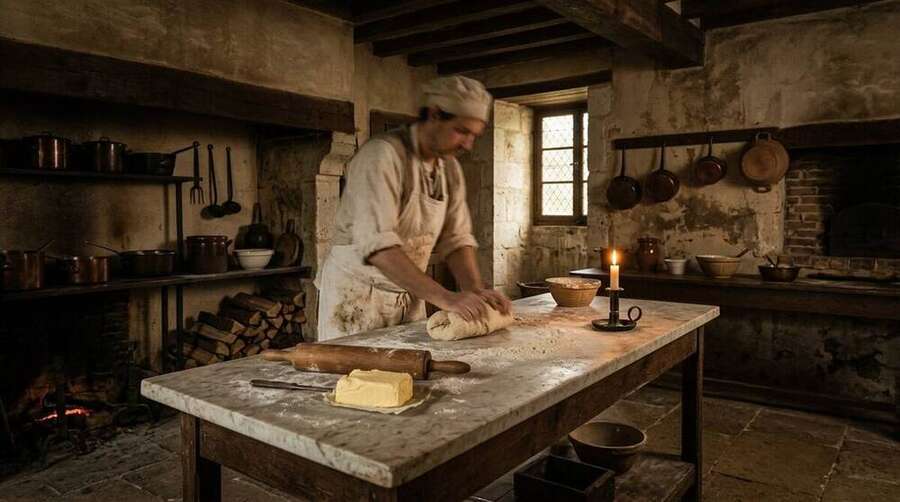
The dough rises in the oven because of three things working together, in sequence and in tension.
Water vaporises at 100 °C and expands roughly 1,600 times in volume. This is the primary lift — entirely steam-driven, in the case of true puff pastry.
As the butter melts, its fat fries the dough layers from within and releases the water it carried (about 17 % by weight) into the layers as further steam.
The gluten network in the dough holds the steam pressure long enough for the structure to bake. Then it sets, and the layers stay where they are.
The single most important thing to understand about lamination is that the layers stay separate only as long as the butter remains a continuous sheet. The moment a sheet of butter melts and is absorbed into the dough above and below it, the two dough layers fuse, and the structure is gone. This is why temperature control is, by a meaningful margin, the most important variable in laminated work — more important than flour, more important than ratio, more important than the brand of butter.
Lamination is one technique, applied four ways, with consequences out of all proportion to the simplicity of the rules.
The four classical doughs
The same architecture of folded butter and dough produces four canonically distinct pastries, depending on three variables: whether yeast is involved, whether sugar is laminated in, and how the underlying dough is enriched. The rest of the world’s laminated pastries — palmiers, sausage rolls, vol-au-vent, mille-feuille, danish wienerbrød variations — are children of these four.
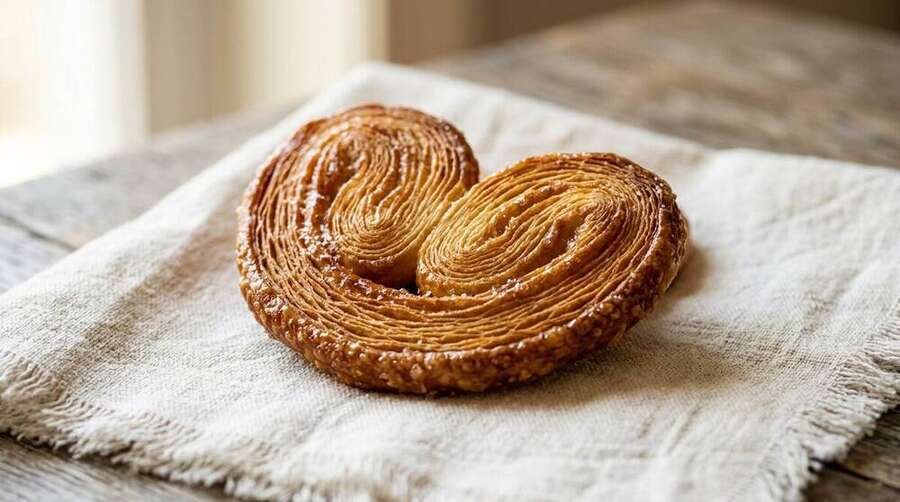
i. Puff pastry
The pure case. Flour, water, salt, and butter. No yeast, no sugar, no enrichment. The lift is entirely steam, and the goal of every other laminated dough is, in some way, to add complexity to this clean foundation without losing its lift.
3⁶ butter layers
- flour10.5 – 11.5 % protein
- butter≥ 30 % of finished raw weight · 82 % fat
- détrempe water40 – 45 % hydration
- rest, between turns30 min minimum · 1 hr ideal
- bake200 – 220 °C · structure sets fast, hard heat
Six single turns, each tripling the number of layers, give 729 — the canonical Julia Child number. The maths is simple: starting from a single butter layer enclosed in dough, each tri-fold (“letter fold”) triples the count. Three turns gives 27. Six gives 729. Going further is mostly counterproductive; below about a tenth of a millimetre the layers cannot remain structurally distinct, and they begin to merge through micropores in the butter film.
The technique itself is older than the canonical recipe. The earliest documented puff-pastry-like preparation appears in a 1607 Spanish cookbook by Domingo Hernández de Maceras; François Pierre La Varenne, in Le Cuisinier François (1651), was the first to record the modern tourage method in print. The pastry that emerged from this lineage was perfected, two centuries later, by Antonin Carême — the same Carême who codified the mother sauces, working at the same scale of grand-house labour. The Carême puff is essentially the puff we still make.
For the impatient, there is the demi-feuilletée — Julia Child’s rough puff, around 72 layers, faster and substantially less work, with predictably less drama in the final lift. It is a perfectly serious technique. It just is not the same thing.
ii. Croissant dough
Add yeast and milk to the détrempe; reduce the number of turns; and you have made croissant dough. The reduction in layer count is not a corner cut. It is necessary. Yeast produces carbon dioxide during proofing, and CO₂ bubbles will rupture layers thinner than about a tenth of a millimetre — which is what you would have if you tried to apply puff-pastry maths to a yeast-leavened dough. Twenty-seven layers is the working sweet spot; some recipes push to 81 with a fourth turn, but a fifth turn meaningfully degrades the final crumb.

plus yeast, plus milk
- yeast (fresh)7.5 % baker’s · ~2.5 % if dried
- sugar6 – 12 % baker’s
- salt1.8 – 2.2 % baker’s
- predough mix~19 °C · stop at homogeneous
- proof60 min at 31 °C · to 2.5×, not 3×
- bake165 – 205 °C · 10 – 20 min
Two details about croissant dough are worth absorbing. First, the predough is mixed only until homogeneous — meaningfully under-developed compared to a bread dough. Bread wants strong gluten; croissant wants a slack network that the lamination itself will tighten over the next several turns. Second, the yeast is kept low and the proof is kept short — sixty minutes at thirty-one degrees, no more. Going past 2.5× volume risks rupturing the layers from the inside, which is the most heartbreaking failure in this category, because it happens last and looks like success right up until the oven.
iii. Danish (wienerbrød)
The Danish is a croissant dough that has been substantially enriched: more egg, more milk, sometimes cardamom, often less sugar in the dough than in the filling. The lamination is identical to croissant — twenty-seven layers, three single turns — but the eating texture is denser, more cake-like, less shattering. It is also the only one of the four whose name is a piece of European labour history: Austrian bakers brought the technique to Copenhagen during a 1850 strike of the local Danish bakers, and the city’s bakers built on it. The Danes still call it wienerbrød — Viennese bread.
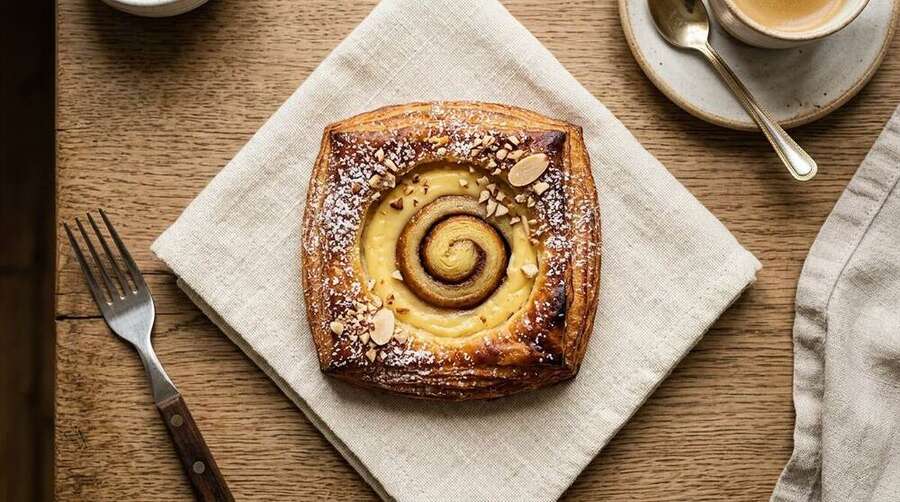
but enriched: egg, milk, butter
- eggssignificant; gives the rich crumb
- milkreplaces most of the water
- cardamomtraditional, optional
- fillingremonce, custard, jam, marzipan
- bake180 – 200 °C · slightly cooler than croissant
iv. Kouign-amann
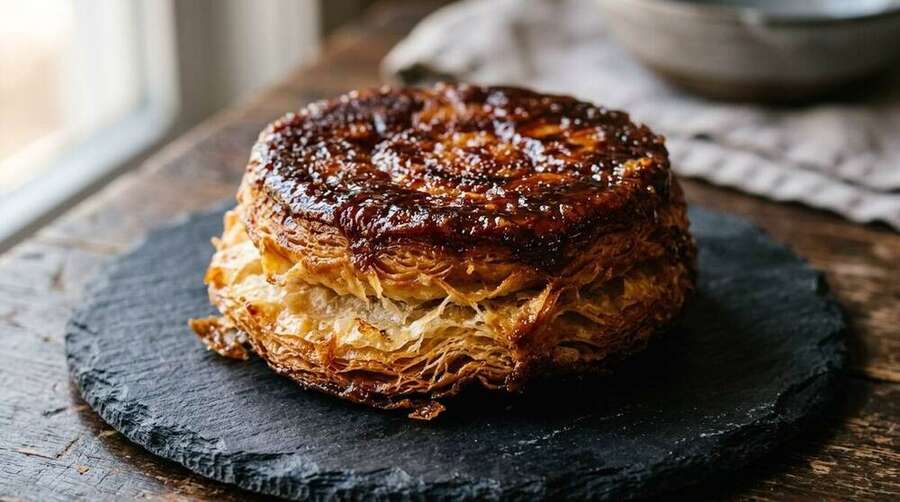
The outlier. A laminated yeast dough whose lamination incorporates not only butter but also large quantities of sugar, folded in between the layers. In the oven, the sugar caramelises while the steam expands the structure — producing a pastry whose interior is shatteringly layered and whose exterior is glazed with a hard mahogany caramel. Invented in Douarnenez, on the Finistère coast, around 1860, by a baker named Yves-René Scordia. The name is Breton: kouign for cake, amann for butter. Cake of butter. The New York Times, in 2011, described it as “the fattiest pastry in all of Europe.” It was not exaggerating.
by weight
- baseyeast-leavened bread dough
- turns3 single, with sugar between layers
- layers27 (sometimes 81)
- originDouarnenez, Brittany · ca. 1860
- bake~175 °C · slow, to caramelise without burning
The maths of layers
The geometry of lamination is one of those rare things in cooking that can be expressed in a single formula and trusted absolutely:
f — folds per turn (single = 2, book = 3)
n — number of turns
For the standard single turn (a tri-fold, like a letter), each turn triples the layer count. The progression is unforgiving in its simplicity:
The temptation to take the maths further is a real one, and a beginner’s mistake. Below roughly a tenth of a millimetre per layer, two failure modes appear together: the butter film becomes too thin to remain a continuous barrier, and the dough sheets begin to fuse through micropores in the butter. The pastry rises less, not more. The Wikipedia note on croissants puts it tightly: “a large number of relatively thin layers leads to interconnections between different dough layers, as well as less dough lift.” Twenty-seven is not a compromise. It is an optimum.
Temperature, the everything variable
If you are going to remember one thing from this article, remember this: butter at twelve to fifteen degrees Celsius. Both warmer and colder are wrong. The window is narrow, and almost every laminated-dough disaster begins with butter outside it.
The principle: butter must roll, not crack and not smear. Too cold, and it shatters into discrete chunks during the first pass of the rolling pin, leaving the layers uneven and the dough ruptured at the fault lines. Too warm, and it migrates into the dough, fusing the sheets above and below it. In either failure mode, what comes out of the oven is dense, greasy, and structurally indistinguishable from a thick scone.
The détrempe must also be cold — four to eight degrees, fresh from the refrigerator — and it must rest, properly, between every turn. At least thirty minutes; ideally an hour. Overnight, for serious work. The dough is not asking to be rolled again; it is asking to relax. If you push past that, the gluten will tighten and shrink under the pin, and the layers will no longer roll evenly. You will fight the dough; the dough will win.
The bench, properly set
Most of what makes serious lamination possible at home is, surprisingly, surface and pin. A few inexpensive tools handle the rest.
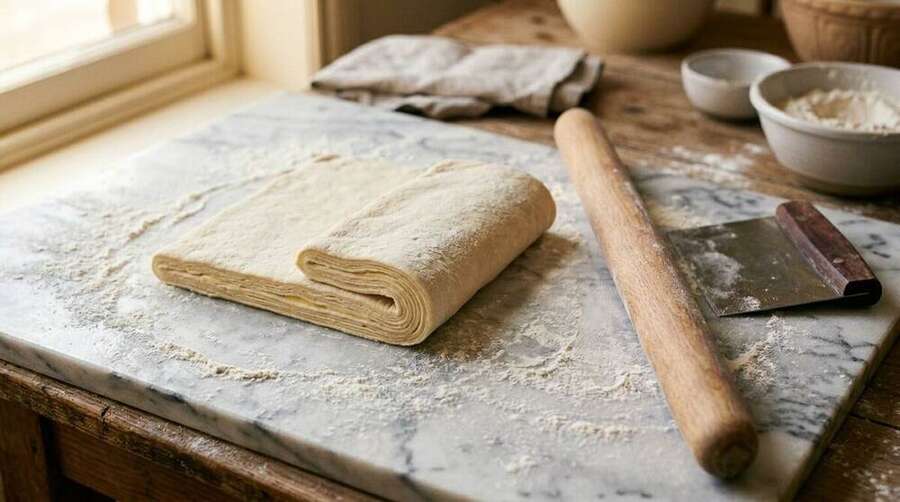
A marble slab
Marble holds cold better than wood, plastic, or stainless. A 30 × 40 cm slab from a stoneworker is twenty euros and lasts a lifetime. Chill it in the fridge between turns if your kitchen is warm. The cost is low; the benefit is enormous.
A long French rolling pin
Tapered, no handles. Professional pastry chefs prefer it because the absence of handles transfers the cook’s pressure directly to the dough. A straight pin works perfectly; a tapered French pin works better. Either way: long enough to span the dough’s full width.
A bench scraper
Metal, square edge. Used for cutting clean rectangles, lifting sheets of dough off the marble without tearing them, and clearing the surface between turns. Three euros. Indispensable.
A baking stone or steel
Pre-heated for thirty minutes before baking, on the bottom rack. Provides the bottom heat that domestic ovens generally do not, and prevents the soggy-bottom failure that ruins more puff pastry than any other single cause.
For puff pastry specifically, two further tricks are worth knowing. Docking — pricking the rolled-out dough with a fork, or with a spiked dough docker — prevents wild, uneven rise in places you do not want it. Vol-au-vent shells get docked in the centre but not at the rim. Steam in the early bake — a small pan of water on the bottom rack, or a fast spritz of water onto the oven walls just before closing — delays crust formation in the first few minutes, allowing the structure to expand maximally before the surface sets. Croissant benefits from this; very buttery puff sometimes does not.
Six rules for the lamination
- 01Use 82 % butter. European-style. The lower water content (~17 %) means less free water to weaken layers, and the higher fat content gives better plasticity at cold temperatures. This is not a snobbery; it is a structural requirement.
- 02Match the temperatures. Butter and dough must be the same temperature when they meet. Different stiffnesses will rupture the layer geometry at the first pass.
- 03Rest between every turn. Thirty minutes is the floor; an hour is the standard; overnight is a real tool. The dough is not idling — it is relaxing the gluten you just tightened, and the butter is re-chilling to working stiffness.
- 04Roll evenly. Uneven thickness in the dough or the butter means uneven layers, which means uneven lift. Use a yardstick or a metal ruler. A long French pin helps; a straight pin works.
- 05Stop when the maths says stop. Twenty-seven layers for croissant, seven hundred and twenty-nine for puff. Pushing past — to “make sure” — produces fewer good layers, not more.
- 06High oven, fast set. 200 to 220 °C for puff. The structure must set before the butter has fully absorbed into the dough. A timid oven gives a heavy, greasy pastry; a screaming hot one gives the lift you spent two days earning.
When it doesn’t work
The failures are predictable, and almost all of them are temperature failures wearing different masks.
Butter breaks through
Cause — Butter too cold and brittle, or unevenly thick. It cracks and ruptures through the dough during rolling.
Fix — Bring butter to 13–15 °C before starting; pound it evenly between two sheets of parchment to a uniform 1 cm slab.
Layers merged, dense crumb
Cause — Butter too warm (above 17 °C); insufficient chilling between turns; too many turns producing layers below 0.1 mm.
Fix — Hold butter at 12–15 °C; chill an hour between every turn; respect the layer count.
No lift in the oven
Cause — Oven not hot enough to set the structure before the butter absorbs; or, for croissant, dough over-proofed past 2.5×, or the yeast was old.
Fix — Pre-heat to 200 °C minimum; check yeast freshness; pull from proof at 2.5×, never 3×.
Dough shrinking back
Cause — Insufficient resting between turns; gluten too elastic from over-mixed predough or the wrong flour.
Fix — Rest 30–60 minutes between every turn; use 10.5–11.5 % protein flour; under-mix the predough.
Soggy bottom
Cause — Baking surface too cool; insufficient bottom heat; too much moisture in any filling.
Fix — Pre-heat the baking sheet or stone; use bottom heat or convection from below; dock the dough with a fork or roller for a flat bake.
Collapse on cooling
Cause — Over-proofed before baking; the layer structure is destroyed by excess CO₂ before it ever reaches the oven.
Fix — Proof to 2.5× volume, no further. At 31 °C this is roughly 60 minutes; cooler proofs run longer. Do not exceed 32 °C — the butter starts to melt.
What it gives you
It gives you, eventually, an obedient dough. After enough turns, enough rests, enough days of mistakes, the dough begins to behave. It rolls evenly. It chills predictably. It rises in the oven the way it is supposed to rise, with the lift in the right place and the layers visible from across the room.
It also gives you something rarer than that. Because lamination is a technique with a small set of strict rules, every laminated dough you have ever eaten in a serious bakery — every croissant, every mille-feuille, every kouign-amann, every palmier sold at the corner of a Parisian bakery for a euro fifty — was made by someone working through the same six rules. The same butter, the same fold count, the same rest, the same temperature. Once you have done the work yourself, you are no longer a customer; you are a colleague.
That is a different kind of fluency than most cooking gives you. The technique is patient, narrow, and old, and it asks for time more than it asks for talent. The first batch will probably not be the one you wanted. The third or fourth, with the marble cold and the butter at fourteen degrees and the dough resting overnight, almost certainly will be.
Worth the two days it takes to earn it.
— Morgan H., with Iris L.

