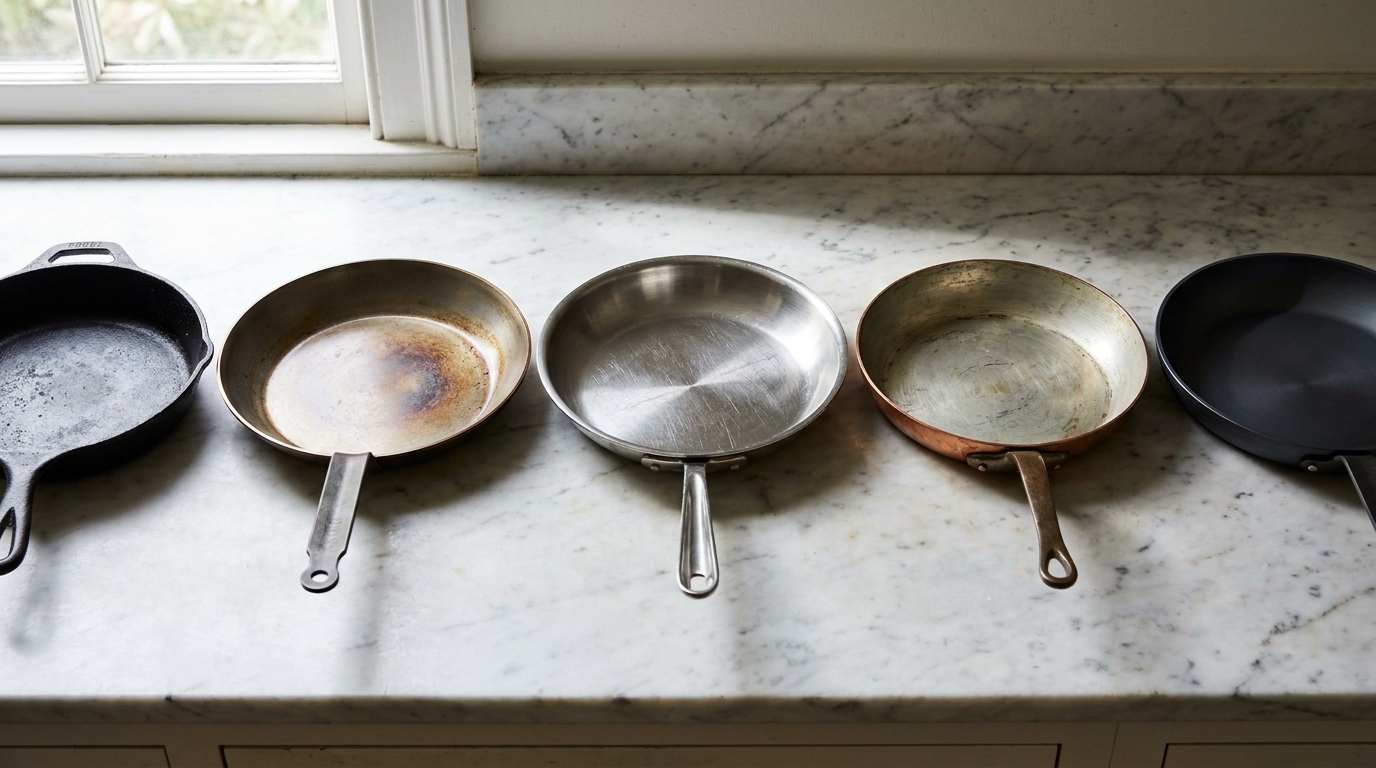
Stand at a working stove for a service and watch which pan a cook reaches for. Steak goes in the heavy black skillet that has been sitting on a low flame for ten minutes. The fish goes in the thin grey one, cold off the rack, lit two minutes ago. The pan sauce gets finished in the shiny one. Nobody is thinking about metallurgy. But every one of those choices is a metallurgical decision, made on instinct, that a buying guide would have gotten wrong.
Search for cookware advice and you will be handed the same sentence in fifty different fonts: this pan heats evenly. It is the single most repeated claim in the category, and it is close to meaningless. “Evenly” is not a property of a metal. It is a vague feeling about three or four properties that pull in different directions, and the pans that win on one of them lose badly on the others.
This is the part the guides skip, usually because the guide is published by a company that sells pans. There is no universal pan, and the absence of one is not a problem to be solved by spending more money. It is physics. Once you can name the four numbers that actually decide how a pan behaves, the whole shelf reorganises itself — not into good and bad, but into a set of tools, each built for a job the others do poorly.
This is the field guide to those numbers, and to the five metals that sit at the extremes of them.
The Metallurgy of Heat
Why “heats evenly” is a sales pitch, not a spec
When a metal sits over a flame, four separate things are happening, and each one has a number attached to it. Most cookware writing collapses all four into the word “even.” Keep them apart and the behaviour of every pan you have ever used suddenly makes sense.
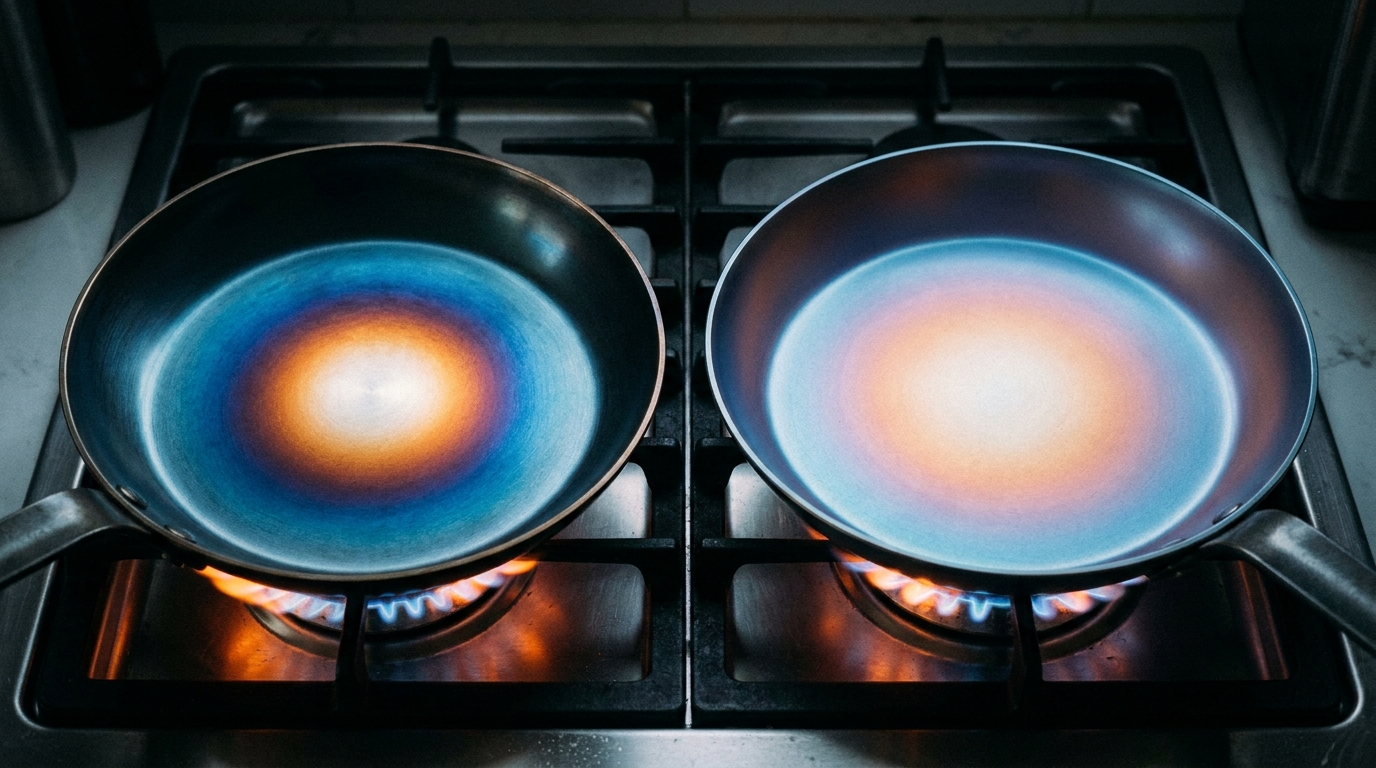
The first is thermal conductivity — how fast heat travels through the metal, sideways, from the hot spot over the burner toward the cool edges. Copper conducts at around 400 watts per metre-kelvin. Aluminium runs 205–237. Cast iron and carbon steel sit down around 45–55. Stainless steel is roughly 15 — the worst conductor in the kitchen by a wide margin. A pan made of pure stainless has a burning-hot centre and cold rims because the metal physically cannot move the heat outward fast enough.
The second is specific heat capacity — how much energy the metal stores per kilogram for each degree you raise it. This matters less on its own than in combination with the third number and with sheer mass. A heavy pan holds a large reservoir of heat; a thin one holds almost none.
The third is the one nobody quotes, and it is the one that explains the most: thermal diffusivity. It is conductivity divided by the product of density and heat capacity, and it measures how quickly a temperature change spreads through the material. Copper’s diffusivity is about 111 mm²/s. Stainless steel’s is about 3.8. Copper redistributes a change in heat roughly thirty times faster than stainless. This single number is what people are actually feeling when they call a pan “responsive.”
The fourth is emissivity — how much infrared heat the surface radiates toward the food, as opposed to only conducting it on contact. A polished copper or stainless surface radiates almost nothing (emissivity near 0.05–0.1). A well-seasoned cast iron or carbon steel surface radiates a great deal (0.8 and up). A blackened, seasoned pan is cooking your steak partly with radiant heat, like a tiny grill — which is why its crust comes out more uniform than the contact-only crust from bright stainless.
| Metal | Conductivity W/m·K |
Diffusivity mm²/s |
Emissivity (seasoned/oxidised) |
12″ pan mass |
|---|---|---|---|---|
| Copper | ~400 | ~111 | 0.05 polished | ~1.8 kg |
| Aluminium | 205–237 | ~97 | 0.04–0.27 | light |
| Carbon steel | 43–55 | ~13–15 | ~0.82 seasoned | ~2.2 kg |
| Cast iron | 50–55 | ~12–15 | 0.77–0.96 | ~3.6 kg |
| Stainless 304 | ~15 | ~3.8 | 0.075 polished | ~2.1 kg |
Values are typical ranges at room temperature and shift with exact alloy and surface state. They are meant to be read against each other, not as fixed constants.
One category sits outside this whole conversation, and it is worth setting aside cleanly: non-stick. PTFE coatings conduct at roughly 0.25 W/m·K — they are, in physical terms, excellent insulators, which is exactly why a non-stick pan needs a thick aluminium body underneath to function at all. The coating is a separate set of trade-offs with its own rules. Everything below is about bare metal: copper, aluminium, carbon steel, cast iron, and stainless. The five honest ones.
There is no universal pan, and the absence of one is not a problem. It is physics.
Cast iron — the flywheel
Cast iron is, by the conductivity number, a mediocre conductor: 50–55 W/m·K, roughly a thirtieth of copper. Heat crawls sideways through it. Put a 30-centimetre skillet over a burner narrower than its base and you will get a hot ring in the middle and cooler edges, and no amount of waiting fully fixes it, because the metal cannot move heat outward fast enough. On the spec sheet, this looks like a flaw.
It is not a flaw, because conductivity is the wrong number for what cast iron is for. The right number is mass. A 30-centimetre cast iron skillet weighs around 3.6 kilograms, and the metal is 3.5 to 6 millimetres thick. That mass is a thermal flywheel. It takes a long time to spin up — five minutes or more of preheating to reach a true searing temperature — but once it is loaded with energy, it does not give it back easily.
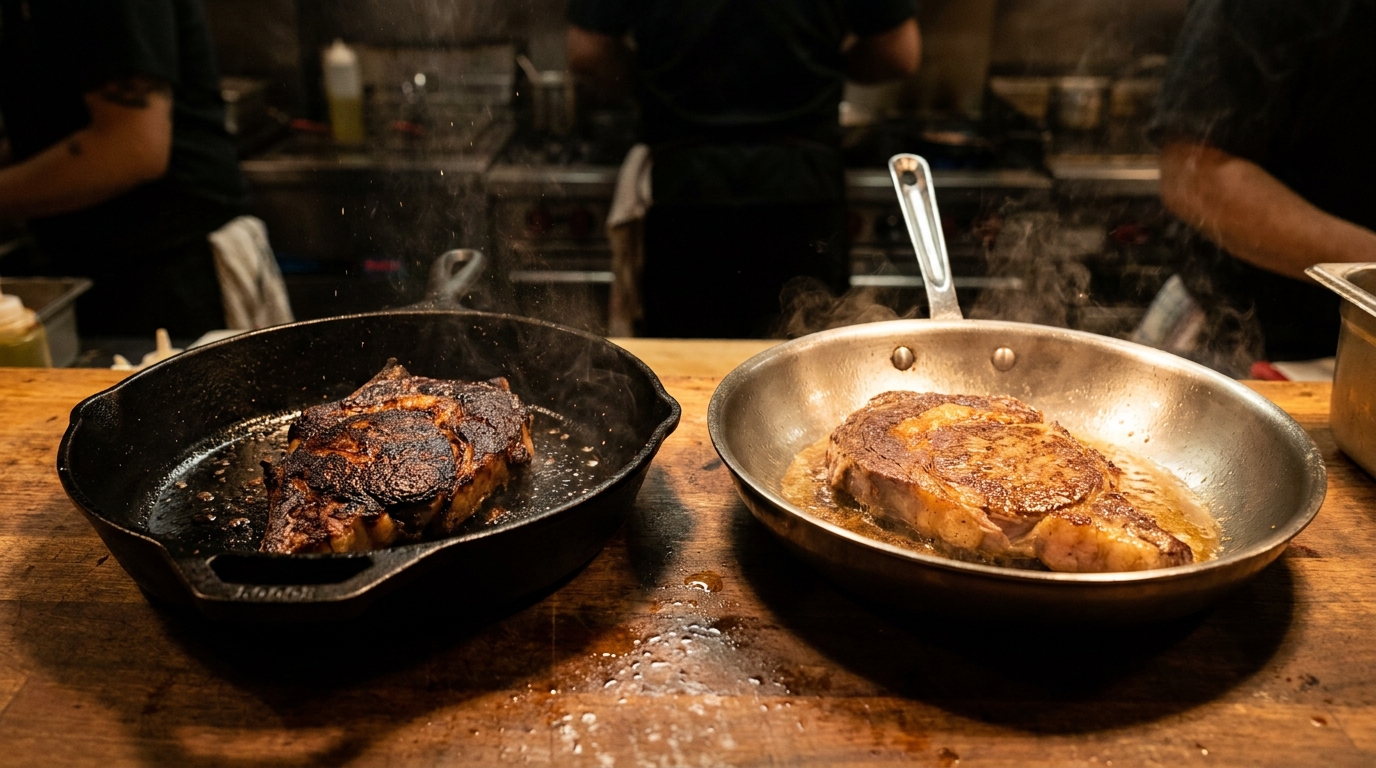
This is what you want under a thick steak. When a cold piece of meat hits a light pan, the surface temperature of that pan can crash by 80–100 °C, and the sear stalls while the pan struggles back up. Drop the same steak onto preheated cast iron and the surface falls maybe 30–50 °C, because the flywheel has energy to spare. The crust never stops forming. The same logic is why cast iron is the right tool for a long oven braise or any low, patient cook — it holds a set temperature against disturbance. (We lean on exactly this stability in braised short ribs and across low-temperature cooking.)
There is a second, quieter advantage hiding in the emissivity column. A seasoned cast iron surface radiates infrared at 0.77–0.96 — roughly ten times a polished metal. A meaningful share of the cooking is happening by radiation, not just contact, which is part of why cast iron crust looks the way it does. The seasoning that does this is not magic; it is polymerised fat, unsaturated oils heated past their smoke point until they cross-link into a hard, bonded layer on the iron. It is chemistry you build on purpose, one thin coat at a time.
The metallurgy explains the brittleness too. Cast iron carries 2–4% carbon, far more than steel, and that carbon precipitates as flakes of graphite through the metal. The graphite is self-lubricating and damps vibration, but it makes the iron brittle, which is why the walls have to be thick — and why the pan is heavy in the first place. The properties are a package; you do not get the flywheel without the weight.
One caution that belongs to the chemistry: bare cast iron is reactive. A long simmer of something acidic — a tomato sauce left to cook down for an hour in unseasoned or thinly seasoned iron — will strip seasoning and can pick up a faint metallic note. Short contact is fine. Long, acidic, low cooks belong in a different pan, which is the cue for the next two metals.
Cast iron is not a conductor. It is a heat battery — slow to charge, but you can throw a frozen steak at it and it won’t flinch.
Carbon steel — the responsive one
Carbon steel is, chemically, cast iron’s leaner sibling: the same iron-and-carbon family, but with far less carbon and no graphite flakes, which makes it tough rather than brittle. Its conductivity is almost identical — 43–55 W/m·K. On paper, the two metals look like the same pan. In the hand they could not be more different, and the reason is geometry, not chemistry.
Because carbon steel is not brittle, it can be made thin: 1.2 to 2 millimetres against cast iron’s 3.5 to 6. A 25-centimetre carbon steel pan weighs around 1.6 kilograms instead of 2.3, and that thin wall changes everything about its timing. It reaches searing heat in roughly ninety seconds rather than five minutes, and — the part professionals actually care about — it recovers three to four times faster after food goes in. The flywheel is small, so it spins up and down quickly.
That responsiveness is the entire case for carbon steel. In a brasserie turning two hundred covers a service, cast iron is unusable: too heavy on the wrist to flip and toss, too slow to recover between portions. Carbon steel is the compromise that French professional kitchens settled on more than a century ago — the durability of iron without the dead weight, and a recovery time fast enough to fire one portion after another without waiting for the pan to climb back. It is the default pan for an omelette, for fish, for anything delicate that you steer by adjusting the heat second to second. It also runs the cold-start method for crispy skin, where the gentle climb and quick response are the whole technique.
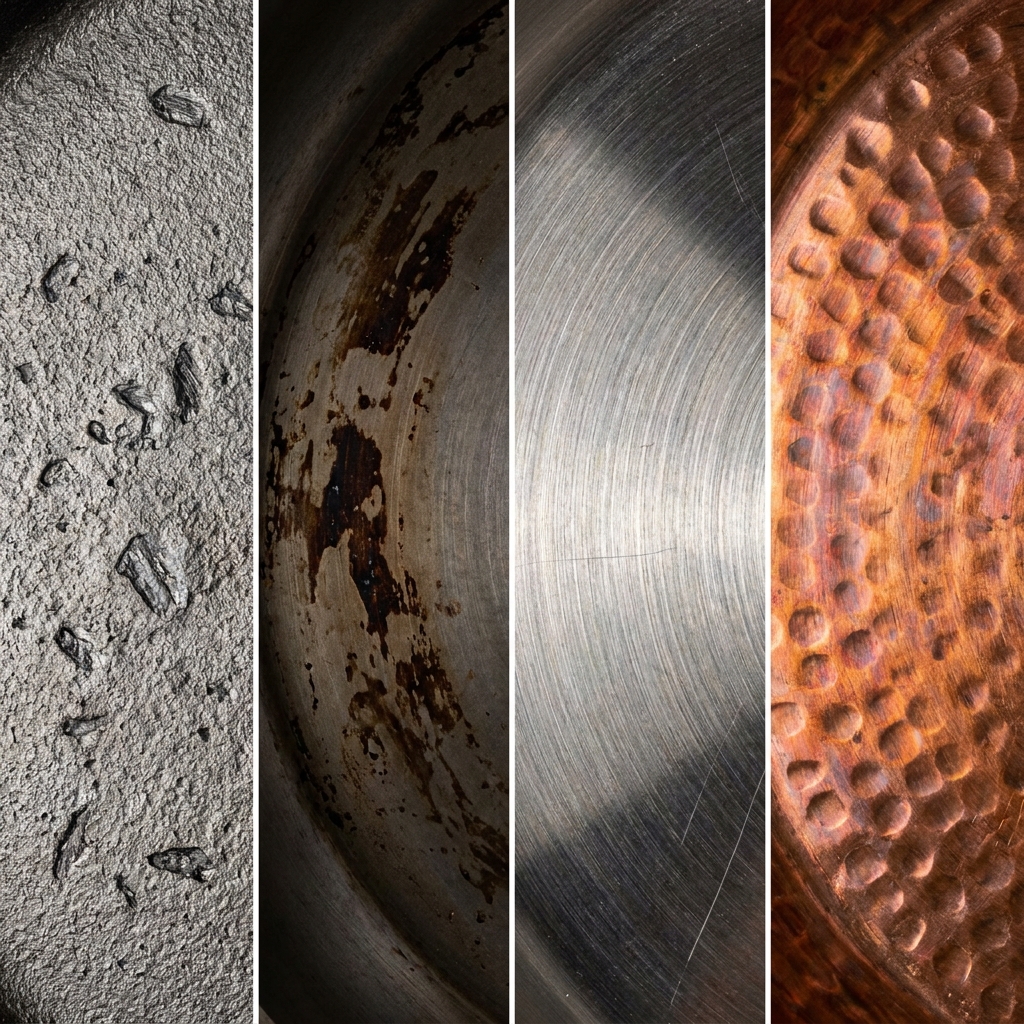
Carbon steel seasons exactly like cast iron — the same polymerised-oil layer — but it takes the seasoning a little differently. Its surface is smoother and tighter-grained, with fewer of the microscopic pores that give porous cast iron its grip, so the early coats can feel less willing. They build. Given a few rounds, a carbon steel pan becomes as slick as anything in the kitchen, and its emissivity climbs from around 0.34 bare to 0.82 or more once seasoned — the same radiant bonus cast iron gets.
The history is written into the objects. De Buyer has been forging steel pans in the Vosges since 1830, in a region that happened to have both iron ore and the forests to make charcoal; its “Mineral B” line — the B is for the factory beeswax-and-oil protection you burn off before the first seasoning — is still a professional reference. A French line cook’s pan is a piece of industrial heritage that has barely changed shape in two hundred years, for the simple reason that the physics never changed.
Stainless & clad — the engineered compromise
Pure stainless steel is the worst cooking conductor on the shelf, at about 15 W/m·K. A pan made of stainless alone is close to unusable for anything that needs control — the centre over the burner scorches while the rim stays cool, with a gradient you cannot cook around. And yet stainless is everywhere, for one reason that has nothing to do with heat: it is hard, durable, and chemically non-reactive. It will not corrode, will not pick up metallic flavours, and shrugs off acid.
So the industry engineered around the weakness. A good stainless pan is not stainless; it is a sandwich. Tri-ply and multi-clad pans bond a core of aluminium (205–237 W/m·K) or even copper (400) between two skins of stainless. The conductive core spreads the heat sideways the way stainless never could; the stainless skins give you the durable, non-reactive cooking surface. The thicker that base — the best run 2.5 to 5 millimetres — the larger the heat reservoir and the more stable the pan when you deglaze or add a cold ingredient. This is the only pan on the list whose virtues are entirely a feat of construction rather than a single metal.
Stainless is also the pan everyone accuses of “sticking,” and the reason is worth getting right, because it is not a defect and the fix is not a different pan. Two things make food stick to stainless. The first is chemistry: at around 150 °C, proteins form genuine covalent bonds with the iron and chromium atoms at the steel’s surface. The second is geometry: the surface, smooth as it looks, has microscopic crevices that food grips mechanically. The professional fix exploits both. Heat the dry pan until a drop of water hits the Leidenfrost point and rolls; then add oil. The hot, thinned oil floods the crevices and a cushion of vapour briefly lifts the food off the metal, so the protein never gets the contact it needs to bond. Stick happens at the wrong temperature, not in the wrong pan.
What stainless gives back, the seasoned pans cannot: a truly non-reactive surface. Cook a long tomato sauce, a white-wine reduction, anything bright and acidic, and stainless will not touch the flavour. Its near-zero emissivity (0.075 polished) means it cooks only by conduction — the crust forms exactly where metal meets food and nowhere else — but for sauce work that precision is the point. It is the pan you reach for to build and finish, which is why it lives next to the work in the mother sauces. A thick clad base also lets you deglaze with cold liquid without the thermal shock that would warp a thin pan.
Stainless doesn’t stick because it’s bad. It sticks because proteins bond to chromium at 150 °C. The fix isn’t a better pan. The fix is temperature.
Copper — the sprinter
Copper is the extreme case, the metal that makes the whole framework legible. Its conductivity is about 400 W/m·K — only silver beats it — and its diffusivity, around 111 mm²/s, is the highest of any cooking metal. A 2-millimetre copper pan holds a more uniform surface temperature than a 5-millimetre stainless one. There are no hot spots, because heat cannot stay concentrated anywhere; it floods the whole base almost instantly.
And it responds. Copper’s specific heat is low (about 385 J/kg·K) and the walls are thin, so it stores very little energy — turn the flame down and the pan follows within seconds. This is a sprinter: it sprints up to temperature, sprints back down, and never coasts. It is the opposite of cast iron in every measurable way, which is precisely why it is the right tool for the opposite kind of cooking.
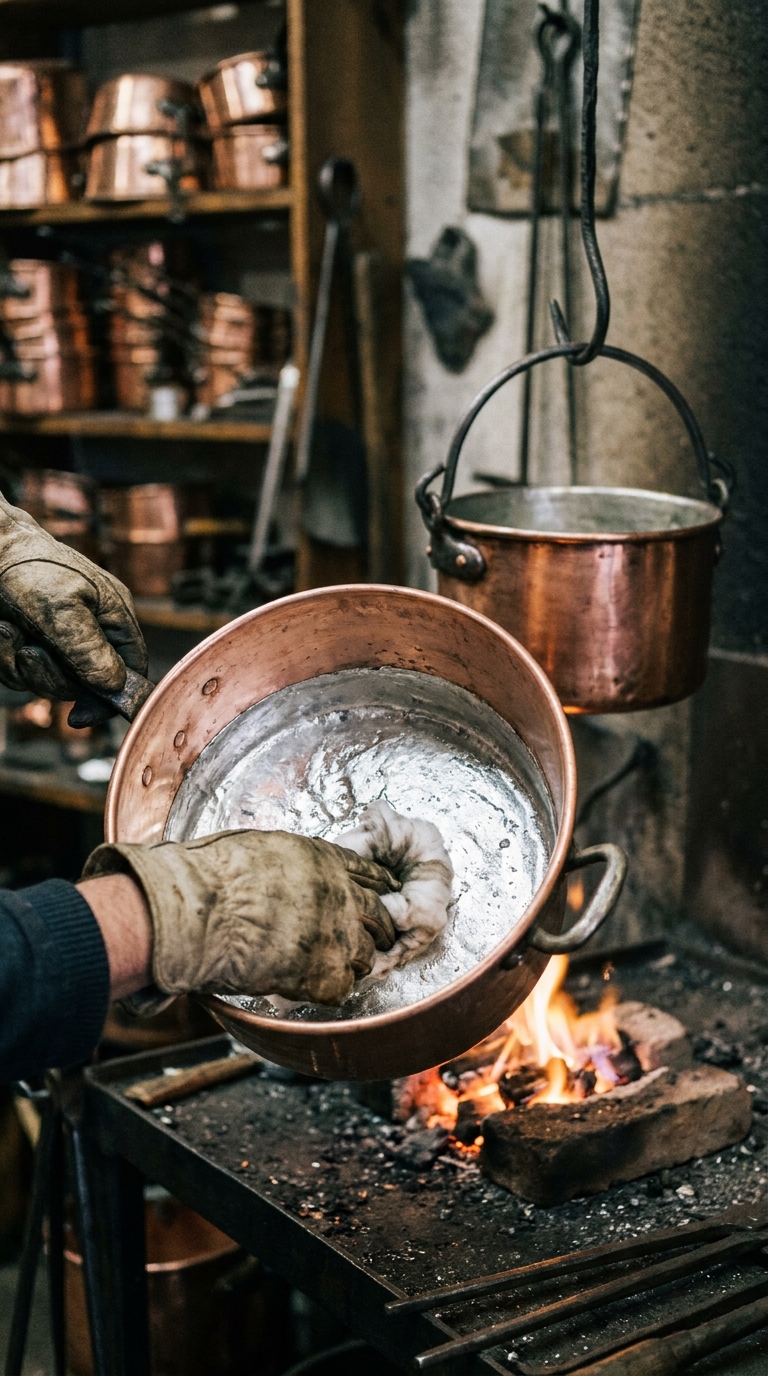
This is why the classic confiture pan and the caramel pot are copper. Pectin sets within a narrow window around 105 °C, and sugar scorches the instant any part of the pan runs hotter than the rest. Copper’s furious diffusivity erases hot spots, so the sugar comes up to temperature as one mass and gels or caramelises without a single burnt patch. Its near-zero emissivity helps here too: with almost no radiant heat coming off the metal, delicate things — a crème anglaise, a sabayon — cook gently from contact alone, with no scorching radiation cooking the edges ahead of the centre.
Copper has one real cost, and it is the reason the workshops in the photo still exist. Bare copper is reactive: cooked against acidic food it leaches copper ions, enough that the World Health Organization’s tolerable daily intake can be exceeded by a single acidic dish in an unlined pot. So traditional copper is lined — historically with tin, which is non-reactive, melts at 232 °C, and lasts five to ten years before it must be re-applied. Re-tinning is a craft, not a chore; it is one of the quiet reasons copper stayed a professional and not a domestic metal.
Four questions before you buy another pan
Put the five metals back on the counter and the shelf is no longer a ranking. It is a set of answers to different questions. You do not need the best pan. You need the pan whose physics matches the thing in your hand. Four questions sort almost everything:
Cast iron or thick carbon steel. You want the flywheel — mass that doesn’t flinch when cold food lands.
Thin carbon steel, or copper if you have it. Low mass, fast recovery — the pan obeys the flame.
Tin-lined copper, or a well-built aluminium clad. Diffusivity erases the burnt patch.
Tri-ply stainless. The surface stays out of the flavour; the clad base stays stable.
Notice what the four answers add up to. No single pan appears in all four boxes — not even close. The honest kit is not one expensive do-everything pan; it is two or three honest ones that, between them, cover the quadrants: a heavy iron or carbon-steel skillet for heat, a thin carbon-steel pan for speed, and a clad stainless pan for acids and sauces. Add tin-lined copper only if you cook a lot of sugar. That is the whole battery, and it costs less than the single “best” pan the guides keep trying to sell you.
The marketing wants you to believe that more money buys a pan that does everything well. The physics says otherwise, and it has been saying so since Escoffier specified copper by the millimetre. The metals have not changed. The four numbers have not changed. The only thing the guides add is the fiction of a universal pan — and once you can read the numbers, you can see straight through it.
The best pan is the one whose physics matches your technique. Everything else is marketing.
Stanford Advanced Materials, Thermal Diffusivity Tables. Matmake, Thermal Conductivity of Common Materials. Engineering ToolBox, specific-heat and density tables. FLIR / Transmetra, Emissivity Tables. All Cookware Reviews, Emissivity for Kitchen Surfaces (2025).
J. Kenji López-Alt, The Food Lab (searing and moisture). Harold McGee, On Food and Cooking. Science of Cooking / Royal Society of Chemistry, why food sticks to stainless. Sheryl Canter, The Chemistry of Cast Iron Seasoning (2010).
De Buyer, Mineral B (Val-d’Ajol, Vosges, est. 1830). Mauviel, Villedieu-les-Poêles (est. 1830). Wikipedia, Cast-iron cookware (Griswold, Wagner, Lodge). Prudent Reviews, cast-iron skillet weights.
World Health Organization, tolerable daily intake for copper. America’s Test Kitchen, acid reactivity in bare cast iron.
— Iris L., with Morgan H.