Tempering is the most common instruction in chocolate work, and the least explained. Melt it, cool it, warm it back up, the recipe says, with the confidence of someone reading a spell off a card. Hit these three numbers. Do not ask why. Most people who follow the steps have no idea what the steps are for — and that is exactly why it goes wrong so often.
Here is what the ritual is actually about. The fat in chocolate — cocoa butter — can solidify into six different crystal structures from the very same molecules. Six. They are not minor variations; they have different melting points, different textures, different lifespans. Five of them are, for a chocolatier, wrong. Only one gives you the clean snap, the mirror gloss, the way a good bar releases from a mould and melts the instant it touches your tongue.
So tempering is not really melting and cooling. It is crystal selection. Everything in the procedure — the precise temperatures, the patience, the stirring — exists to coax the cocoa butter into one specific crystal form and shut the other five out. Once you see it that way, the mystery dissolves. The three magic numbers stop being arbitrary and become what they always were: the temperatures at which the wrong crystals melt and the right one survives.
This is the field guide to those six crystals, and to the narrow window where the only good one lives.
The Six Faces of Cocoa Butter
What tempering actually fixes
Take a bar of chocolate that was simply melted and left to set on its own, and compare it to a properly tempered one. The differences are not cosmetic; each one is a direct readout of the crystal underneath. Untempered chocolate is dull, because its surface is a disorganised jumble of crystal sizes that scatters light instead of reflecting it. It is soft and crumbly, because the loose crystal lattice has no structural rigidity. It refuses to release cleanly from a mould, because it never contracted. And within a few days it grows a pale grey film, because the unstable crystals it formed are already migrating toward something else.
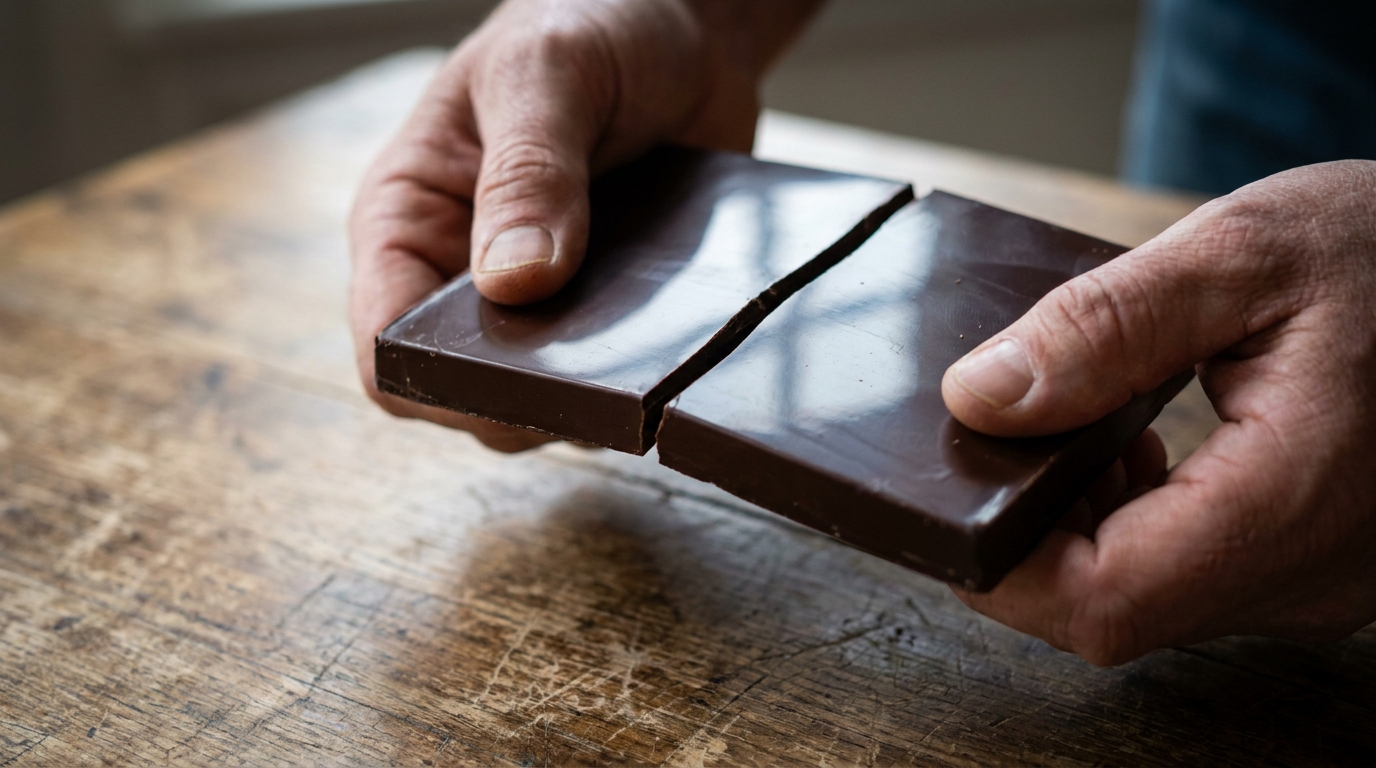
Tempered chocolate is the opposite on every count, and for one reason: its fat has set almost entirely into a single, tightly-packed crystal form. That uniform surface reflects light evenly, which is the gloss. The dense lattice resists fracture until it gives all at once, which is the snap. The crystal contracts by roughly two percent as it solidifies, pulling the chocolate away from the mould walls so it drops out clean. And it melts sharply at around 34 °C — just below body temperature — which is why a good square turns liquid the moment it sits on your tongue and not a degree before.
That last property is the one you feel without naming it. A correctly tempered chocolate holds its shape in a warm hand and then releases all at once in the mouth, a clean cool-to-melt transition that reads as quality even to someone who has never heard the word “temper.” A badly set chocolate either stays slightly greasy and waxy, never quite melting, or softens too early and turns claggy. The eating experience that distinguishes good chocolate from indifferent chocolate is, to a surprising degree, just the melting curve of one crystal — and the whole of tempering exists to lock that curve in.
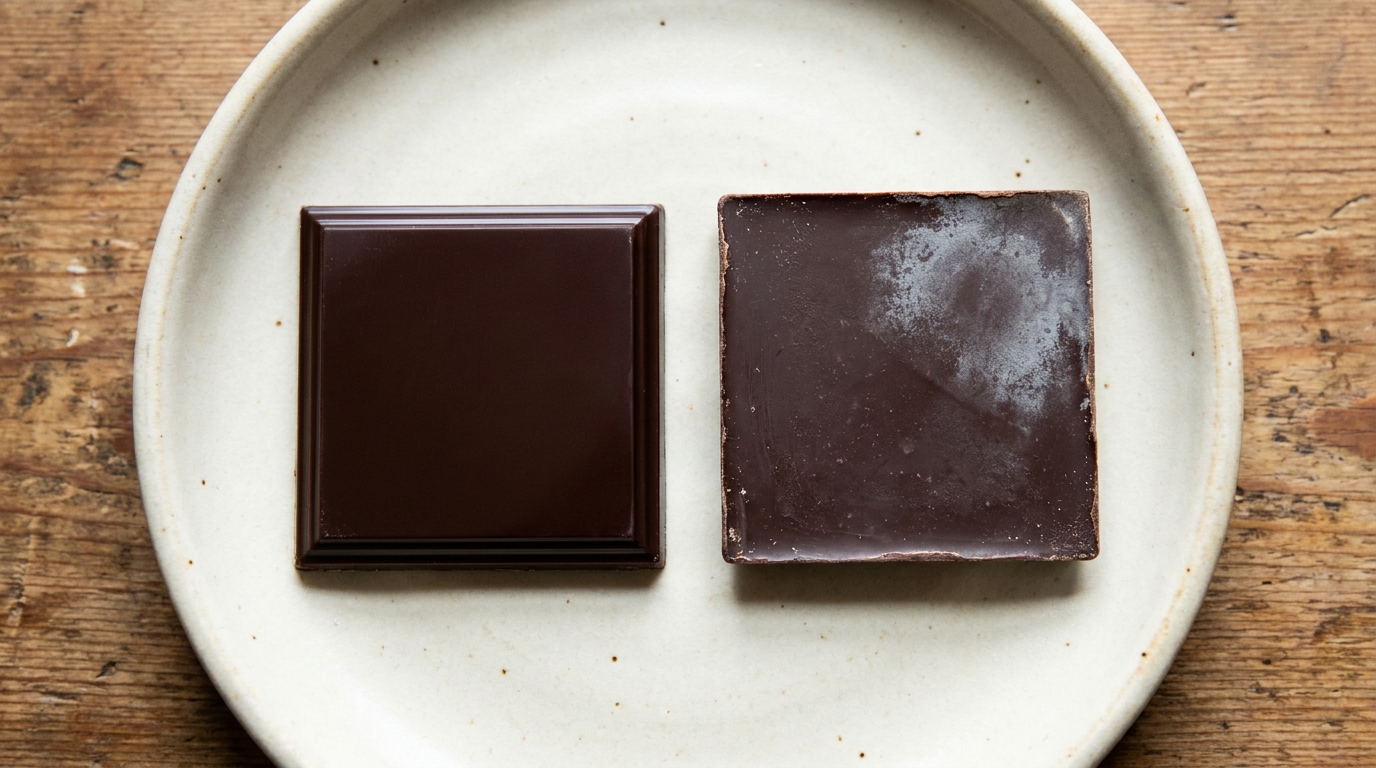
Every one of those qualities is a property of the crystal, not of the cacao. A cheap couverture, tempered well, will snap and shine. A magnificent single-origin, tempered badly, will be a dull, bending disappointment. The bean matters for flavour. The crystal decides everything else.
Six ways to pack the same molecules
Cocoa butter is unusually fussy fat. Most fats crystallise more or less one way; cocoa butter is polymorphic, meaning its triglycerides — dominated by three closely related molecules the literature labels POP, POS and SOS — can stack into six distinct lattices. They were catalogued by Wille and Lutton in 1966, numbered I through VI, and the modern science has only refined their picture. Each form has its own melting point, and that range spans nearly twenty degrees.
| Form | Melts at | What it gives you |
|---|---|---|
| I | ~17 °C | Soft, crumbly, no snap |
| II | ~21 °C | Soft, crumbly, no snap |
| III | ~26 °C | Firm but dull, no snap |
| IV | ~28 °C | Firm, faint gloss — melts too easily, blooms fast |
| V | ~34 °C | Snap, gloss, clean release, melts at body temperature — the target |
| VI | ~36 °C | Waxy, the cause of bloom — forms slowly over time |
Rounded values after Wille & Lutton (1966); exact figures shift by a degree or so with measurement method and cocoa-butter origin.
Read down the last column and the whole craft comes into focus. Forms I through IV are too soft, too dull, or too low-melting to be any use — a Form IV bar looks almost right and then betrays you within a week. Form V is the one you want: it melts at body temperature, packs densely enough to snap and shine, and contracts enough to release. Form VI is the troublemaker at the far end — more stable even than V, but waxy, slow to form, and the eventual destination of every neglected bar.
The reason cocoa butter behaves this way — sharply, with one perfect form rather than a vague slush across a wide range — comes down to its molecules. Three triglycerides dominate it, abbreviated POP, POS and SOS, and they are unusually symmetrical and similar in size. Symmetrical, similar molecules stack like a tidy stack of identical plates: when they find their best arrangement, they all melt at almost exactly the same temperature, which gives Form V its remarkably narrow, body-temperature melt. Most kitchen fats are a jumble of mismatched triglycerides and so soften gradually over a broad range; cocoa butter, alone among the common fats, can be marshalled into a single near-perfect crystal. That is the gift, and the difficulty, in the same fact — the same precision that makes a great snap possible is what makes it so easy to miss.
That last point is the quiet tragedy built into chocolate. Form V is not the most stable arrangement; Form VI is. Left alone, cocoa butter wants to end up as Form VI. Tempering is the act of parking it, deliberately, in the second-best, metastable form — the only one that tastes and looks right — and then racing to set and store it before it drifts toward the stable form that doesn’t. You are not fighting chaos. You are fighting thermodynamics, and thermodynamics is patient.
Tempering is not a ritual. It is an applied thermodynamics problem with six possible outcomes and one correct answer.
How tempering selects Form V — the three-temperature curve
Now the three magic numbers make sense, because each one does a specific job on a specific crystal. Tempering dark chocolate is a curve in three moves.
Above 36 °C every crystal form melts. Going to ~50 °C wipes the slate completely clean — no seed of any form survives.
Below Form V’s melting point, crystals nucleate — both the Form V you want and some unstable Form IV you don’t.
Warm back to just under Form V’s melting point. Forms I–IV (all below 30 °C) melt away; Form V survives. You now hold a pure Form V seed.
That third step is the elegant one. By reheating to 31–32 °C you are running a temperature that is fatal to Forms I through IV and survivable for Form V. The wrong crystals die; the right one is left seeding the whole mass. Hold the chocolate in that window and pour it, and the Form V seeds template the rest of the fat into Form V as it sets. The curve is not a recipe someone guessed at — it is the only path that ends with one crystal and not six. It is the same logic of butter temperature and a narrow margin that governs laminated doughs: control the fat’s crystal behaviour through temperature, or lose the structure.
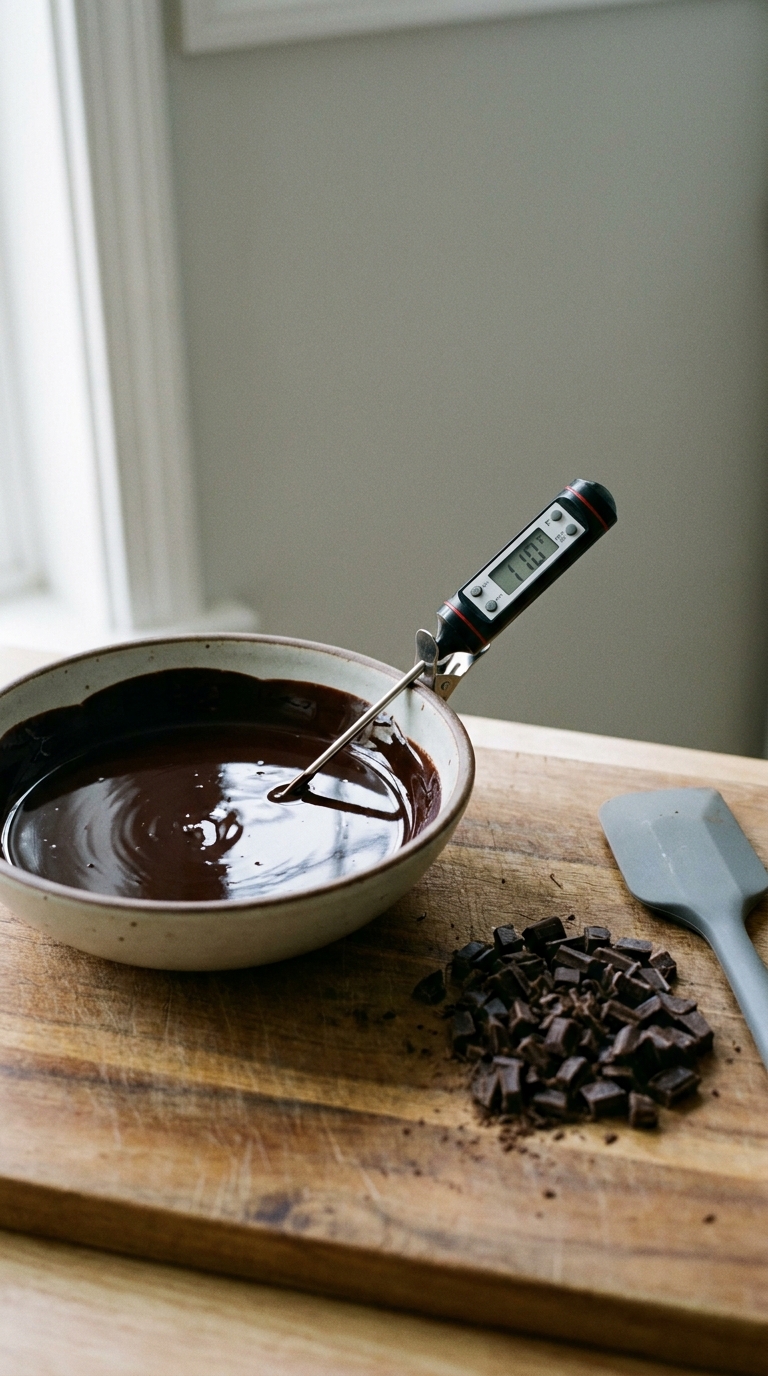
One thing the curve does not tell you is that the chocolate fights back. Crystallising cocoa butter releases its own heat — roughly 157 joules for every gram that sets — so a large batch warms itself as it works, which is part of why tempering in a hot kitchen is so much harder. The room is not neutral. It is a third hand on the thermometer, and not always a helpful one.
Why bloom happens — and why it isn’t mould
That pale grey film on old chocolate frightens people into the bin. It shouldn’t. Bloom is not mould, not spoilage, not a sign the chocolate has gone off. It is the crystal structure telling on itself, and there are two kinds.
Fat bloom is the common one, and it is simply Form V growing up into Form VI. Remember that Form V is metastable: over weeks and months, its crystals slowly convert to the more stable Form VI, which grows in larger crystals that push out toward the surface and scatter light as a grey, waxy haze. Warm storage and temperature swings above about 25 °C accelerate it — every time some Form V partially melts and re-sets, the system edges closer to Form VI. A poor initial temper, with too few Form V seeds to begin with, blooms faster still. The tell: the haze is soft, wipes away under a finger, and then returns, because the crystal underneath is still Form VI.
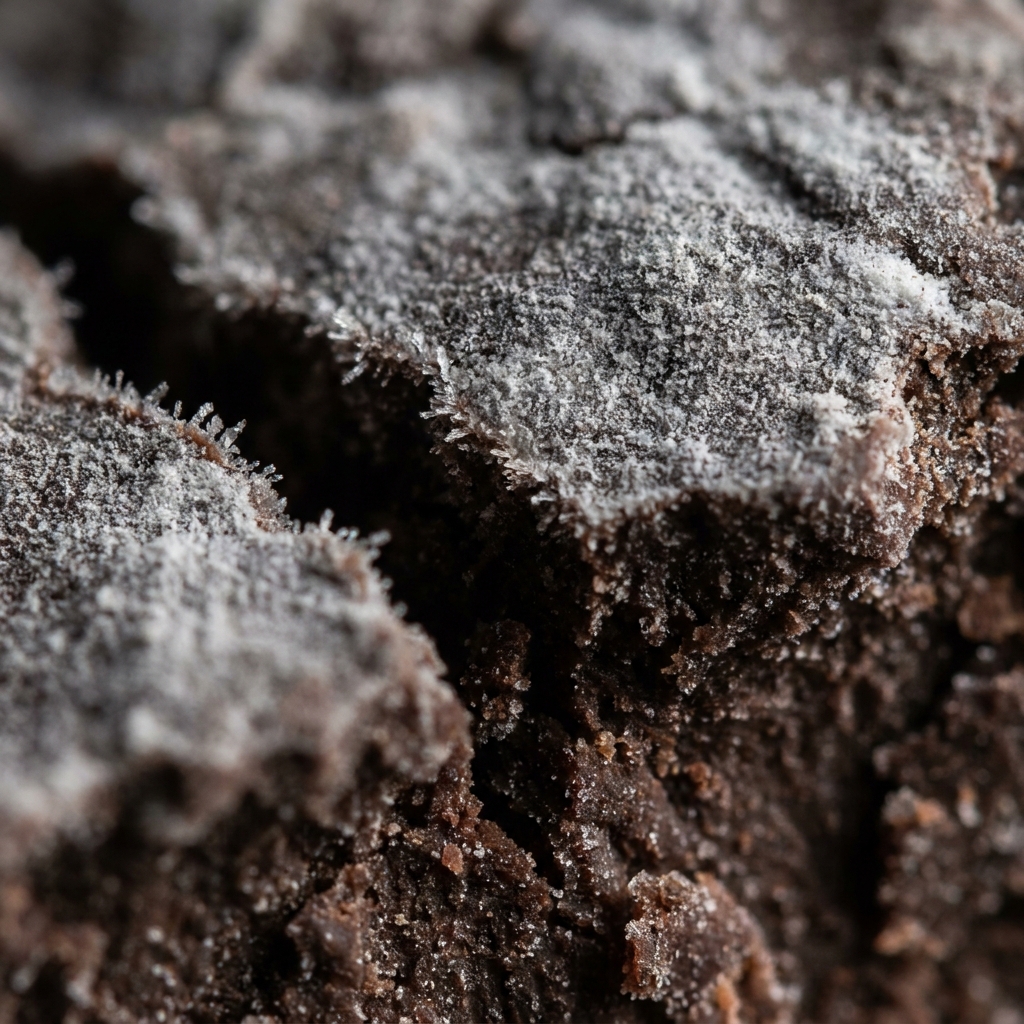
Sugar bloom is the rarer one and a different story entirely. It happens when moisture lands on the surface — condensation from pulling chocolate straight out of the fridge into a warm room, or storage in damp air — dissolves the surface sugar, then evaporates and leaves the sugar recrystallised as a coarse, gritty white film. The quick way to tell them apart: fat bloom is soft, waxy, and wipes away; sugar bloom is dry, sandy, and does not respond to gentle warming. Neither is dangerous. Both are quality faults, and fat bloom, at least, you can erase — re-melt, re-temper, and the chocolate is back in Form V, none the wiser about its age.
Why milk and white chocolate are harder
Anyone who has tempered both will tell you the same thing: dark behaves, milk is fussier, white is a menace. This is not a personal failing or bad luck. It is milk fat, and it changes the physics.
Cocoa butter crystallises so cleanly because it is built from a narrow, well-matched set of triglycerides that stack neatly. Milk fat is the opposite — a sprawling mixture of many different fatty acids that cannot fit into the cocoa butter lattice. It sits among the cocoa-butter crystals like grit in a gearbox, disrupting the packing and lowering the effective melting range of the whole system. The practical consequences stack up fast. The working window narrows: dark gives you roughly two degrees of margin, milk about one, white about one. The chocolate needs to be cooled further before it will nucleate, because the messy fat mixture resists organising. And white chocolate carries milk solids that scorch above about 45 °C, so it cannot even be melted as hot as dark.
| Type | Melt out | Cool to | Work at |
|---|---|---|---|
| Dark | 48–50 °C | 27–28 °C | 31–32 °C |
| Milk | 45 °C | 26–27 °C | 29–30 °C |
| White | 40–45 °C | 25–26 °C | 28–29 °C |
Typical working ranges; exact values shift with brand and formulation. Note the whole curve sliding down — and the working window shrinking — as milk fat rises.
So “I can temper dark but not white” is not a confession. It is a description of the chemistry. Moving from dark to milk to white shifts the entire temperature curve down by several degrees and roughly halves your margin for error. Knowing that in advance is half the battle — you stop blaming yourself and start cooling further and watching the probe harder.
Milk chocolate doesn’t temper “differently.” It tempers lower, with less margin — because milk fat is a polite intruder in the lattice, and the system knows it.
The methods, and why they all chase the same crystal
There are three common ways to temper, and from the outside they look unrelated. They are not. Each is just a different way of getting Form V seeds into liquid chocolate and then holding the mass in the working window so those seeds survive and multiply.
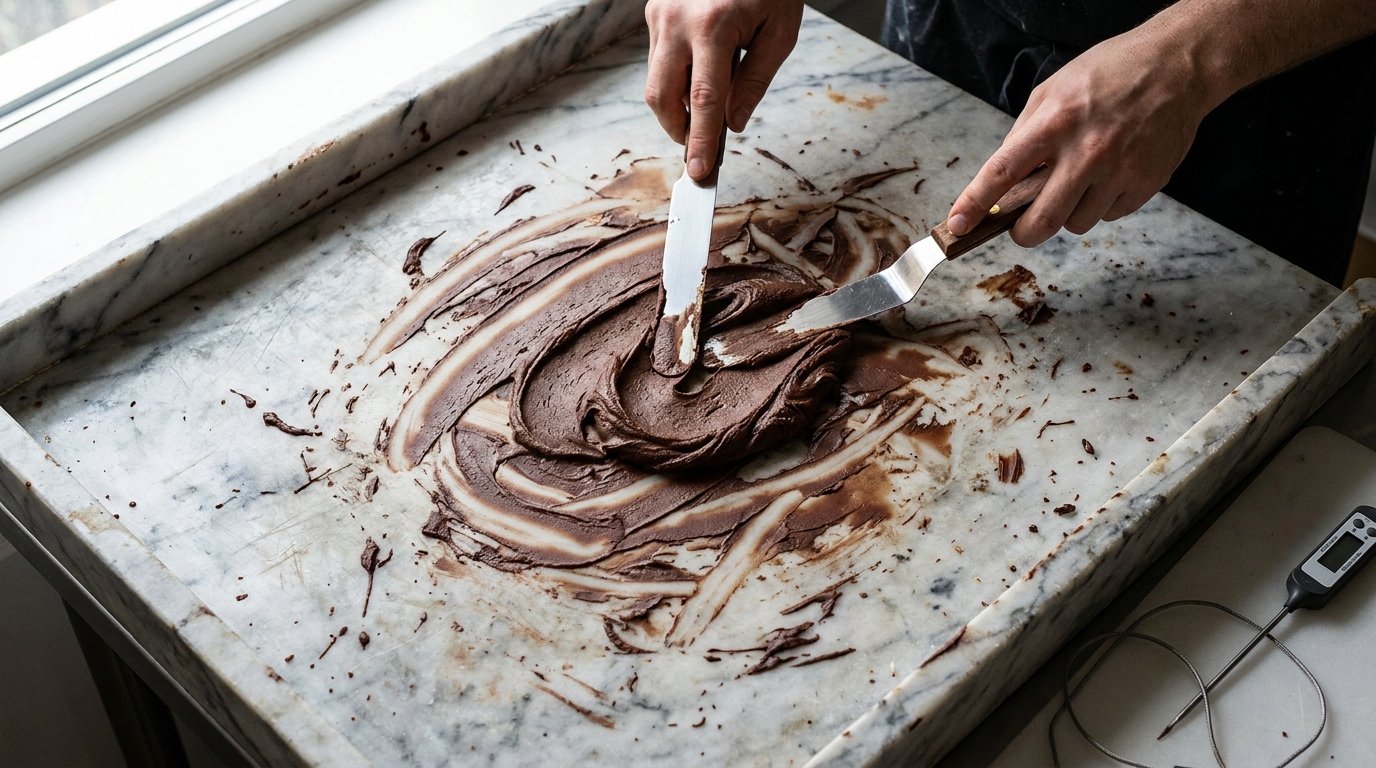
Seeding imports the crystals: stir a quantity of already-tempered solid chocolate into the melted batch, and the existing Form V crystals it carries seed the whole mass. It is the most forgiving method and needs nothing but a thermometer. Tabling grows them: pour most of the melted chocolate onto a cool marble slab and work it with a spatula until friction and contact nucleate Form V, then stir that back into the warm remainder. Machine tempering cultivates them continuously: chocolate is recirculated over cooling elements under constant shear, which both nucleates the right crystals and melts out the wrong ones, holding the whole batch in temper for hours.
Different tools, identical physics. The marble slab, the block of seed chocolate, the machine — they are three ways of persuading the molecules to choose the same path. This is the part worth internalising, and the same truth runs through the science of laminated pastry: the technique serves the material, never the other way round. A pastry chef who understands the six faces of cocoa butter can temper with any of the three. One who only memorised the steps can fail with the best machine in the building.
Patience is just precision, slowed down
The quiet gift of understanding the crystal is that failure stops being mysterious. Every way tempering goes wrong is legible once you know what you are looking at.
Cooled too fast, or never reheated into the Form V window. Restart from the melt.
Under-seeded, or stored somewhere that cycles above 25 °C. The structure drifted to Form VI.
A poor initial temper, or simply old chocolate. Re-melt and re-temper to reset it.
Working temperature drifted past 32 °C and killed the Form V. Restart from the melt.
Cocoa butter can pack itself six ways, and five of them are wrong. The gap between the fourth form and the fifth — between the one that looks almost right and the one that is — is about five and a half degrees Celsius. That interval is the entire art of chocolate, written as a temperature. It is not a large number. It is everything.
Which is also why tempering resists shortcuts. Every time the temperature drifts, the molecules get more options; every time you rush, they take the easy path to a form that blooms in a week; every time you wait, they fall into the one that snaps and shines and keeps for months. The methods are just different ways of asking nicely. The window is narrow, the patience is the price — and the same steadiness that holds chocolate at 31.5 °C without reaching for your phone is the one that waits on a craquelin to colour without opening the oven. It is the same muscle.
Tempering chocolate is what it looks like when you respect a material that has more options than you do — and have the patience to let it choose the right one.
Wille & Lutton, polymorphism of cocoa butter (1966) — the six-form nomenclature. Loisel et al. (1998); E. O. Afoakwa, Chocolate Science and Technology. MIT Laboratory for Chocolate Science.
S. T. Beckett, The Science of Chocolate (industrial parameters). King Arthur Baking, tempering temperatures and methods. Callebaut Academy, on sugar bloom.
Codex / Valrhona on cocoa-butter and milk-solids minimums. Industry data on cocoa-butter content by chocolate type.
Practitioner protocols (Dandelion Chocolate craft method; seeding vs. tabling comparisons). Reported latent heat of crystallisation ≈ 157 J/g.
— Théo M., with Iris L.