This is a Sunday cake. Not because it is ceremonial, but because it needs time — a slow bake, a long chill — and Sunday is the only day most people can actually give it that. The New York cheesecake is structurally simple and demanding in execution. The debate over the water bath is not a matter of taste. It is a matter of understanding what heat does to protein.
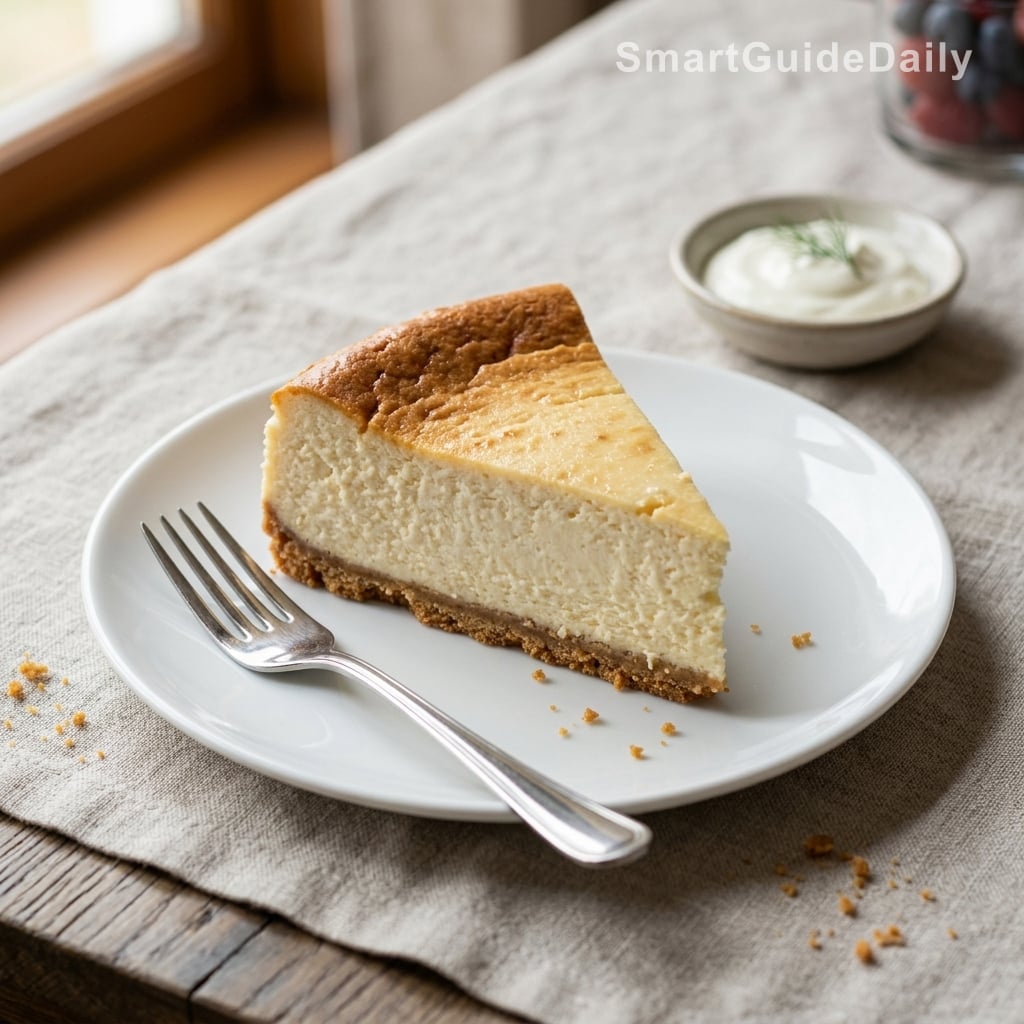
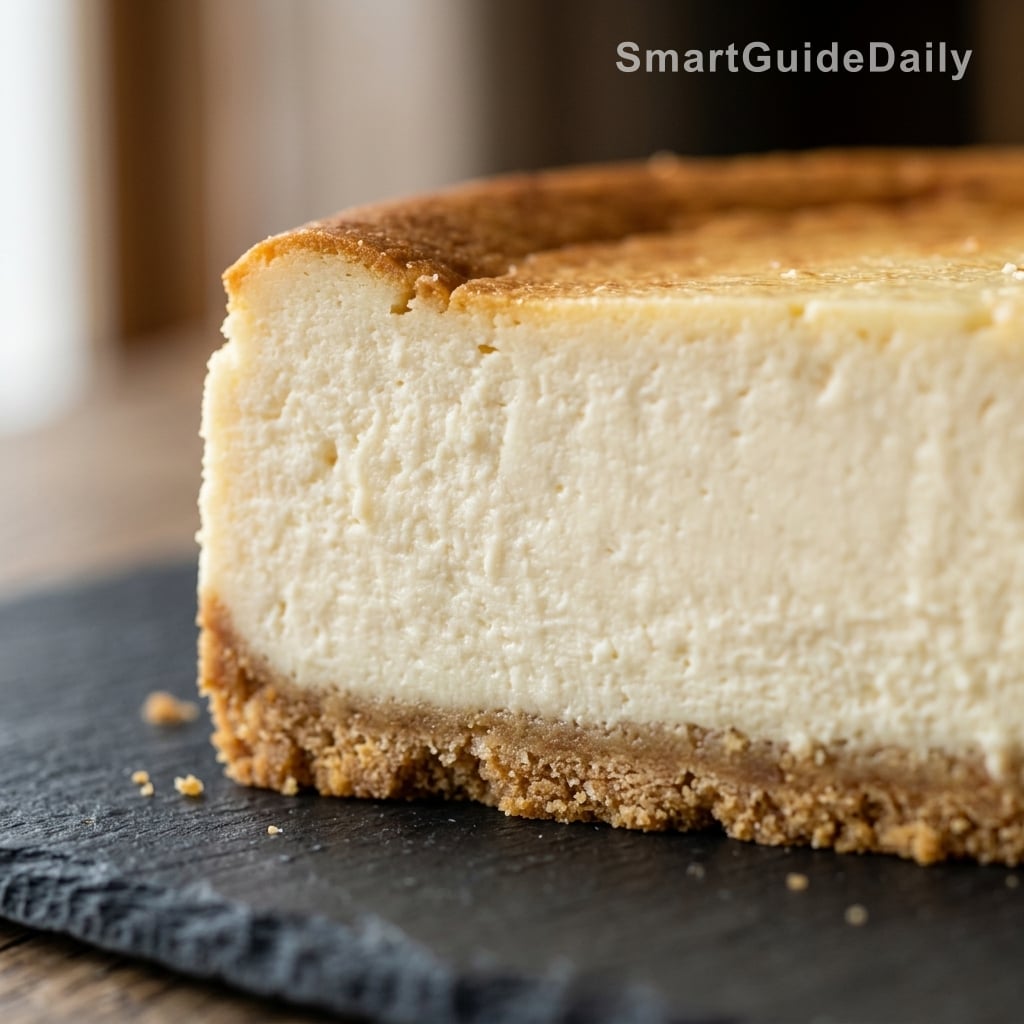
The surface should be pale and matte — not golden, not cracked. When you run a knife through it for the first time, after a full night in the fridge, the resistance should be uniform from edge to center. The filling has a density that holds the blade’s path clean. The crumb of the crust, just barely visible at the base, should be compact enough to lift with a spatula without breaking apart. This is what correctly baked, correctly chilled cream cheese and eggs look like.
Why you’ll love this recipe
Ingredient Notes
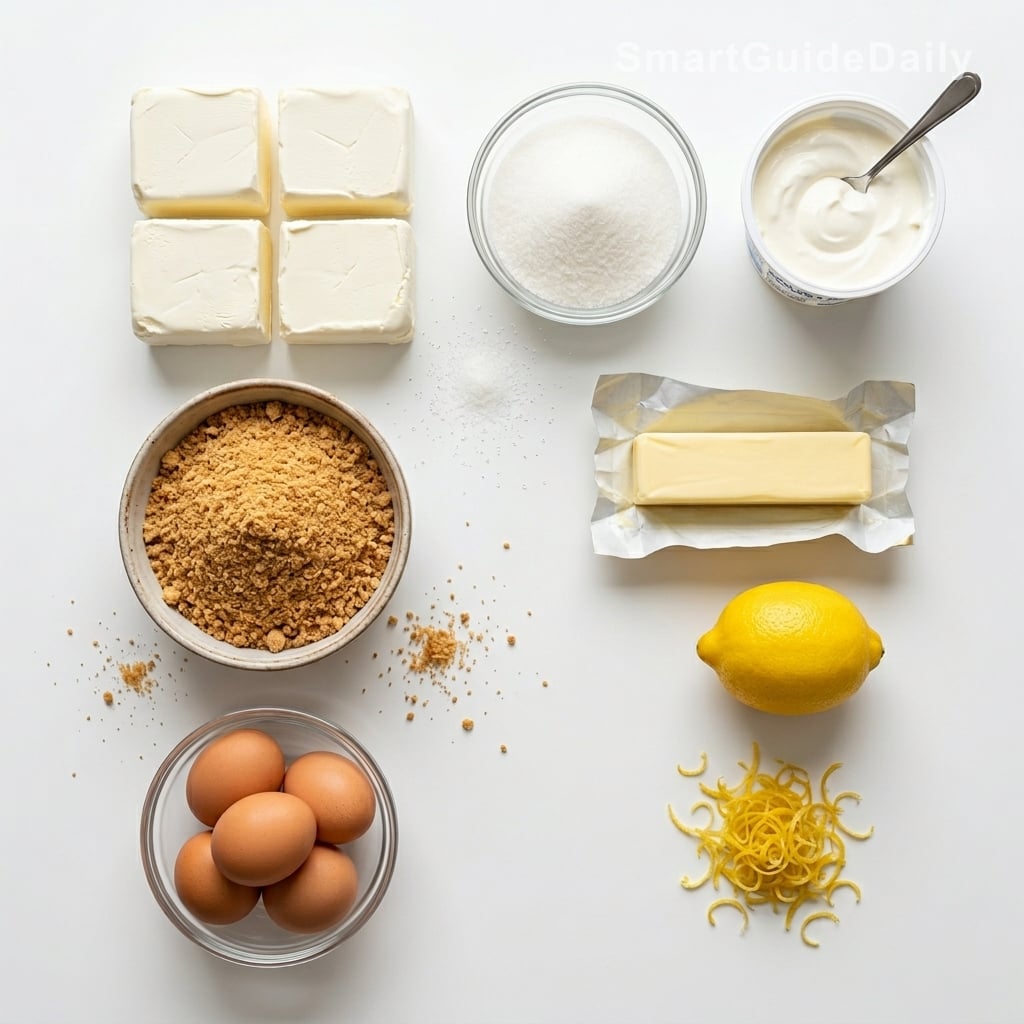
Everything on the counter before it becomes something worth arguing about.
- Full-fat cream cheese (4 × 8 oz / 900g total) : The fat content is around 33%. It is structural. Low-fat versions contain more water and modified starches that behave differently under heat — the texture becomes rubbery and the flavor flattens. Use it at genuine room temperature: cold cream cheese does not blend smooth and you will bake in lumps.
- Eggs (4 large) : They set the protein structure of the filling. Four eggs for 32 oz of cream cheese is the baseline. More eggs push the texture toward something firmer and custardy; fewer, and the center will not hold when sliced. Add them one at a time and mix only until each disappears into the batter.
- Sour cream (1 cup / 240g) : Adds tang and loosens the filling slightly. The acidity also interacts with egg proteins during baking, contributing to a smoother, more uniform set. Full-fat only — light versions add water you do not want in the batter.
- Graham crackers (1½ cups crumbs / 180g) : Use the plain variety. Cinnamon-spiced ones compete with the filling. The crumbs need to be fine enough to compact into a single solid layer — too coarse and the crust crumbles when you cut a slice. Mix with melted butter at roughly a 1:2.5 ratio of butter to crumbs by weight.
- Lemon (zest + 1 tablespoon juice) : The zest carries the flavor; the juice adds a small amount of acid that cuts through the richness of the cream cheese. It does not make the cheesecake taste like lemon. It makes it taste like itself.
- Sugar (1 cup / 200g) : Reducing it below about 180g noticeably affects both flavor and set. Sugar interacts with egg and cream cheese proteins during baking — it is not just sweetness, it is part of the structure. Do not cut it in the name of health and then wonder why the texture is off.
Pull Everything from the Fridge an Hour Ahead
Cold cream cheese is the single biggest cause of lumpy, over-beaten cheesecake batter. When the blocks are at actual room temperature — not just slightly less cold — they blend smooth with minimal mixing. That matters because over-mixing is the second biggest problem. Every extra pass of the mixer incorporates air. That air expands in the oven, the filling puffs, and when it cools it pulls inward and cracks the surface. Room temperature cream cheese blends smooth at low speed in under two minutes. Cold cream cheese takes five minutes at high speed and produces batter laced with tiny air bubbles you cannot see but will absolutely feel later. The eggs and sour cream should come to room temperature for the same reason. An hour on the counter is enough — set them out when you start your coffee.
Press the Crust Until It Stops Moving
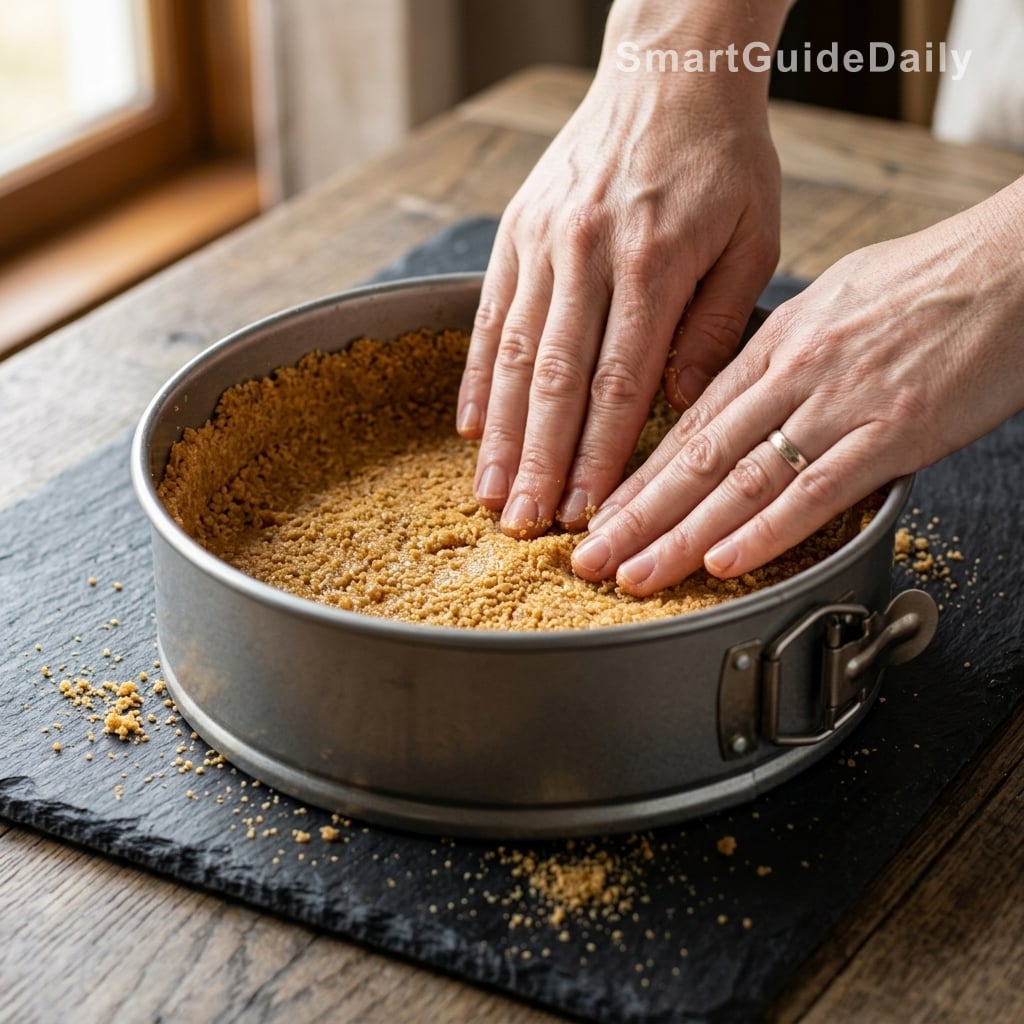
The crust is 180g of graham cracker crumbs, 30g of sugar, and 85g of melted butter — fat to crumb at roughly 47% by weight, enough to bind without turning greasy. Press it into the bottom of a 9-inch springform pan with the flat base of a measuring cup, using real pressure. You are not arranging crumbs. You are compacting them into a single mass that will hold a slice together when cut. Take the crust about an inch up the sides of the pan. Bake it at 350°F (175°C) for 10 minutes before adding anything — it should smell like toasted grain and warm butter when it comes out. Let it cool for at least 15 minutes before pouring in the filling. If the crust is still hot when the batter hits it, the butter can separate and the bind is lost.
Mix the Filling Low and Slow, Then Stop
Beat the cream cheese and sugar together at low speed until completely smooth — no visible lumps, no streaks. Add the sour cream and mix briefly. Add the eggs one at a time, mixing only until each one is incorporated. Add the vanilla and lemon last. The entire process should take under four minutes. Stop there. The batter should look smooth and dense, not airy or glossy with bubbles. Hold a spoonful up to the light: it should be opaque, heavy, and slow to fall off the spoon. If it looks light and frothy, you have gone too far. Pour it over the cooled crust slowly, from the center outward, and tap the pan twice on the counter to release any trapped air near the surface.
Understand the Water Bath Before You Decide to Skip It
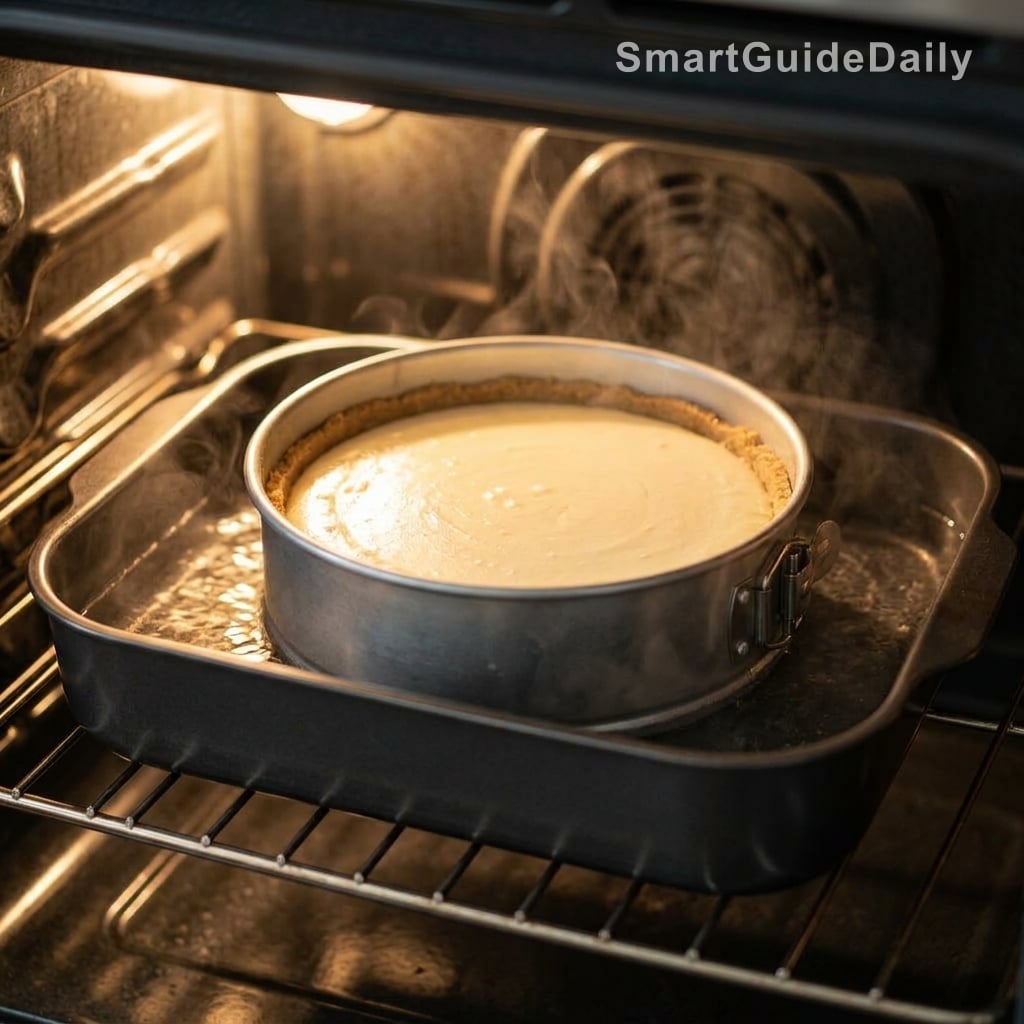
Water at sea level cannot exceed 212°F (100°C) while it remains liquid. That is the entire reason the water bath works. The cheesecake sits surrounded by a medium that caps the ambient temperature, so the outer edge of the filling never gets hotter than 212°F — and in practice stays well below that. The protein network in the filling tightens at an even rate across the full diameter. No cracks.
Without a water bath, baking at 325°F (165°C), the outer edges reach oven temperature first. They firm up and contract while the center is still soft. When the cake cools and the center finally finishes setting, the surface has no elasticity left to accommodate the movement. It splits.
The water bath is not ceremony. It is a thermodynamics problem with a clean solution.
If you choose to skip it — and it is a legitimate choice — reduce the oven temperature to 300°F (150°C), place a separate pan of hot water on the rack below without touching the springform, and when the bake is done, turn off the oven and leave the cheesecake inside with the door cracked for a full hour. This slows the cool-down and gives the surface time to settle without splitting. The result is close, but not identical: the texture at the edges is very slightly less smooth, and the risk of a hairline crack is real. Whether that matters depends on how you are serving it.
Set the Timer and Leave the Oven Alone
Bake at 325°F (165°C) in the water bath for 55 to 65 minutes. The cheesecake is done when the edges are clearly set and the center has a wobble roughly the size of a golf ball — slow, viscous, not liquid. An instant-read thermometer at the center should read between 150°F and 155°F (65–68°C). Above 160°F, the egg proteins have tightened too far and the texture will be dense and slightly grainy in the mouth. Turn off the oven. Leave the door closed for 30 minutes, then crack it slightly for another 30. Move the pan to the counter, run a thin knife around the inside edge immediately, then refrigerate uncovered for a minimum of six hours and preferably overnight. The uncovered chill allows any surface moisture to evaporate rather than collect back onto the top.
Tips & Tricks
- Run a knife around the edge within five minutes of coming out of the oven. As the cheesecake cools, it contracts slightly. If it is adhering to the side of the pan when it does, it tears along the top. This single step prevents most cracks that happen after the bake.
- Refrigerate uncovered the first night. Covering a warm cheesecake traps steam and makes the top tacky. Leave it open in the fridge until it is fully cold — around 40°F (4°C) throughout — then wrap if storing beyond 24 hours.
- Add a small pinch of fine salt to the filling. Around half a teaspoon. It does not make the cheesecake taste salty. It makes the sweetness read more clearly and the cream cheese flavor more distinct.
- Slice with a warm, dry knife. Run the blade under hot water, dry it completely, make one clean cut, then repeat for each slice. A cold or wet blade drags through the filling and produces a ragged face. One warm, dry pass gives you a clean cross-section.
Can I make this cheesecake without a water bath?
Yes, with specific adjustments. Reduce the oven temperature to 300°F (150°C) and place a separate pan of hot water on the rack below the cheesecake — not touching the pan. When baking is done, leave the cheesecake in the switched-off oven with the door cracked for one full hour before moving it. The result is structurally close, but the texture at the outer edge will be slightly less uniform and the risk of a surface crack is meaningfully higher.
Why did my cheesecake crack?
Almost always, one of three causes: the batter was over-mixed and incorporated too much air; the oven temperature was too high for the edges; or the cake cooled too quickly and the surface contracted unevenly. A crack does not affect the texture or flavor of the interior. If it happens, spread a thin layer of sour cream over the top before serving and refrigerate for 30 minutes — it disappears visually.
The center was still wobbly when I took it out. Is it underbaked?
A slow, golf-ball-sized wobble at the center is the correct end point. The cheesecake finishes setting as it cools in the switched-off oven and then overnight in the fridge. If the wobble covers more than half the diameter and looks liquid rather than viscous, add 10 minutes and check the internal temperature — you are looking for 150–155°F (65–68°C) at the center.
How long does it keep, and can I freeze it?
Refrigerated and wrapped, three to four days. For freezing: wrap individual slices or the whole cake tightly in plastic film and then in foil — it holds well for up to one month. Thaw overnight in the fridge. Do not thaw at room temperature, as the texture of the outer layer becomes uneven.
Do I need a springform pan, or can I use a regular cake pan?
A springform is strongly recommended. The release latch lets you remove the sides without inverting the cake, which would destroy the top surface and likely break the crust. A regular 9-inch cake pan works technically if lined with parchment, but removing the cheesecake cleanly requires patience and some risk. The springform eliminates that problem entirely.
Can I adjust the size of the pan?
An 8-inch pan produces a taller cake and needs an additional 10–15 minutes of baking time. A 10-inch pan produces a shallower cake with a shorter bake. In both cases, use internal temperature — 150–155°F (65–68°C) at the center — as your primary indicator, not the timer.
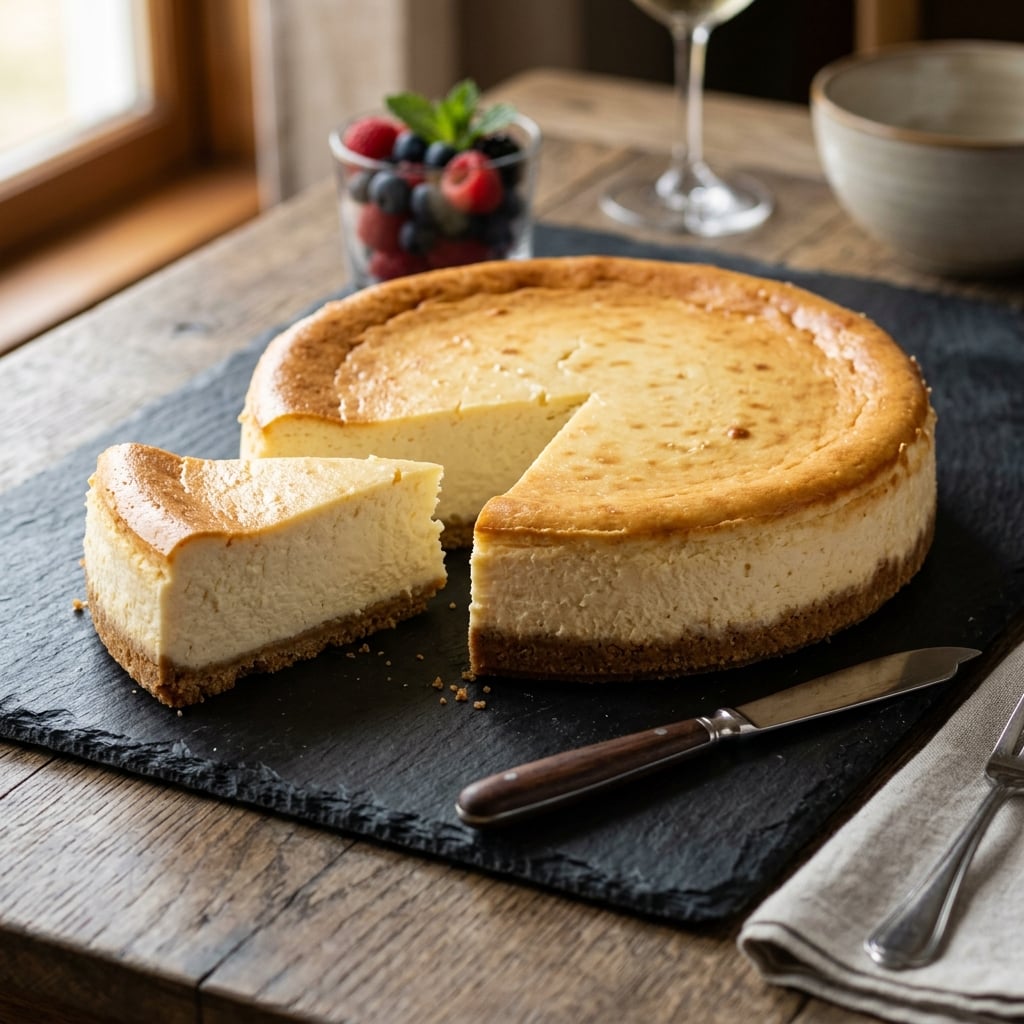
The Proper New York Cheesecake: Water Bath vs No Water Bath
American
Desserts
A full-fat, no-shortcut New York cheesecake baked in a water bath for a smooth, even set. The recipe covers the water bath method in detail and explains exactly what changes — and what risks — come with skipping it.
Ingredients
- — Crust —
- 180g plain graham cracker crumbs (about 12 full crackers)
- 30g granulated sugar
- 85g unsalted butter, melted
- — Filling —
- 900g full-fat cream cheese (4 × 225g blocks), at room temperature
- 200g granulated sugar
- 4 large eggs, at room temperature
- 240g full-fat sour cream, at room temperature
- 1 tsp pure vanilla extract
- 1 lemon, zest finely grated + 1 tbsp juice
- ½ tsp fine salt
Instructions
- 1At least one hour before starting, set the cream cheese, eggs, and sour cream on the counter to reach room temperature.
- 2Preheat the oven to 350°F (175°C). Stir together the graham cracker crumbs, 30g sugar, and melted butter until the mixture resembles wet sand. Press firmly and evenly into the base and about 1 inch up the sides of a 9-inch springform pan using the flat base of a measuring cup.
- 3Bake the crust for 10 minutes until lightly set. Remove and let cool for at least 15 minutes. Reduce the oven temperature to 325°F (165°C). Bring a kettle of water to a boil.
- 4Wrap the outside of the springform pan tightly with two layers of heavy-duty aluminum foil, crimping the foil high enough up the sides to prevent any water from seeping in during the water bath.
- 5Beat the cream cheese and sugar on low speed until completely smooth, with no visible lumps — about 2 minutes. Add the sour cream and mix briefly until incorporated.
- 6Add the eggs one at a time, mixing on low speed only until each egg disappears into the batter. Add the vanilla extract, lemon zest, lemon juice, and salt. Mix until just combined. Do not continue mixing once the batter is smooth.
- 7Pour the filling over the cooled crust. Set the foil-wrapped springform inside a large roasting pan. Pour the boiling water into the roasting pan to a depth of 1 inch around the springform — do not splash water into the filling.
- 8Bake at 325°F (165°C) for 55 to 65 minutes, until the edges are firmly set and the center has a slow, viscous wobble roughly the size of a golf ball. An instant-read thermometer inserted at the center should read 150–155°F (65–68°C).
- 9Turn the oven off without opening the door. Leave the cheesecake inside for 30 minutes, then crack the oven door slightly and leave for 30 more minutes.
- 10Remove the springform from the water bath and peel off the foil. Immediately run a thin knife or offset spatula around the inside edge of the pan. Set on a wire rack and cool to room temperature, about 1 hour.
- 11Refrigerate uncovered for at least 6 hours, preferably overnight. Before serving, release and remove the springform sides. Slice with a knife run under hot water and dried completely between each cut.
Notes
• Do not cover the cheesecake while it is still warm. Trapped steam condenses on the surface and makes it tacky. Leave it uncovered in the fridge until fully cold, then wrap if storing beyond 24 hours.
• The wobble at the center when you pull the cake from the oven is correct — the cheesecake finishes setting during the long chill. Overbaking to eliminate the wobble produces a grainy texture.
• To skip the water bath: bake at 300°F (150°C), place a pan of hot water on the rack below, and rest in the switched-off oven with the door cracked for one full hour after baking. The result is close but not identical to the water bath method.
Nutrition Facts (per serving, estimated)
| 510 kcalCalories | 8gProtein | 33gCarbs | 38gFat |